
Travelling in Greece: Ferries, Flights, Cars and Trains Explained
Updated October 2026
Travelling in Greece is easy once you know which tool does which job. Ferries join the islands, small planes cover the long hops, trains and coaches run the mainland, and a hire car opens the places none of them reach. The trouble for first-timers is the order of play: what to book before you leave Australia, what to leave until the week, and which choices cost you a day.
This is the Cycladic Spaces guide to getting around Greece, written for Australians who are flying in from the other side of the world and want the logistics settled before they arrive. I am Greek-Australian, I have done every one of these crossings, and I have missed a few ferries so you do not have to. If you are still working out the trip itself, start with how to travel to Greece from Australia.
How do you get around Greece?
You get around Greece by ferry between islands, by domestic flight when the distance is long, by train or KTEL coach on the mainland, and by hire car or scooter once you are on an island or in the countryside. Most itineraries use two or three of these. A classic ten days, Athens to Paros, Naxos and Santorini and back, uses ferries for the islands, a flight home or a fast boat to Piraeus, and a taxi or metro in Athens. A mainland loop through Meteora, Delphi and the Peloponnese needs a car, or patience with the coach timetable.
The quick ranking by usefulness for a first trip is ferries first, then flights, then hire cars, then coaches, then trains. Trains look appealing on a map and run on only a few routes, so they are the least useful of the five.
Which is better for Greece, a ferry or a flight?
Take the ferry for any hop under about four hours and the flight when the boat would eat half a day. Athens to Santorini by plane is 45 minutes. By conventional ferry it is eight hours and by fast boat it is closer to five. Athens to Paros, Naxos or Syros by ferry is a pleasant morning. Ferries also carry your bags for free, run closer to town centres, and need no airport transfers on either end.
Flights win when you have four days to see the Cyclades, when the meltemi is blowing, or when you want Crete, Rhodes or Corfu without a ten-hour sail. Flights also lose to ferries on flexibility, because planes are small and the baggage rules are tight.
Ferries in Greece
How do Greek ferries work?
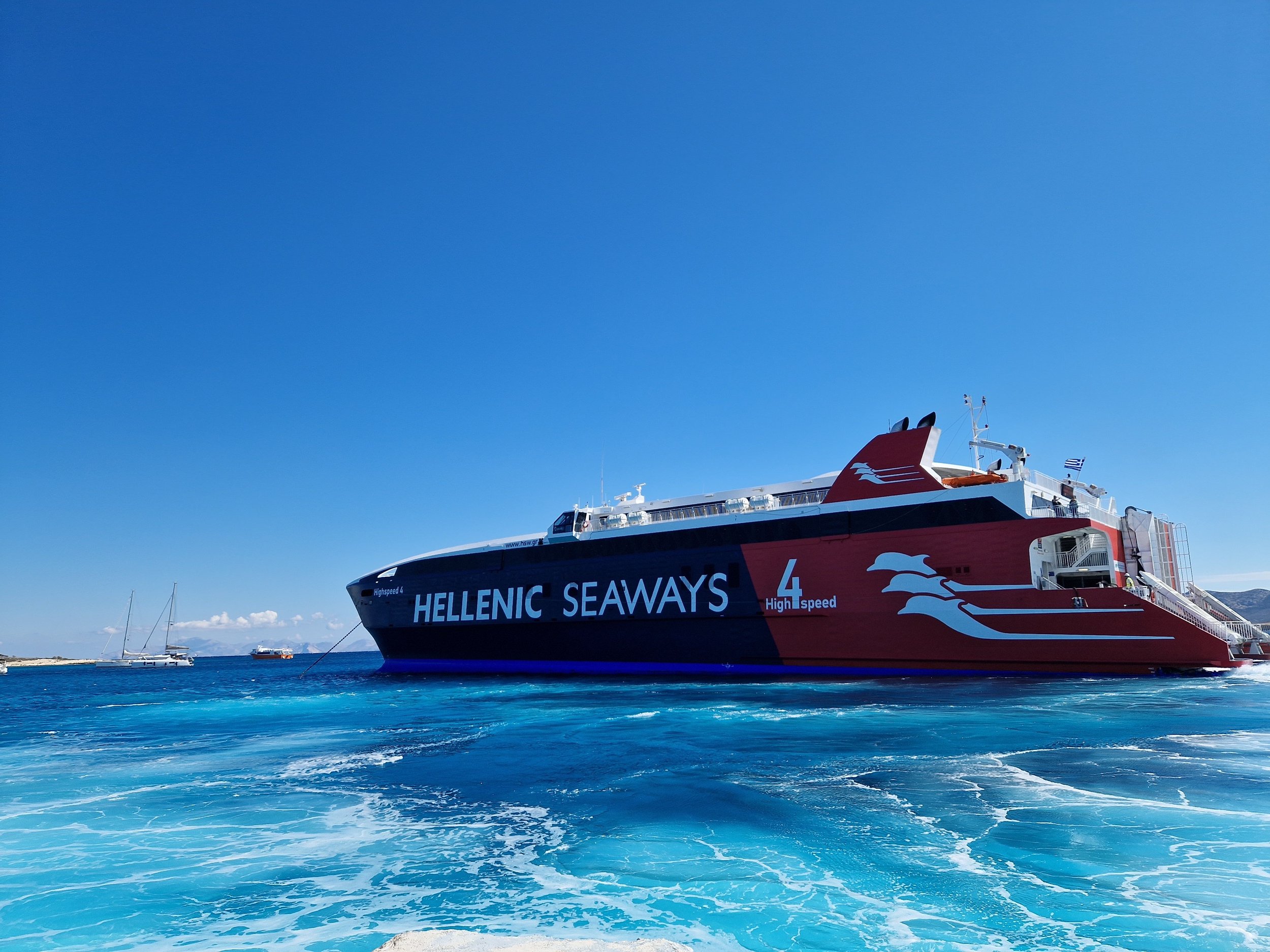
Greece has no single ferry system. A handful of companies run overlapping routes from three Athens ports, Piraeus, Rafina and Lavrio, plus Thessaloniki and Volos in the north. The main operators on the Cyclades routes are Blue Star Ferries, Hellenic Seaways, SeaJets, Golden Star Ferries and Fast Ferries, and Minoan Lines runs Crete. Our guide to Greek ferry companies compares them line by line.
Conventional ferries are big, slow and cheap, and have cafés, deck space and cabins on long routes. High-speed boats are smaller, quicker and dearer, and the ride can be rough in wind. Both sail the same ports, so the choice is time against comfort.
How much do ferries cost?
Economy tickets from Athens to the main Cyclades run from roughly €40 on a slow boat to €90 or more on a fast one in summer, with prices rising in July and August. Cabins, car decks and extra seats add to that. These are ballpark figures and operators change them, so check the live fare before you plan a budget. Our breakdown of what Greece costs for Australians has the ferry line in context.
Where do you book Greek ferries?
Book on the operator's own site or through a ferry search site that lists every operator on a route. Search sites save time because they show alternatives when one boat sells out. Book summer sailings, especially Santorini, Mykonos and anything on a Friday or Sunday, two to four weeks ahead. Shoulder season sails with space on the day, though booking early still locks the cheaper fare.
What about meltemi winds and cancellations?
The meltemi is a strong northerly that blows across the Aegean from roughly mid-June to September, hardest in July and August. When winds reach force 8 or above, authorities hold ferries in port, and fast boats are cancelled first. Plan a buffer day before any flight home, never book a ferry on the same day as an international departure, and keep your accommodation flexible for the last night. The Cyclades are the windiest, and the Ionian islands on the west coast are much calmer.
Which Athens port do you leave from?
Most Cyclades sailings leave from Piraeus. Rafina is closer to the airport and serves Andros, Tinos, Mykonos, Paros and Naxos on some boats. Lavrio serves a few of the smaller Cyclades. Your ticket names the port and gate. Piraeus is enormous, with gates spread along several kilometres of quay, so arrive 60 minutes early and check the gate number the day before. Metro Line 1 runs straight to Piraeus.
Tips for the ferry itself
Download the ticket to your phone, because paper tickets are rare. Board early on a busy boat to claim an indoor seat. If you get seasick, sit in the middle of the ship on a low deck and take tablets before you board. Keep your passport, phone and wallet on you, not in the luggage racks. For the islands you can reach with short crossings, see our guide to Greek islands you can reach without a long ferry.
Domestic flights in Greece
Who flies within Greece?
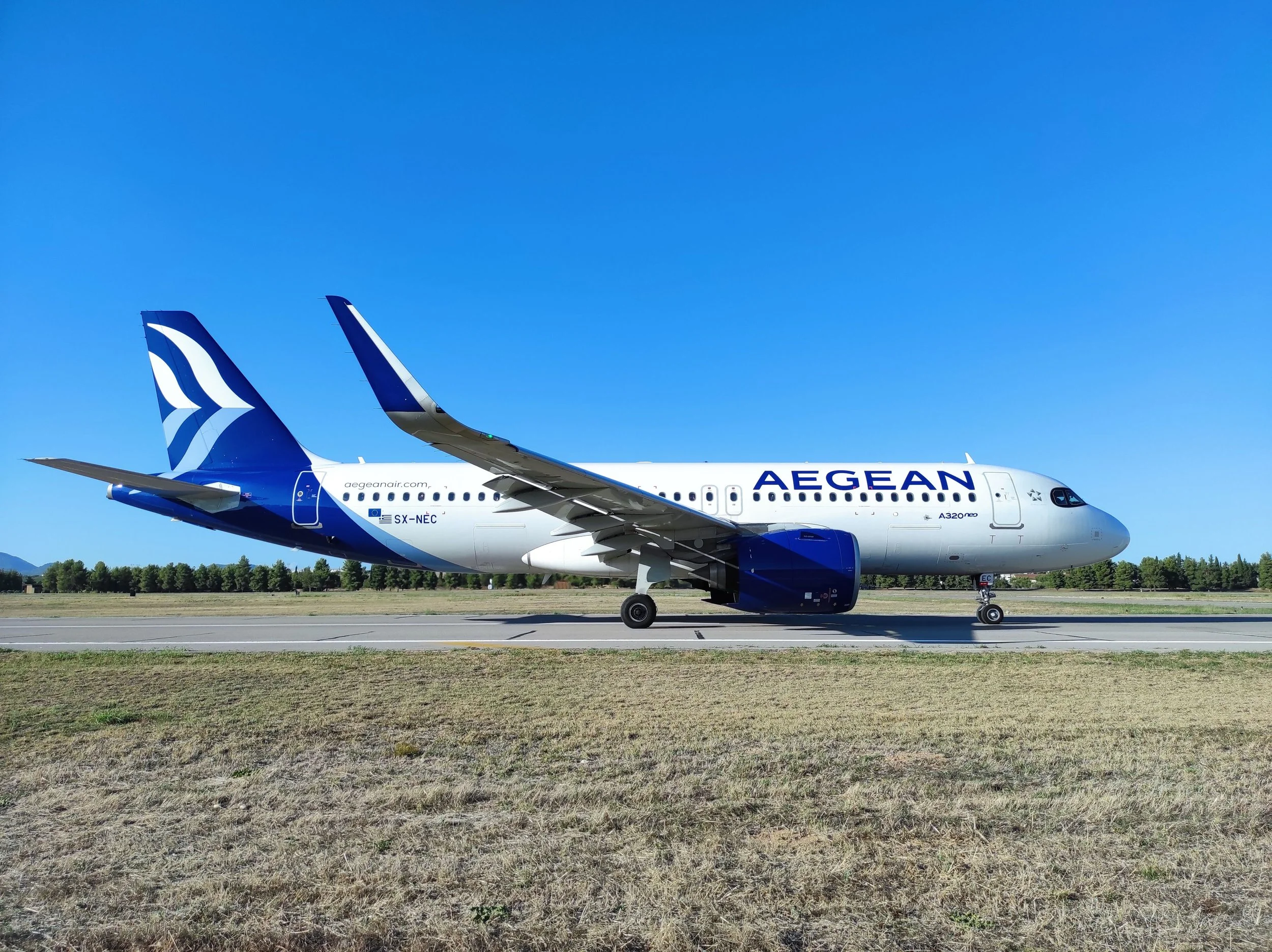
Aegean Airlines and its sister carrier Olympic Air cover most routes, with Sky Express as the main alternative and Ryanair running seasonal flights between larger airports. Athens connects to Santorini, Mykonos, Naxos, Paros, Crete, Rhodes, Corfu, Thessaloniki and dozens of smaller islands. Thessaloniki has its own domestic and international network, so you can avoid Athens altogether on some trips.
What are the baggage rules?
Baggage rules are tighter than on your international flight, and cheap fares may include only a small carry-on bag. Check the allowance before you book, and weigh your luggage before you leave the hotel. If you are flying in from Australia with a large case and then flying to an island, pay for the bag at booking, as airport prices are higher.
How much do domestic flights cost?
Prices swing widely. Off-season fares to Crete can be very cheap, while a July seat to Santorini can top €200. Book early for summer and compare the price of the flight with the ferry plus the time it costs you.
Trains in Greece
The Greek rail network is small and mostly useful on one corridor. Hellenic Train runs services between Athens and Thessaloniki, which take around four hours on the express, and a suburban line connects Athens, the airport, Piraeus and Corinth. Parts of the network have had works and replacement buses in recent years, so check the live timetable on the Hellenic Train site before you build a day around a particular service. There is no rail to the islands, and no useful rail to Meteora or Delphi from Athens without changes, so mainland sightseeing means buses or a car.
Buses and KTEL coaches
KTEL is the national network of regional coach operators. Athens has two long-distance bus terminals, Kifissos and Liosion, and routes run to Delphi, Meteora (via Trikala or Kalambaka), Nafplio, Thessaloniki and many small towns. Coaches are clean and cheap, though the timetable thins out in the afternoon and on Sundays, and online booking is patchy, so ask your hotel to check times. On islands, local buses link the main town and the main beaches, with timetables posted at the bus station, and service dwindles after sunset.
Cycladic Spaces Tip: PLEASE PLEASE keep your stuff safe! Pickpockets are RIFE at the bus stations, especially at Kifissos in Athens. This is no joke. They are FAST, they will TARGET YOU. Keep your shit safe! Don’t put anything in your pockets. I cant STRESS THIS ENOUGH!
Hiring a car in Greece
Do Australians need an International Driving Permit in Greece?
Yes. Australians need their valid Australian licence and an International Driving Permit to drive in Greece. You buy the IDP from your state motoring club before you leave, and it is cheap and issued quickly. Carry both documents whenever you drive, because police checks and rental counters ask for them, and some insurers refuse claims without them. The Australian Automobile Association has a list of issuing clubs on its website.
What do you need to know before you drive?
Greeks drive on the right, so Australians spend the first day fighting the instinct. Island roads can be narrow, steep and unlit, and goat tracks pass as roads on some maps. Drive an automatic only if you book it early, because automatics are scarcer and dearer. Rent the smallest car that fits your party, since parking in island towns is tight. Take full insurance with a low or zero excess, and photograph the car before you leave the lot. Most rental firms hold a deposit on a credit card, and drivers under 25 usually pay a young driver surcharge.
Can you take a rental car on a ferry?
Most rental firms bar or restrict ferry travel, and cover often does not apply on board or on the other island. The simple fix is to hire a car on each island you want one on, which also costs less than paying a ferry fee for a vehicle. Book ahead from June to September, because small islands run out of cars.
Is it worth hiring a car at all?
On the mainland, yes. A car is the only practical way to combine Delphi, Meteora, the Peloponnese and Mani at your own pace. On the islands it depends. Naxos, Crete, Lefkada and Milos are much better with a car, and Santorini, Paros and Tinos are easy with buses, taxis or a scooter. Our guides to where to stay in Naxos and where to stay in Lefkada say which base works without wheels.
Scooters and quad bikes
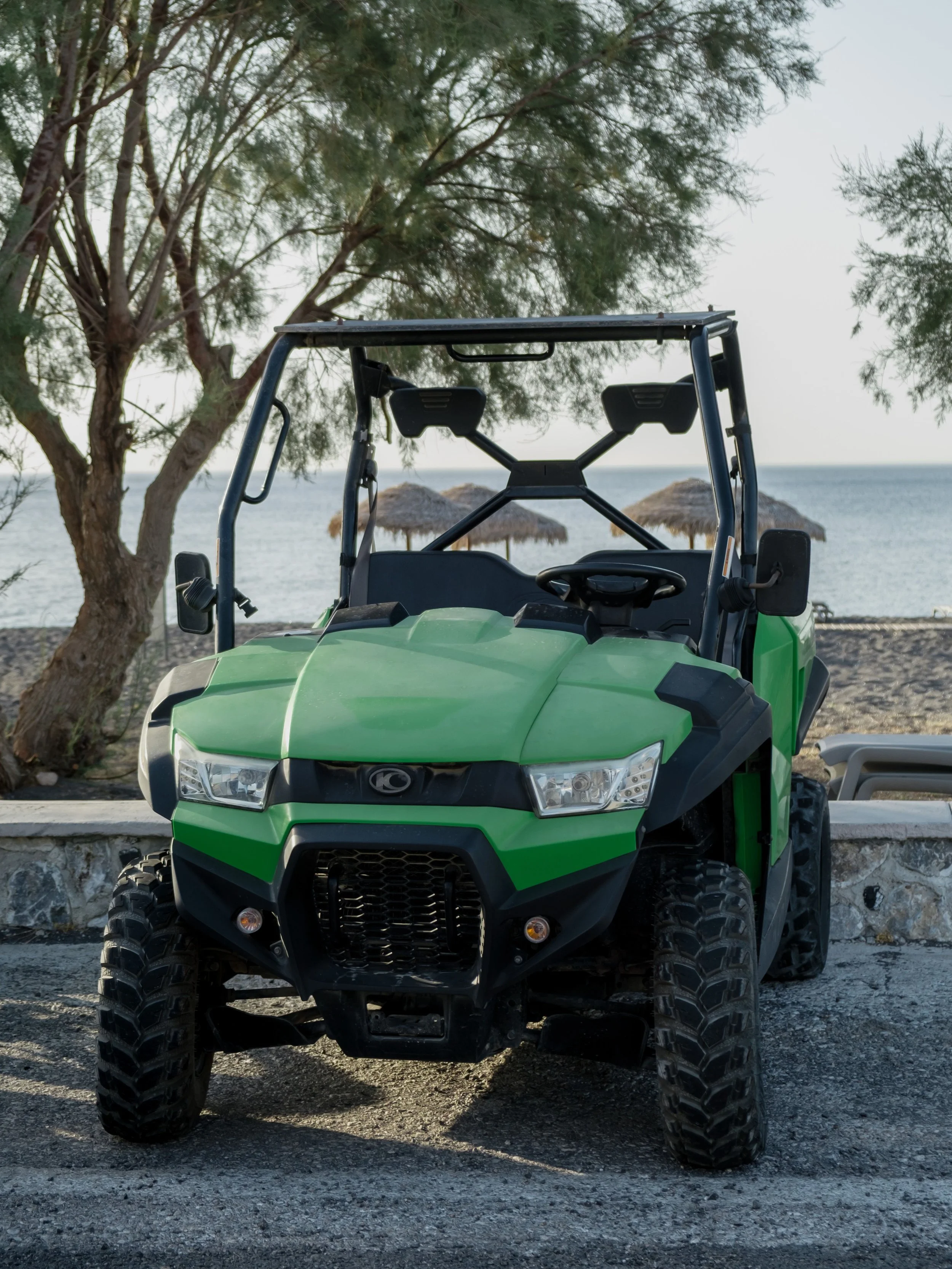
Scooters are the cheapest way to cover an island and one of the most common causes of tourist injury in Greece. You need the right licence category for the engine size, and your travel insurance may not cover you without it or without a helmet. Check your policy before you ride, wear a helmet, and avoid dirt roads on a rental. Our guide to Greek travel insurance for Australians covers what to look for.
Taxis and ride apps
Taxis in Athens are metered, and ride apps such as FREENOW and Uber work through licensed taxis, which helps you avoid overcharging. On the islands, taxis are scarce, set prices for common trips, and are hard to find at 2am. Book airport and port transfers ahead in high season, and agree the fare first when there is no meter. Our guide to whether Athens is safe explains the main taxi scams.
Getting around Athens
The metro is the backbone. Line 3 runs from Athens airport to Syntagma in about 40 minutes, Line 1 reaches Piraeus, and trams run to the coast. Walk the centre, as the Acropolis, Plaka and Koukaki are close together. Our Athens itinerary turns that into a day-by-day plan.
A sample route using every mode
Here is how the pieces fit on a typical two-week trip from Australia. Fly into Athens and spend three nights using the metro and your feet. Take a morning ferry from Piraeus to Paros or Naxos and stay four or five nights, with a scooter or buses for beaches. Take a short ferry on to a second island, Milos or Santorini, for four nights. Fly or sail back to Athens with a night in hand before your international flight. The 10 day Greek islands itinerary gives the same shape with dates and ferry times.
What should you book before you leave Australia?
Book the long-haul flights, the first and last nights in Athens, and any car you want in summer. Book the main ferries once your dates are fixed, preferably three to four weeks out. Leave a day or two loose in the middle of the trip, because Greek weather and ferry timetables both change plans. Buy travel insurance when you book, and read the Smartraveller advice for Greece before you go. For entry rules, see what Australians need to know about ETIAS and the new EU border rules. The Visit Greece site lists official transport links.
How to get around each island group
The Cyclades
The Cyclades are the island-hopping heartland, and the ferry network here is dense. Paros, Naxos and Syros are hubs, so boats run between them all day in summer. Santorini, Mykonos and Milos are easier to reach from a hub than from each other. Plan your route as a line or a loop rather than a zigzag, and check that the boat you want runs on your day, because some links run only a few times a week. Our guide to the Greek islands beyond the obvious sorts the quieter ones. If the crowds of the famous two put you off, read why I do not recommend Santorini or Mykonos first.
Crete
Crete is big, and you need a car. The overnight ferry from Piraeus to Heraklion or Chania takes eight to nine hours and drops you in the morning, and the flight takes about 50 minutes. Cross the island by road and plan on the drive taking longer than the map suggests, because the mountains slow everything down.
The Ionian islands
Corfu, Lefkada, Kefalonia, Zakynthos and Ithaca sit on the west coast and are not linked to the Cyclades by ferry. Reach them by direct flights, or by driving to the mainland ports at Patras, Igoumenitsa or Kyllini and taking a ferry from there. Lefkada is joined to the mainland by a causeway, so you can drive on. Our Lefkada travel guide has the details.
The Dodecanese
Rhodes and Kos are far from Athens. Fly, as the ferry from Piraeus takes the best part of a day or night. Once there, small ferries and excursion boats link the neighbouring islands, and Symi is an easy day trip from Rhodes, as our guide to Goat Beach on Symi shows.
The Saronic islands
Aegina, Poros, Hydra and Spetses are a short boat ride from Piraeus, and some of them are an easy day trip. Hydra bans cars, so you walk or ride a donkey or water taxi. They suit travellers who have only a few days and want an island without a long sail.
Road trips on the Greek mainland
A car on the mainland gives you the best of the country in a week. Athens to Delphi is about two and a half hours, Delphi to Meteora another three, and Athens to Nafplio about two. A loop of Athens, Corinth Canal, Nafplio, Mycenae, Epidaurus and back is easy in three days. Go slow, avoid night driving in the mountains, and fill the tank when it drops below half, as stations thin out in rural areas. Tolls on the main motorways add up, so carry coins or a card and check the toll plazas as you go.
The most common transport mistakes
The mistakes I see most often are the same each summer. People book an island ferry for the morning of an international flight. They hire a scooter without the right licence. They try to see too many islands in ten days and spend half of it on a boat. They book a fast boat in rough weather and spend the crossing queasy. They buy tickets from an unofficial seller at the port when the operator's own counter sits fifty metres away. Fix those five and your trip runs smoothly.
Travelling in Greece with kids, bad knees or heavy bags
Greek stone villages are hilly, stepped and often cobbled, so travelling with a pram, a wheelchair or a heavy suitcase takes planning. Ferries have lifts and ramps on larger boats, though small boats and tender transfers can be difficult. Choose accommodation near the port on arrival days, pack one carry bag per person for the island leg, and leave the big case in Athens if your hotel will store it. Ask for ground-floor rooms and check access before you book.
What does getting around Greece cost?
For a two-week trip with three ferries, one domestic flight, metro and taxi use, and a four-day car hire, budget somewhere between A$600 and A$1,200 per person for transport alone, depending on season and how fast you want to travel. The ferry and flight lines make up most of that. A small car in July can cost more per day than a double room in May, and petrol is dear. Taxis add up on islands where the bus does not run. Convert prices at today's rate, as the euro has moved a lot, and see our full Greece trip budget in AUD.
What to pack and download for getting around
Pack a small day bag you can carry through a ferry terminal, a layer for the boat deck, seasickness tablets, a phone charger and a power bank. Download the ferry operator's app or save the ticket PDF, offline maps for the island, and a ride app for Athens. Bring a card with no foreign transaction fee, plus €50 to €100 in cash for small ports, buses and beach taxis, where card readers fail. Keep copies of your passport, licence and IDP in your phone and in the cloud.
If your plans fall through
Ferries get cancelled, flights get delayed and strikes happen, usually with a few days' notice. Check the news the day before you travel, speak to the operator's counter at the port, and ask your accommodation to hold the room for a late arrival. Keep proof of every booking, since travel insurance claims need receipts. If a sailing is cancelled for weather, operators generally rebook you on the next boat or refund the fare, though accommodation losses fall to you unless your policy covers them.
When is the best time to travel around Greece?
May, June, September and early October. The sea is warm, ferries run full schedules, prices are lower than in peak summer, and the meltemi is weaker. July and August are hot, busy and windy, and booking pressure is highest. Winter has reduced ferry schedules and many island businesses close. See the best time to visit Greece, month by month.
Travelling in Greece FAQs
Is it easy to travel around Greece without a car?
Yes, for Athens and the main islands. Ferries, flights, taxis and island buses cover most trips. A car matters for the mainland and for a few larger islands.
How far ahead should I book Greek ferries?
Two to four weeks ahead for July and August, and a week or less in shoulder season. Book earlier for Santorini, Mykonos, and weekend sailings.
Can I island hop in Greece without booking everything in advance?
Yes, outside peak summer. Keep your first and last nights fixed, and book ferries a few days out. In July and August, book most of it.
What is the best way to get from Athens airport to the city?
The metro is the cheapest and takes about 40 minutes to Syntagma. A taxi has a flat fare to the centre, so check the current rate on the official sign, and the airport express bus runs to Syntagma and Piraeus.
Do Australians need an International Driving Permit in Greece?
Yes. Carry your Australian licence and an IDP issued by your state motoring club.
Are Greek ferries safe?
Yes. Authorities cancel sailings in high wind, so a cancelled boat is a delay rather than a danger. Keep spare time in your itinerary.
Is Greece easy to travel for Australians who do not speak Greek?
Yes. English is widely spoken on ferries, at hotels and in restaurants. Our list of Greek phrases helps in villages.
Read next
Best places to visit in Greece for Australians. Greece or Italy for Australians. How much a trip to Greece costs from Australia.
Book the ferry the week you book the flights, then leave the days between them loose.
