
Updated July 2026
There are seven ferry companies that matter in Greece. Every Aussie booking their first Greek island trip stumbles into the same tangle: high-speed vs conventional, catamaran vs ferry, Blue Star vs Seajets, direct route vs one that stops at five islands you’d never planned to see. Most travel writing simplifies this into “just book on Ferryhopper.” That’s not wrong. But knowing who you’re buying from changes the trip.
This is the guide to Greek ferry companies for Australians. Who owns what, which routes are good, which are miserable, and how to avoid the €80 ferry that turns into a 9-hour ordeal. For the wider trip context (flights, dates, islands to pair), our Travel to Greece from Australia planning guide is the pillar version.
The seven ferry companies you’ll deal with
1. Blue Star Ferries
The workhorse of the Greek islands. Owned by the Attica Group. Runs the big conventional ferries between Piraeus and the Cyclades (Paros, Naxos, Santorini, Ios), plus routes to the Dodecanese and Crete. Not the fastest, but the most reliable.
What to expect: Massive white ferries the size of small cruise ships. Reserved seats, decks with cafes and shops, bring-your-own-lunch on the top deck. The 4-hour Piraeus to Paros run costs around €45 in economy, €65 for a business class seat.
Best for: Longer journeys, travellers with cars, families, anyone prone to seasickness. The conventional ferries handle rough weather far better than the fast catamarans.
Downside: Slow. If speed matters and the weather’s calm, book Seajets instead.
2. Seajets
The high-speed operator. Runs catamarans and hydrofoils that halve travel times on popular Cycladic routes. Piraeus to Mykonos in 3 hours instead of 5 to 6.
What to expect: Aircraft-style seats, three-abreast, no outdoor deck access. Faster and more expensive. Piraeus to Santorini via Seajets is about €90 to €110 economy compared to €45 to €60 on Blue Star, but you save 3 hours.
Best for: Time-poor travellers, short island hops between the Cyclades, calm weather days.
Downside: Cancels for weather far more often than Blue Star. On a windy shoulder-season day the Seajets goes and the Blue Star doesn’t, or vice versa. Also miserable in rough seas because the cabin has no windows to look out of, which makes motion sickness worse.
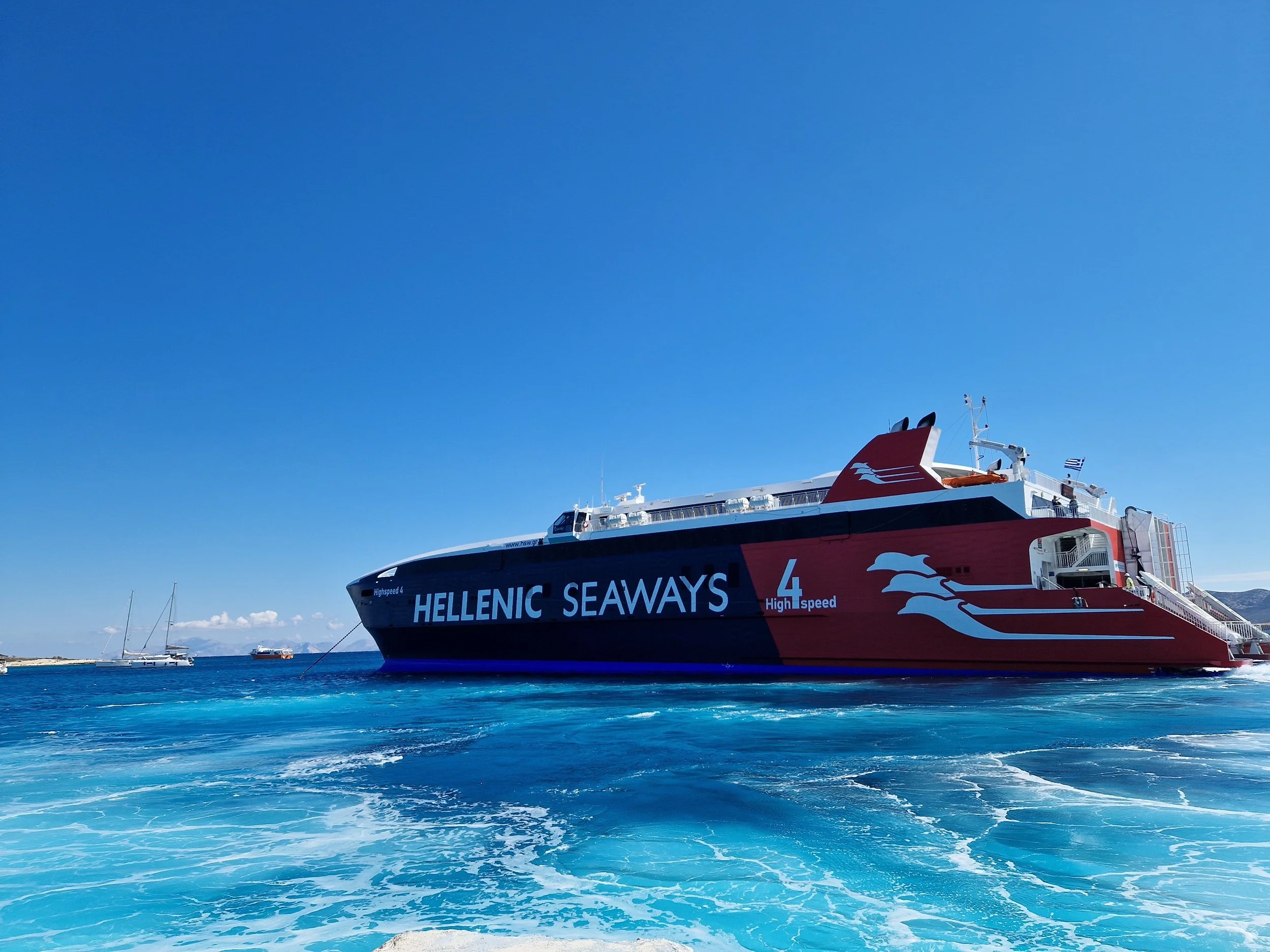
3. Hellenic Seaways
Sister company to Blue Star (both owned by Attica Group). Runs the Saronic Gulf routes from Piraeus to Aegina, Hydra, Poros and Spetses. Also some Sporades and Dodecanese runs.
What to expect: Fast catamarans (Flying Cat, Flying Dolphin) for the Saronic. Older ferries on longer routes. Piraeus to Hydra takes 1.5 hours and costs about €30.
Best for: Day trips from Athens (Aegina, Hydra, Poros). If you’re basing yourself in Athens and want an island day escape, this is the operator.
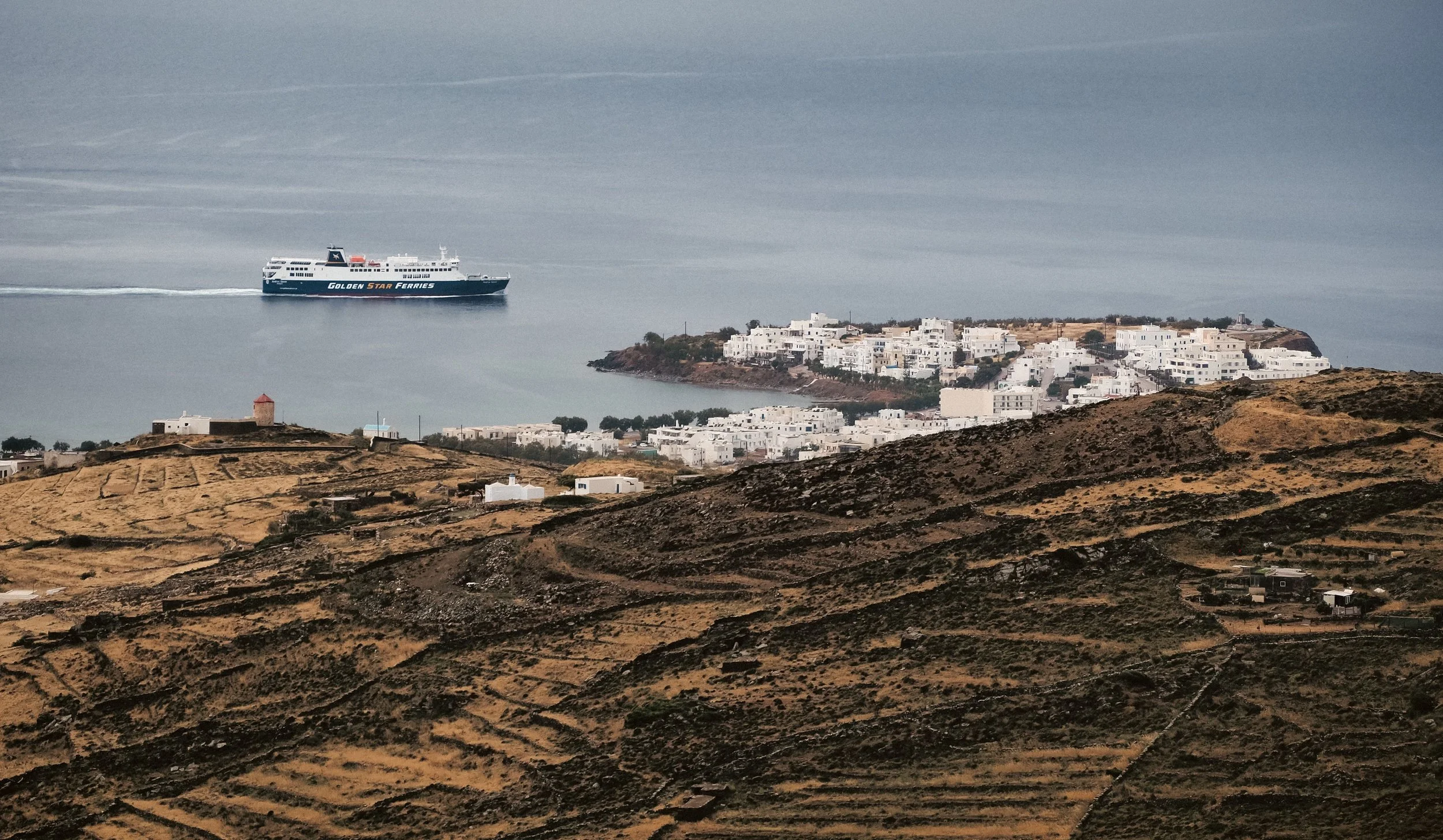
4. Golden Star Ferries
A smaller operator that competes with Blue Star on the Rafina-to-Andros-to-Tinos-to-Mykonos route. Also serves some Northern Cyclades.
What to expect: Modern catamarans that are faster than the big Blue Stars. Efficient, less crowded, generally cheaper. The main service is Superrunner and Superexpress.
Best for: Anyone flying into Athens Airport and heading to Andros, Tinos or Mykonos. Rafina Port is much closer to the airport than Piraeus (30 minutes vs 90).
5. Fast Ferries
Another Rafina-based operator on the Cyclades route. Direct competitor to Golden Star. Runs similar catamaran services to Andros, Tinos and Mykonos.
What to expect: Comparable to Golden Star. Prices tend to run €5 to €10 lower per ticket, service is fine, catamarans are slightly older.
Best for: Budget-conscious travellers using Rafina Port.
6. ANEK Lines
The overnight ferry company. Best known for the Piraeus to Chania (Crete) overnight service, and international routes to Italy.
What to expect: Huge ships with cabins, cafes, restaurants and cinemas. Overnight Piraeus to Chania is about 9 hours. Cabin from €80 for two, deck class from €35.
Best for: Travellers heading to Crete with time to spare. Turning the ferry into overnight accommodation saves you a hotel night in Athens.
7. Minoan Lines
ANEK’s main competitor on Crete and international routes. Also runs the overnight Piraeus to Heraklion (Crete) service.
What to expect: Very similar to ANEK. Big overnight ferries with cabins. Piraeus to Heraklion in 9 hours.
Best for: East Crete travellers heading to Heraklion, Malia, Elounda or Agios Nikolaos.
How to book Greek ferries from Australia
Three legitimate ways.
1. Ferryhopper. The best comparison platform for Greek ferries. Aggregates all seven major operators, shows prices side by side, handles bookings for most of them. Small booking fee (€1 to €3 per ticket) but the UX is worth it. Their app is genuinely useful once you’re travelling because it shows real-time schedule updates and cancellations.
2. Direct on the operator’s website. Slightly cheaper because you skip the booking fee, but you have to check each operator individually. Blue Star, Seajets, Hellenic Seaways all have decent English websites. Golden Star and Fast Ferries less so.
3. A Greek travel agent. Fine for a complex multi-island itinerary but usually adds 10 to 15% commission. Only worth it if the itinerary is genuinely complicated. Speaking of complicated itineraries, our 10-day Greek islands itinerary from Australia shows what a sensible two-island trip looks like.
Avoid: Random third-party booking sites you’ve never heard of, particularly ones that appear at the top of Google ads. Some are legit, but the market has been plagued with resellers who overcharge and don’t confirm bookings.
When to book
High season (mid-June to early September): at least six to eight weeks ahead for popular routes (Piraeus to Santorini, Mykonos, Paros). Popular sailings sell out. Business class and cabins on overnight ferries sell out first.
Shoulder season (April to mid-June, September to October): a week to two weeks ahead is fine. You can often book same-day but you’ll pay full price. See our Best Time to Visit Greece for Australians guide for the month-by-month breakdown.
Low season (November to March): book a couple of days out. Winter schedules are dramatically reduced (some islands have only two or three ferries per week).
Which ferry for which island
Santorini from Athens: Blue Star (5.5 hours, cheap) or Seajets (3.5 hours, expensive). Book Blue Star unless the time saving is genuinely worth €50 per person. (Related reading: why we don’t recommend Santorini or Mykonos.)
Mykonos from Athens: Blue Star or Fast Ferries from Piraeus (5 hours), Golden Star or Fast Ferries from Rafina (4 hours). Rafina is much closer to the airport.
Paros from Athens: Blue Star from Piraeus (4 hours), the sweet spot for value.
Naxos from Athens: Blue Star from Piraeus (4.5 to 5.5 hours). Regular service, several times daily in summer.
Milos from Athens: Blue Star or Zante Ferries (5 to 7 hours). Only two or three sailings a day. Book ahead in July and August.
Crete from Athens: ANEK or Minoan overnight (9 hours to Chania or Heraklion). Or fly. The overnight ferry is a proper experience if you have time.
Hydra or Aegina from Athens: Hellenic Seaways from Piraeus (1.5 hours to Hydra, 45 mins to Aegina). Perfect day trip.
Between the Cyclades: Blue Star runs the main inter-island services. Seajets covers the tourist favourites. Small local operators (SeaBridge, Karlovassi Shipping) handle the tiny hops. See our 2026 Guide to the Greek Islands for pairings that work.
Common Aussie mistakes
Assuming ferries always run. Winds above force 7 (about 50 km/h) shut down the Cycladic routes routinely, especially in July and August when the meltemi wind blows. Have a Plan B, especially on the day you fly out.
Booking the connection too tight. If your ferry lands at 6pm and your dinner reservation is at 7pm, you’re fine. If your ferry lands at 6pm and your international flight leaves at 8pm, that’s a disaster waiting to happen. Give yourself at least four hours between ferry arrival at Piraeus and Athens Airport flight departure.
Buying paper tickets from a port office. Not a mistake exactly, but slower. Most operators now accept e-tickets on your phone. QR code straight to the ferry gate.
Choosing high-speed in rough weather. If the meltemi is up and the forecast says 25 knots, the Seajets will feel like a washing machine. The Blue Star will feel like a big steady boat. Old rule: rougher weather, bigger ferry.
Confusing Piraeus, Rafina and Lavrio. Athens has three ferry ports. Piraeus is the main one, best for Cyclades and Crete. Rafina is closer to the airport, better for Andros, Tinos, Mykonos and northern Cyclades. Lavrio is small, mostly for Kea and a few Cycladic runs. Double-check which port your ferry leaves from before you head out.
Cost expectations for 2026
Rough guide for a summer 2026 booking.
Piraeus to Aegina (Hellenic Seaways): €12 to €18
Piraeus to Hydra (Hellenic Seaways): €30 to €40
Piraeus to Paros (Blue Star): €40 to €55
Piraeus to Naxos (Blue Star): €45 to €60
Piraeus to Santorini (Blue Star): €50 to €65
Piraeus to Santorini (Seajets): €90 to €120
Piraeus to Mykonos (Blue Star): €50 to €65
Rafina to Mykonos (Golden Star): €45 to €60
Piraeus to Chania overnight (ANEK): €35 deck, €80+ cabin
Add €5 to €15 for a car in most cases. Kids pay half.
Practical tools for ferry travel
Ferryhopper app. The one-stop app for schedules, bookings and real-time updates. Free. Download before you fly. Their live updates flag when a ferry is delayed or cancelled far faster than the operator’s own website.
Google Maps for port navigation. Piraeus has 11 gates. Rafina has three. Screenshot your ferry gate number the night before because the mobile signal at Piraeus can be patchy.
Windy.com or Meltemus. Weather forecast apps that specifically model the Aegean winds. If Windy shows red on your travel day, expect delays or cancellations. If it shows green, the trip will be smooth.
A screenshot of your booking. Airplane mode + no wifi at the wrong moment has stranded plenty of Aussies at Piraeus gate 3. Screenshot the QR code and the ticket details as backup.
FAQs
Which is the best Greek ferry company?
For longer routes and reliability, Blue Star Ferries. For speed on popular Cycladic routes, Seajets. For day trips from Athens, Hellenic Seaways. For overnight to Crete, ANEK or Minoan are equivalent.
How do I book Greek ferries from Australia?
Use Ferryhopper for comparison across all operators, or book directly on Blue Star, Seajets or the relevant operator’s website. Book six to eight weeks ahead for high-season Cycladic routes.
Do I need to print my Greek ferry ticket?
No. Most operators accept e-tickets on your phone. Screenshot the QR code as a backup in case of poor signal at the port.
What’s the difference between Blue Star and Seajets?
Blue Star runs large conventional ferries: slower, cheaper, more reliable, better in rough weather. Seajets runs high-speed catamarans: faster, more expensive, more prone to cancellation and to seasickness.
Which Athens port do Greek ferries leave from?
Three ports. Piraeus is the main one (Cyclades, Crete, Dodecanese, Saronic). Rafina serves the northern Cyclades and is closer to the airport. Lavrio is smaller, mostly for Kea.
Do Greek ferries get cancelled?
Yes, regularly. Winds above force 7 (roughly 50 km/h) shut down Cycladic services routinely, especially in July and August. Always keep a buffer day before international flights.
Are Greek ferries safe?
Yes. Greek ferries are subject to strict EU maritime safety rules and cancel readily in bad weather. Major operators (Blue Star, Seajets, ANEK, Minoan) have excellent safety records.
Can I take a car on a Greek ferry?
Yes on conventional ferries (Blue Star, ANEK, Minoan). Not on high-speed catamarans. Add €50 to €150 for a car depending on route.
How much does a ferry cost in Greece?
Ranges from €12 to €18 for a short Saronic hop up to €90 to €120 for high-speed Piraeus to Santorini. Standard Piraeus to Cyclades runs cost €40 to €65 in economy.
Can I sleep on a Greek ferry?
Yes on overnight services (ANEK and Minoan to Crete, international to Italy). Cabins from €80 for two, deck class from €35. Sleeping in the seats on deck class is common but bring a light layer, it gets cold at sea.
