
Greek Phrases You'll Use on Holiday in Greece (the Real Ones)
Updated May 2026
Forget the phrasebook. Three weeks of practising “where is the train station?” in Duolingo will not prepare you for the moment a yiayía at the bakery asks if you want your tsoureki sliced. These are the phrases that earn smiles, get you better tables, and stop you panicking when the waiter starts speaking.
Most Greeks in tourist areas speak English. You will not be stranded if you can’t say “good morning.” But trying, even badly, is the difference between being a tourist and being a guest. And in Greece, the difference matters.
Quick cheatsheet (the eight phrases that do most of the work)
Kalimera: good morning
Yia sou / Yia sas: hi (casual / polite)
Efharisto: thank you
Parakalo: please / you’re welcome / how can I help (it works for all three)
Sygnomi: excuse me / sorry
Ne: yes (yes, it sounds like “no”)
Ohi: no
Logariasmo, parakalo: the bill, please
The greetings (start here)
Greek greetings change depending on the time of day and how well you know the person. You don’t need to nail it. You need to try.
Kalimera (ka-lee-MEH-ra): good morning, used until about midday
Kalispera (ka-lee-SPEH-ra): good afternoon and evening
Kalinihta (ka-lee-NIHK-ta): good night, only when you’re heading to bed
Yia sou (YA-soo): casual hi, to one person
Yia sas (YA-sas): polite hi, to a group or someone you don’t know
Tikanis? (tee-KA-nis): how are you? (casual)
Ti kanete? (tee KA-ne-te): how are you? (polite)
A small but important thing: the “yia” in “yia sou” is also how you cheers. Glass up, eye contact, yia mas (to us), drink. Don’t say “cheers” at a Greek table. You’ll get a polite smile, but the moment is gone.
Ordering food (the part that matters)
This is the high-leverage section. Most of your holiday spending happens here.
Mia [thing], parakalo: one [thing], please. Mia is the unit Greek uses for “a” before feminine nouns. It works for almost anything you’ll order. Mia portokalada (one orange juice). Mia bira (one beer).
Ena frappe, parakalo: one frappe, please. Ena is the masculine/neuter “a.” Use for coffees and most drinks.
Logariasmo, parakalo: the bill, please. The single most useful sentence in this article.
Ti protinete? (tee pro-tee-NEH-te): what do you recommend? The phrase that gets you the off-menu thing the kitchen wants to send out tonight.
Itan poli nostimo: that was very tasty. Say this at the end of the meal and the kitchen will hear about it.
Den trogo kreas: I don’t eat meat.
Echete kati horis gluteni? Do you have anything without gluten?
A note on tipping: rounding up by a euro or two is the norm at tavernas. A 10% tip at a nicer restaurant is generous. Don’t leave 20%. It reads as showing off, not generosity. For the full money picture, read Greek Tourist Tax 2026.
At the coffee shop
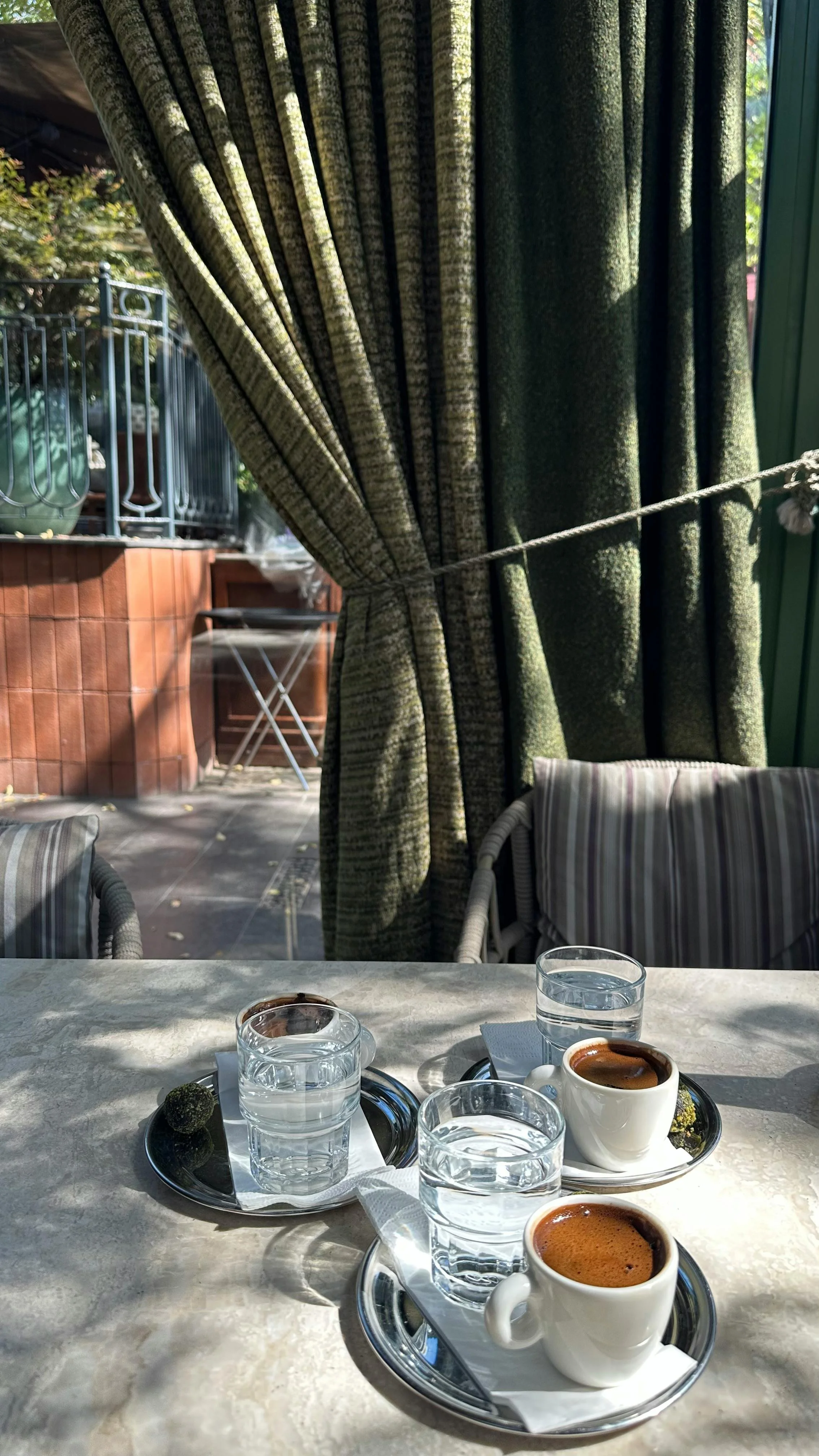
Greek coffee culture is its own world. You’ll use these every day.
Freddo espresso: iced espresso. What most Greeks drink in summer.
Freddo cappuccino: iced cappuccino. The other dominant order.
Frappe: instant coffee whisked into foam, served over ice. Older school but still everywhere.
Sketo (SKE-to): no sugar
Metrio (MEH-tree-o): medium sweet
Gliko (GLEE-ko): sweet
Me gala: with milk
If you order a cafe americano and walk out, you’re missing the whole point. The coffee in Greece is the social ritual. Order something cold, sit for an hour, watch the street, then order another one.
The phrases for when you make a mistake
Sygnomi (sigh-GNO-mee): sorry / excuse me. Use it walking through a crowd, bumping into someone, asking a question.
Den katalaveno (then ka-ta-la-VEH-no): I don’t understand.
Milate Anglika? (mee-LA-te AHN-glee-ka?): do you speak English?
Den milao Ellinika (then mee-LA-o eh-lee-nee-KA): I don’t speak Greek.
Greeks will switch to English the moment they see you struggling. The fact that you tried at all is what sticks.
Practical tools when words fail
The phrases above get you through the social moments. These are the apps and tactics for everything else. Download them before you fly.
Google Translate camera mode. Open the app, tap the camera icon, point it at a menu, sign, or label. The translation appears overlaid on screen, in real time. Works on receipts, museum plaques, ferry timetables, supermarket jars, hand-written taverna specials boards, and the “press this button” notice in your Airbnb. The single most useful travel tool in 2026.
Google Translate conversation mode. Each person speaks into the phone in their own language. It translates aloud, live. Useful for a longer chat with a taxi driver who doesn’t speak English, or a proper conversation with a yiayía at the bakery who wants to know where in Australia you’re from.
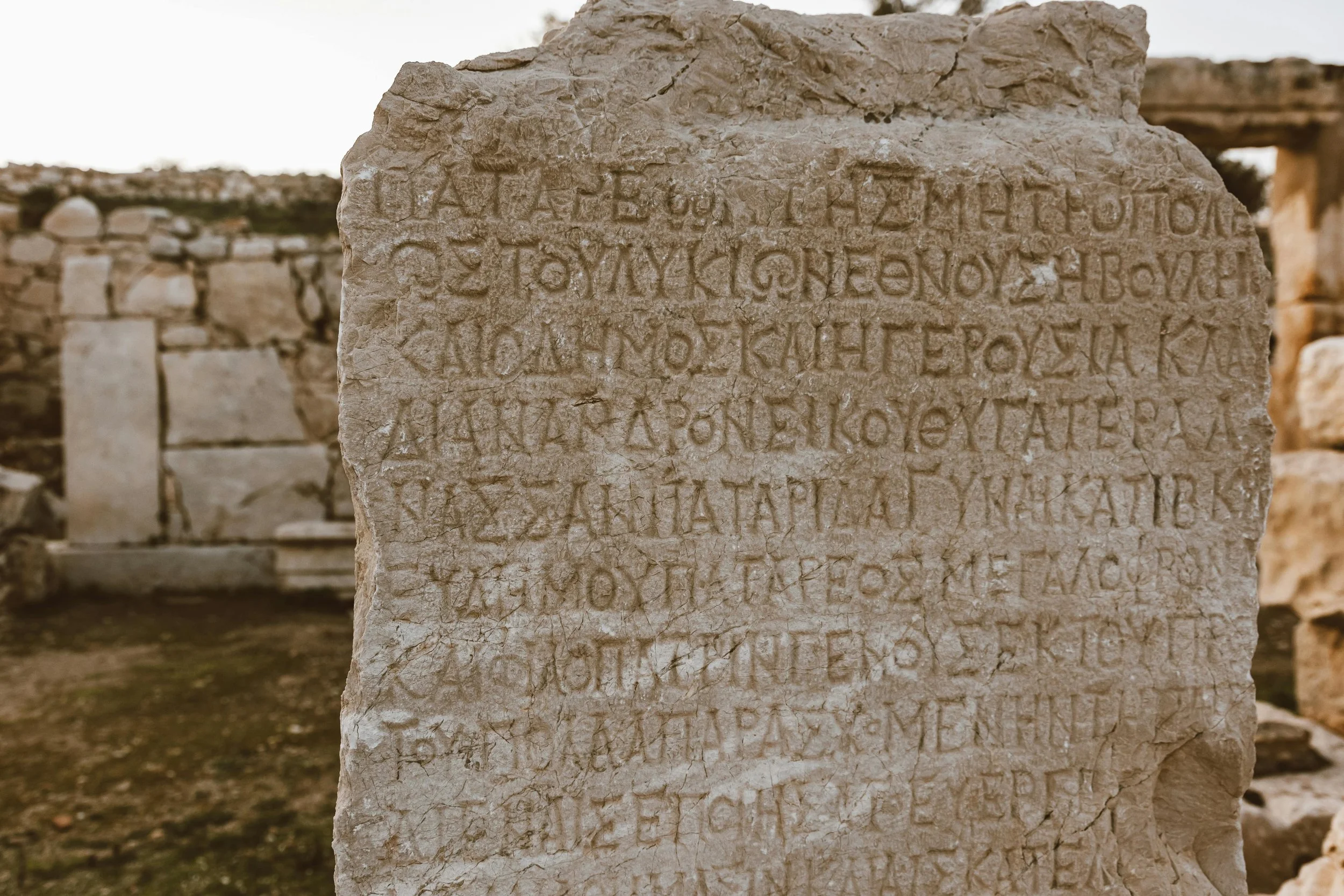
A screenshot of the Greek alphabet on your phone. Saved to your camera roll. Faster than opening Google Translate when you’re squinting at a ferry port destination board or trying to find your street name.
Google Maps, downloaded offline. Before you fly, download Athens, your destination island, and the broader region as offline maps. Saves you on back roads with no signal, on islands where 4G drops, and when you’re trying to find the taverna everyone keeps mentioning.
An eSIM. Airalo or Holafly. Buy a Greek data eSIM in the app, activate it before you land, and you have data the moment the wheels hit the runway in Athens. Cheaper than roaming. No SIM swapping. No queues at the airport kiosk.
Apple Pay or Google Pay. Contactless is everywhere in Greece in 2026. You almost never need euros for day-to-day stuff. Carry a small amount of cash for the taverna in the village and for tipping. Use the phone for everything else.

The social phrases (use these at the right moments)
These are seasonal, religious, or situational. Saying the right one at the right moment earns you serious points.
Christos Anesti (Christ is risen). Said only between Easter midnight and Pentecost. Reply: Alithos Anesti (truly, He is risen). For the full context, read the Greek Easter 2026 Holy Week guide.
Xronia Polla (HRO-nya po-LAH): many years. Said for birthdays, name days, holidays, anything worth celebrating. Your Greek mate will love this one.
Kali orexi (ka-LEE o-REH-xi): enjoy your meal. Always said before eating.
Stin igia mas (steen ee-YEE-ah mas): to our health (the toast). Or just yia mas.
What not to say
Skip these. They mark you as someone who learned Greek from a movie.
Opa! is real, but Greeks use it the way Italians use “mamma mia.” Sparingly, and almost never in the contexts tourists think. Don’t shout it at dinner.
Saganaki is a dish (fried cheese), not a celebration. Don’t yell it as a toast.
The exaggerated plate-smashing thing happens in two specific contexts: at certain bouzoukia and at Easter pot-throwing in Corfu. It is not a thing at your taverna. The waiter will not be amused. For the real version of the after-dark scene, read A Guide to Bouzoukia in Athens.
Pronunciation tips for Aussies
The Greek alphabet doesn’t map one-to-one with English. A few sounds trip Aussie speakers up.
The Greek “h” (as in efharisto) is closer to the soft “h” in “human” than the harsh ch in “loch.” Don’t hawk it.
The rolled “r” doesn’t need to be intense. A single tongue tap is plenty.
Stress matters more than vowels. Get the syllable stress right and Greeks will understand even mangled vowels. Get the stress wrong and you’ll be repeating yourself.
The vowels are flat and consistent. “A” is always ah, “e” is always eh, “i” is always ee, “o” is always oh, “u/ou” is always oo. No silent letters. No diphthong drift. Once you learn the alphabet, you can read any Greek word phonetically. That’s the gift.
If you remember nothing else: efharisto, parakalo, yia sou, logariasmo. Thank you, please, hi, the bill. Those four cover 80% of your interactions, and Greeks will smile every time you try them.
For where to put those phrases to work, read Where to Stay in Athens and The Best Time to Visit Greece.
FAQs
Do I need to speak Greek to travel in Greece?
No. Most Greeks in tourist areas and major cities speak English, and signs in airports, ferry ports, hotels, and tavernas are usually bilingual. Knowing a handful of phrases is a courtesy, not a survival skill. For broader travel advice, see Smartraveller Greece.
How do you say thank you in Greek?
Efharisto (ef-ha-ree-STO). For “thank you very much,” say efharisto poli.
What does “Yamas” mean?
It’s the toast. Short for stin igia mas, meaning “to our health.” Use it at every drink, with eye contact.
Is Greek hard to learn?
The alphabet looks unfamiliar, but the pronunciation is consistent. Once you learn the letters, you can read any word phonetically. Speaking takes practice. Picking up 10-20 phrases for a holiday is easy.
What’s the difference between yia sou and yia sas?
Yia sou is casual, used for one person you know. Yia sas is polite, used for someone older, a group, or someone you don’t know. When in doubt, default to yia sas.
Should I learn Greek before going to Greece?
A few key phrases, yes. A whole language, no, unless you’re moving there. Spend an hour learning the eight phrases in the cheatsheet above and you’re set.
