
ETIAS for Greece: What Australians Need to Know
Updated July 2026
Short answer for the busy: yes, Australians will need ETIAS to enter Greece. Not yet, but soon. The current best-estimate rollout is late 2026, most likely Q4 2026, with a transition period that runs into 2027. The cost is €7. It’s valid for three years. You do it online in about 20 minutes. Don’t panic.
The long answer is the version most Aussies need, because there are traps in the fine print, and the official rollout dates have shifted twice already. Here’s what we know as of 23 July 2026, updated as things move. For everything else you need to plan the trip (flights, ferries, dress codes, seasons), start with our Travel to Greece from Australia planning guide.
What is ETIAS?
ETIAS is the European Travel Information and Authorisation System. Not a visa. A pre-travel authorisation. Same idea as the American ESTA. You fill in an online form, pay a fee, get an email that says you’re approved, and your passport is linked to that approval for three years or until it expires.
ETIAS covers all 30 Schengen-area countries, which includes Greece and everywhere else you’d realistically pair it with (Italy, France, Spain, Germany, Netherlands, Portugal). One ETIAS covers the lot. You do not need a separate one for Greece.
The official source is the European Commission’s ETIAS portal. Bookmark it. Any Australian information page you find (including ours) should be treated as a secondary source that could be out of date.
When does ETIAS start for Australians?
Currently expected: Q4 2026, with a six-month transition period after that where travel without ETIAS is still permitted while the system beds in.
What that means in practice for Australians:
If your Greece trip is before ETIAS launches, you don’t need one
If your trip is during the transition period, you technically don’t need one, but the EU may check anyway. Get one
If your trip is after the transition period ends (currently forecast: mid-to-late 2027), ETIAS is mandatory. No ETIAS, no boarding your flight
Timelines have already slipped twice, from the original 2024 launch, to 2025, to 2026. Assume the 2026 date will hold but check the EU portal one month before you fly.
How much does ETIAS cost?
€7 for travellers aged 18 to 70. Free for anyone under 18 or over 70. Payment is by credit or debit card at the time of application.
The application fee is one-off. Once approved, your ETIAS is valid for three years or until your passport expires, whichever comes first. You can use it for multiple trips inside that window with no additional charge.
Anyone asking you to pay more than €7 is running a scam. There are already private middleman sites charging €40 to €60 for “help” with the application. The real form is 20 minutes on the official EU site. You do not need help.
How to apply for ETIAS from Australia
The process, once the system is live:
1. Apply through the official portal only. here
2. Fill in the form. 20 minutes, less if you have your details on hand. What you’ll need:
Your current passport (must be valid for at least three months after your planned departure from Schengen)
A working email address
Credit or debit card for the €7 fee
Address of your first accommodation in Europe
Your occupation and employer details
3. Wait for approval. Most applications are approved within minutes. Some take up to four days, and a very small percentage go to manual review, which can take up to 30 days. Apply at least a month before you fly if you can.
4. Save the approval email. Screenshot the confirmation. You may not need to show anything at the border because ETIAS is linked to your passport electronically, but airline check-in may ask to see it.
ETIAS vs the 90-in-180 rule
Common confusion. ETIAS does not extend how long you can stay in Europe. Australians can stay in the Schengen area for 90 days out of any rolling 180-day period, both before and after ETIAS.
ETIAS just adds an entry authorisation on top of that 90-day rule. If you want to stay longer than 90 days, you still need a proper visa (working holiday, study, digital nomad depending on the country), and ETIAS doesn’t change that.
The 90-in-180 rule is enforced. Overstaying by even a few days can trigger a formal record on your passport that follows you for years. Track your days. Our New EU Border Rules guide covers the broader border-rules changes coming into force alongside ETIAS.
What about the EES (Entry/Exit System)?
ETIAS and EES are two different things that both get talked about at the same time.
EES is the biometric entry-exit system. Fingerprint and facial photo on your first entry, and then automatic tracking of your entries and exits. It replaces passport stamping. EES rolled out progressively across 2025 into 2026 and is now live at most major European entry points.
ETIAS is the pre-travel authorisation. Separate system. Launching later.
You’ll deal with both. EES happens automatically at the border on arrival. ETIAS is something you do before you fly.
ETIAS for kids and older travellers
Under 18: free. Every family member still needs their own ETIAS application, even babies. Yes, the two-year-old needs one. A parent completes it on their behalf.
Over 70: free. Still apply, still linked to your passport.
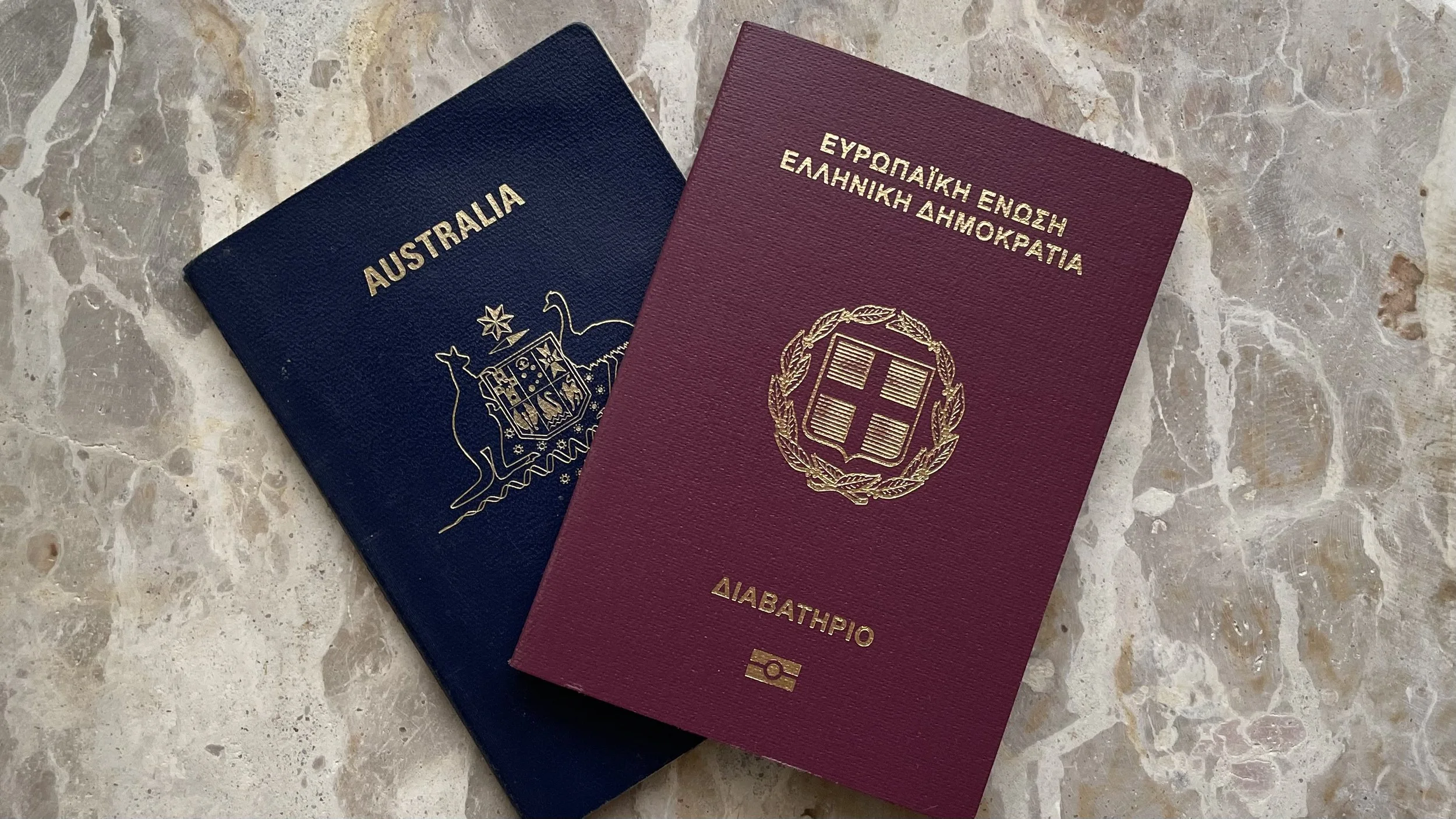
Dual citizens: if you’re an Australian citizen with a second EU passport (Greek, Italian, British is a separate category), enter Europe on your EU passport. No ETIAS required. This is a substantial advantage. If you have a Greek passport by descent, use it.
The DFAT Smartraveller page for Greece is updated in real time and will confirm current ETIAS status for Australians before you fly.
Common mistakes Aussies make
Assuming ETIAS is a visa. It’s not. It doesn’t guarantee entry. Border officials can still refuse you at their discretion, though this is rare for Australians.
Leaving it to the last minute. Most approvals are fast. A small number go to manual review that can take 30 days. Apply at least a month out.
Passport too close to expiry. Your passport must be valid for at least three months beyond your Schengen exit date, and issued within the last 10 years. Australians renewing passports at the moment are seeing wait times of six to eight weeks. Check yours now.
Old ETIAS from your last Europe trip. Valid for three years, but only if your passport hasn’t changed. New passport, new ETIAS.
Paying a scam site. €7 is the only fee. If a site is charging €40, close the tab.
What ETIAS means for Australians travelling to Greece
Practically, very little changes. You still book flights the same way. You still land at Athens Airport. You still get 90 days in the Schengen area. The one difference is that at some point in late 2026 or 2027, you’ll do a 20-minute online form before your flight, and then the system remembers you.
If you’re a regular European traveller (say, one Greek trip a year), your ETIAS covers you for the next three trips at no extra cost. If you’re a one-time traveller, it’s a €7 add-on that gets built into your holiday budget somewhere between airport parking and travel insurance. Speaking of which, our Greek travel insurance guide for Aussies covers the policies that will cover what you need in 2026.
Practical tools for the ETIAS rollout
Set a Google alert for “ETIAS launch date” and “ETIAS Australia” so you get notified when the system goes live and when the transition period ends.
Bookmark the EU official portal. Do not save any third-party ETIAS site.
Keep a passport reminder. Every Australian passport has an expiry date that Greece requires to be at least three months in the future. Set a calendar reminder for six months before your passport expires so you can renew without stress.
Screenshot your ETIAS confirmation email as soon as it arrives. Store it in the same folder as your travel insurance PDF and boarding pass. Losing the email won’t invalidate your ETIAS but it may slow you down at check-in.
FAQs
Do Australians need ETIAS for Greece?
Yes, once the system launches (currently forecast Q4 2026, with a transition period after that). Cost is €7 and it’s valid for three years. Apply online through the official EU portal.
Is ETIAS a visa?
No. It’s a pre-travel authorisation, closer to the US ESTA. It doesn’t guarantee entry, and you still need a proper visa if you want to stay longer than 90 days.
How long does ETIAS take to approve?
Most applications are approved within minutes. Some take up to four days. A small percentage go to manual review, which can take up to 30 days. Apply at least a month before you fly.
Do children need ETIAS?
Yes. Every family member including babies needs their own ETIAS. It’s free for under-18s and over-70s, but the application still has to be submitted.
How long is ETIAS valid?
Three years or until your passport expires, whichever comes first.
Can I still visit Greece before ETIAS launches?
Yes. Australians can enter Greece and the wider Schengen area for stays of up to 90 days in any 180-day period with just a valid passport. ETIAS only becomes required when the system officially launches.
Does ETIAS extend how long I can stay in Greece?
No. ETIAS does not affect the 90-in-180 rule. Australians remain limited to 90 days in Schengen countries per rolling 180-day period.
Do I need ETIAS if I have a Greek passport?
No. Enter Europe on your EU passport and ETIAS does not apply. Even if you’re a dual Australian-Greek citizen, use your EU passport at European borders.
How much does ETIAS cost?
€7 for travellers aged 18 to 70. Free for children under 18 and adults over 70.
Where do I apply?
Only through the official EU portal at travel-europe.europa.eu/etias once launched. Third-party sites charging more than €7 are scams.
