
Oxi Day, Why 28 October Still Matters to the Greek Diaspora
Updated September 2026
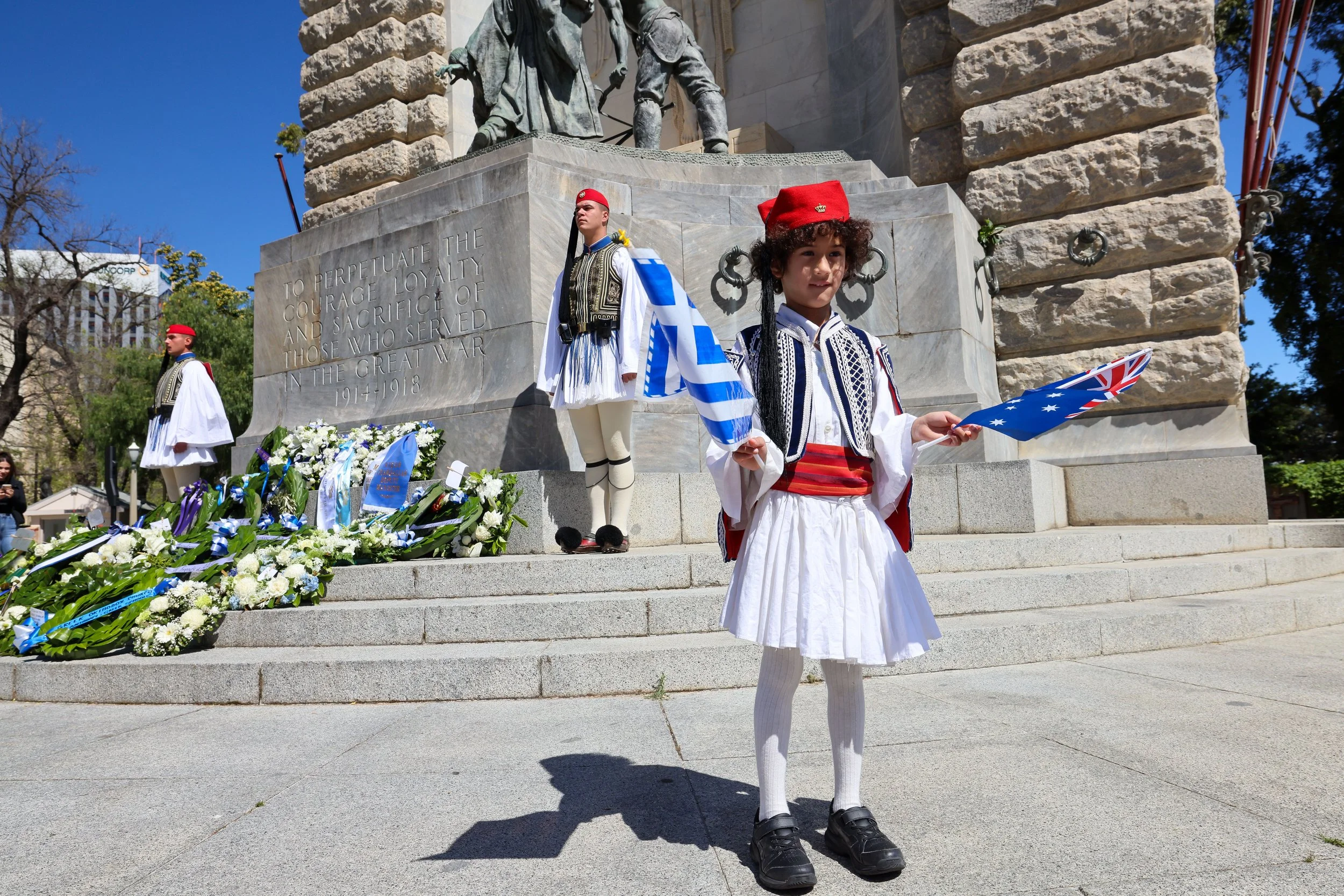
Every 28 October, Greek families in Australia get up early, iron the school uniform with the Greek flag pin, and head to a parade, a church service, or a community hall. The kids recite Ioannis Metaxas’s one-word answer. The old men in the front row cry. Everybody sings the national anthem. Then everyone goes to lunch and argues about whether the roast lamb needs more lemon.
This is Oxi Day. The most important secular date on the Greek diaspora calendar after 25 March. In 2026 it falls on a Wednesday, which is inconvenient for the Melbourne parade and gives Adelaide an excuse to run the community lunch on the following Sunday. Here is what the day means, why it still matters two generations after the war, and where to find the events in your city.
What Oxi Day commemorates
On 28 October 1940, at 3am, the Italian ambassador to Greece delivered an ultimatum to Greek Prime Minister Ioannis Metaxas. Mussolini demanded free passage for Italian troops through Greek territory to open a new front in the war. If Greece refused, Italy would invade. The story goes that Metaxas answered in one word.
Óchi. No.
Historians will tell you the actual response was a longer diplomatic sentence in French, closer to “then it is war.” The point stands. Greece refused. Italian troops crossed the Albanian border into Epirus within hours. Within weeks, the Greek army had pushed them back and occupied a third of Albania. It was the first Axis defeat of the war, and the reason Winston Churchill said afterwards that Greeks did not fight like heroes but that heroes fought like Greeks.
The war for Greece did not end well. Germany invaded in April 1941 to rescue the collapsing Italian campaign, and the occupation that followed was one of the most brutal in Europe. Athens starved. Villages were massacred. The country did not properly recover until decades later. But 28 October remains the day Greeks remember that the answer was no, and that saying no cost everything.
Why the diaspora keeps commemorating it
Because most Greek-Australian families are here because of what came after Oxi Day. The Greek Civil War (1946 to 1949), the poverty of the 1950s, the Colonels’ junta of the 1960s and 70s. The waves of migration that filled Melbourne’s Oakleigh and Adelaide’s western suburbs are direct downstream consequences of the Second World War in Greece. Almost every Greek-Australian family over 60 has a grandmother who remembers hiding in a village during the occupation, an uncle who fought in the resistance, or a father who left because there was nothing left.
Oxi Day is not just a battle anniversary. It is the diaspora’s annual ritual of saying: we know why we are here.
Where the Oxi Day events happen in Australia
Every state capital with a significant Greek community runs a formal program on or around 28 October. Formats vary by city but the shape is consistent: a doxology (thanksgiving service) at the local Greek Orthodox cathedral, a wreath-laying at a war memorial or Greek community centre, and a parade or community lunch.
Melbourne
The largest Oxi Day program in the country. The Greek Community of Melbourne (GCM) runs the flagship event, which usually includes a morning doxology at the Cathedral of Annunciation (Evangelismos) in East Melbourne, a wreath-laying at the Shrine of Remembrance, and a parade featuring Greek schools, dance groups and community associations. Speeches, national anthems, then a community lunch. Check greekcommunity.com.au in early October for the exact schedule.
Sydney
Coordinated by the Greek Orthodox Community of NSW. Doxology at the Cathedral of the Annunciation of Our Lady in Redfern, followed by a wreath-laying at Martin Place cenotaph or the ANZAC War Memorial in Hyde Park, then community events at parishes across the metropolitan area. See gocnsw.org.au for the day’s program.
Adelaide
The Greek Orthodox Community of South Australia coordinates the Adelaide program. Doxology at the Cathedral of the Archangels Michael and Gabriel on Franklin Street, wreath-laying at the National War Memorial on North Terrace, and school parades from Greek Orthodox schools including St George College. If 28 October falls midweek, the community lunch usually shifts to the following Sunday. Check via the Greek Consulate of Adelaide or your local parish.
Brisbane, Perth, Canberra, Hobart, Darwin
Each city runs a smaller-scale program through its Greek Orthodox community and/or Hellenic Association. Cathedral service, wreath-laying at a state war memorial, community event. Check your local Greek Orthodox parish website in early October for the exact schedule, or ask at the church after the previous Sunday service.
What happens at an Oxi Day event, if you’ve never been
Turn up in your best. The doxology is a church service, so shoulders and knees covered, and the men tend to be in suits. The wreath-laying is outdoors, so bring a coat because Melbourne is cold in October and Adelaide can go either way.
The order of service, in most cities:
Doxology (thanksgiving service) at the Greek Orthodox cathedral. Around 30 to 45 minutes. Sung in Greek and Modern Greek. If you don’t follow it word-for-word, the ritual carries the meaning.
Procession to the war memorial or Greek community centre.
Wreath-laying by the Greek consul, community president, and representatives of Greek associations and Greek schools.
National anthems (Greek first, then Australian).
Speeches, usually from the consul and community leaders. Sometimes a schoolchild recites the Óchi speech or a poem.
Parade of Greek school students, dance groups (in traditional dress), war veterans’ associations, and diaspora organisations.
Community lunch or reception. This is where most of the actual community happens.
The whole thing usually runs from about 9am to 2pm. Kids get bored around hour three. Bring snacks.
What to wear
Formal enough for church. Suits and ties are common on older men. Younger men in smart shirt and trousers. Women in dresses or smart pants. Kids in school uniform if they attend a Greek school, or church-formal if they don’t. Small Greek flag pins are worn on lapels by many attendees. If you want to add one, buy at any Greek deli or from The Greek Warehouse in Adelaide.
Cycladic Spaces tip
Cycladic Spaces tip: if you’ve never been to an Oxi Day event and you have kids, bring them to the wreath-laying rather than the church service. The outdoor part is where the emotion sits. The trumpets, the parade, the veterans standing at attention in front of the war memorial. This is where a second or third-generation Aussie Greek child suddenly understands why nona still keeps her Greek passport in a drawer.
Oxi Day in Greece itself
28 October is a national public holiday in Greece. Everything closes: banks, most shops, schools, some restaurants. Parades happen in every city and town. The biggest is in Thessaloniki, which was the front-line city during the Italian invasion and holds the largest military parade in the country. Athens runs a smaller student parade in Syntagma Square. Regional cities do their own versions. If you’re planning a Greek trip and want to see how a national holiday really feels, October gives you two of them (25 March is the other, more famous internationally).
If you’re building a trip around cultural moments, our Greek festivals and cultural events guide covers the full calendar of what’s worth planning around.
What Oxi Day means to a second or third-generation Aussie Greek
You might have grown up going to the parade and thinking it was just something the family did. The Greek school uniform, the wreath, the men in suits crying at a war memorial 76 years after the fact. You didn’t understand it as a kid. You understood it as background weather.
Then somebody in the family dies, or you go to Greece and see the war memorial in a village of 400 people with 63 names on it from a single week in 1943, and suddenly the whole thing lands. That is why the diaspora still shows up on 28 October. Because the answer was no. Because the cost was everything. Because being Greek in Australia is inseparable from that history.
You can skip other things. But Oxi Day is the one your yiayiá expects to see you at.
How to prepare if it’s your first Oxi Day
Turn up 10 minutes early. The cathedral fills up.
Learn the Greek national anthem, first verse. It’s sung standing.
Bring cash for the collection tray at the doxology, and for the community lunch if it’s ticketed.
Introduce yourself to your local Greek consul. They’re usually at the wreath-laying and always happy to meet diaspora Greeks doing well in Australia.
Wear the Greek pin. It matters.
Common questions
What is Oxi Day?
Oxi Day (28 October) commemorates the Greek refusal to allow Italian troops to enter Greece in 1940. It is one of two Greek national holidays celebrating independence and resistance, the other being 25 March.
Why do Greek Australians commemorate Oxi Day?
Because the war that followed the Greek Óchi shaped the migration patterns that brought most Greek families to Australia. It is the diaspora’s annual acknowledgment of the historical events that made the community exist.
Where are the Oxi Day events in Melbourne?
Coordinated by the Greek Community of Melbourne. Doxology at the Cathedral of Annunciation in East Melbourne, wreath-laying at the Shrine of Remembrance, and a community parade. Full program at greekcommunity.com.au closer to the date.
Is 28 October a public holiday in Australia?
No. Australian workplaces continue as normal. Greek community events happen before or after work, or on the following Sunday if 28 October falls midweek.
Can non-Greeks attend Oxi Day events?
Yes, absolutely. Community events, church services and wreath-layings are open to all. Local Australian politicians, RSL representatives and consular staff from allied nations often attend.
What should I wear to Oxi Day events?
Church-formal. Suits for men, dresses or smart trousers for women. Greek flag pin on the lapel if you have one. Kids in Greek school uniform if applicable, otherwise smart-casual.
What is the difference between Oxi Day and 25 March?
25 March (Greek Independence Day) commemorates the 1821 start of the Greek War of Independence against Ottoman rule. 28 October (Oxi Day) commemorates the 1940 refusal to allow Italian invasion. Both are national holidays. Both are commemorated by the diaspora.
Where to read next
The Greek Warehouse opens in Findon, where to buy the pin, the flag and the icon.
Greek festivals and cultural events 2026, the full calendar.
Travel to Greece from Australia 2027, The Planning Guide, if this year’s Oxi Day makes you want to book the trip.
