
Greek Islands You Can Reach Without a Long Ferry (2026)
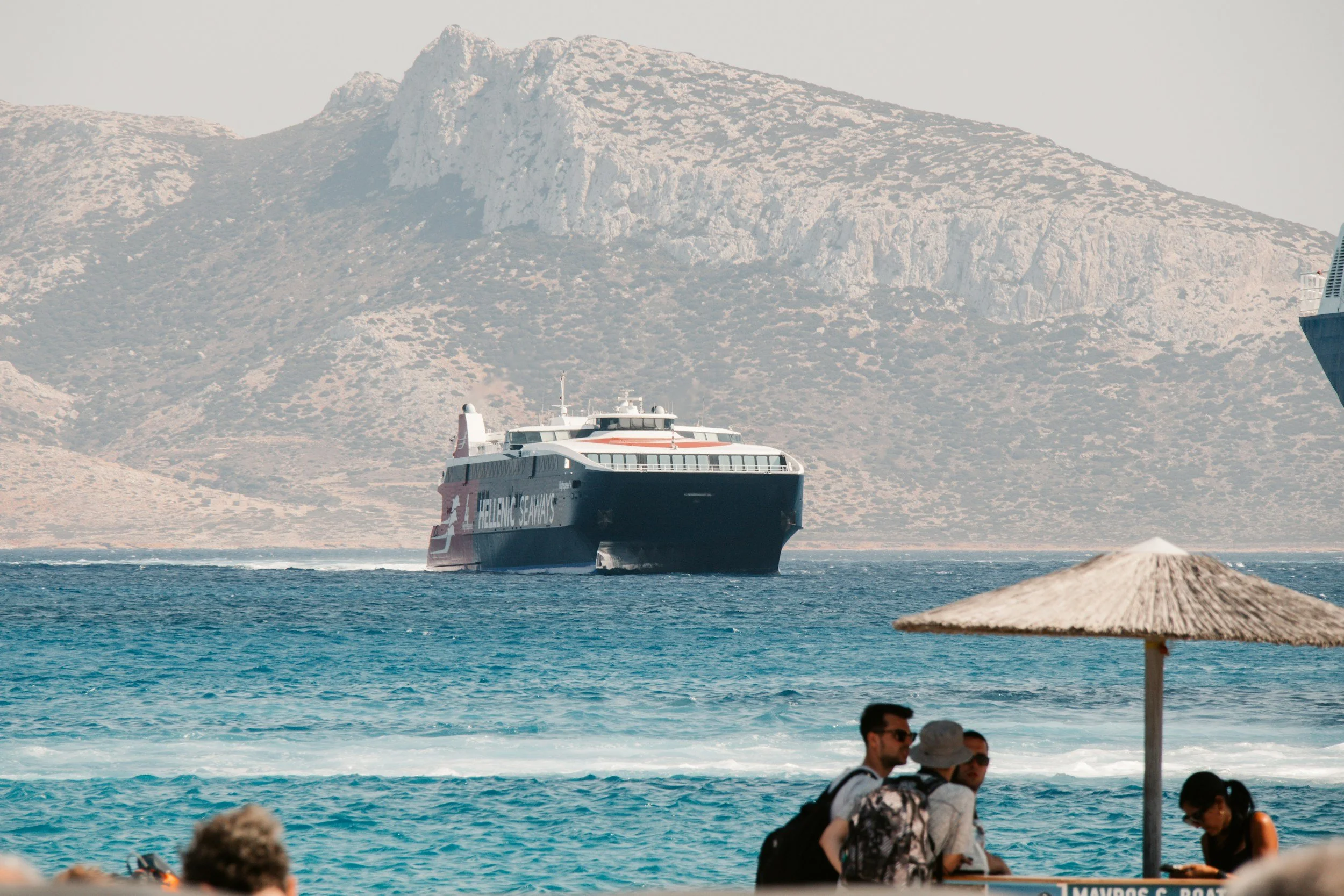
Some people love Greek ferries. The salt air, the anticipation, watching an island appear on the horizon. I get it.
And some people would rather do almost anything else.
Maybe you got seasick once and never recovered. Maybe you watched Titanic at an impressionable age. Maybe you just don’t want to spend four hours on a boat when you could be on a beach.
Good news, you can still do the Greek islands.
Some have bridges. Plenty have airports. And others have ferry crossings so short that if you’re still terrified, you might need to have a conversation with yourself.
Below are the best Greek islands you can reach with minimal or no time on a boat.
Quick shortlist (for people who don’t want to scroll)
If you want zero ferry time:
Lefkada (bridge)
Evia (bridge)
If you can handle 10 to 40 minutes:
Poros (5 min)
Elafonissos (10 to 15 min)
Salamina (15 min)
Thassos (35 min)
Aegina (40 to 75 min)
If you want an island flight instead:
Crete, Rhodes, Corfu, Kos, Skiathos (and more)
Greek islands you can drive to (no ferry needed)
1. Evia
Ferry time: None (bridge), or short crossings if you want them
Greece’s second-largest island and somehow one of its least known outside the country. Evia is connected to the mainland by two bridges at Halkida, about an hour’s drive from Athens. You can be on the island without ever stepping foot on a boat.
The old sliding bridge at Halkida is worth seeing for its own sake. The waters beneath it change direction every six hours due to tidal forces, a phenomenon that reportedly puzzled Aristotle.
If you do want a short crossing for the novelty factor, there are local ferries across the Evoikos Gulf (the kind where you barely have time to unzip your bag before you’re on the other side).
Why go: beaches on the east coast, mountains, forests, rivers, hot springs in Edipsos, and the famous dried figs of Kymi.
2. Lefkada
Ferry time: None (bridge)
Yes, there’s a bridge to Lefkada. And no, it’s not one of those terrifying “why did I agree to this” bridges.
Some people criticise Lefkada as being “the island that isn’t really an island” because it’s connected to the mainland by a causeway. I’d argue that just makes it easier to get to.
And once you’re there, it’s instantly obvious why people rave about it.
Lefkada has some of the most photographed beaches in Greece. Porto Katsiki and Egremni regularly appear on “best beaches in Europe” lists, and for once, the hype is deserved. The water is that absurd shade of turquoise you assume is photoshopped until you see it in real life.
Bonus: from Lefkada you can take short ferries to Kefalonia (under an hour) and Meganisi (around 20 minutes).
Greek islands with very short ferry crossings
3. Poros
Ferry time: 5 minutes
The word “poros” means a narrow strip of sea, and at its closest point, Poros is only a few hundred metres from the Peloponnese coast.
These days you take a five-minute ferry from Galatas, or you can convince someone with a small boat to take you across.
Five minutes. If that still scares you, I’m not sure what to tell you.
4. Elafonissos
Ferry time: 10 to 15 minutes
A tiny island off the southern Peloponnese with one of the best beaches in Greece.
Simos Beach has the kind of white sand and shallow turquoise water that makes you question why you ever did Cyclades ferries in the first place.
The crossing from Pounta is quick, sheltered, and usually calm.
The catch: it’s a long drive down the Peloponnese to get there. But if you’re road-tripping anyway, it’s a perfect little detour.
5. Salamina
Ferry time: 15 minutes
It’s hard to think of Salamina as a normal Greek island, because it’s so close to Piraeus it almost feels like a suburb.
But it’s bigger than you’d expect, and parts of it feel surprisingly local and quiet once you get away from the port.
History nerd detail: this is where the Battle of Salamis took place in 480 BCE, when the Athenian fleet defeated the Persians.
6. Thassos
Ferry time: 35 minutes
From the small port of Keramoti (near Kavala), the ferry to Thassos takes about 35 minutes.
Thassos is green, mountainous, and has excellent beaches. It’s popular with Greeks and northern Europeans, but it’s still weirdly under the radar for Australian travellers.
It also feels more forested than most Greek islands. In places, pine trees come down almost to the water.
7. Aegina
Ferry time: 40 to 75 minutes
The most accessible of the Saronic islands.
Fast ferries from Piraeus can be around 40 minutes. Regular ferries are closer to an hour (give or take, depending on the route and stops).
Aegina has everything you want from a Greek island without the stress.
seafood tavernas
beaches and little fishing villages
the Temple of Aphaia (one of the best-preserved ancient temples in Greece)
pistachios everywhere, in every possible format
Day-trippable from Athens, which is both a blessing and a curse.
8. Agistri
Ferry time: about 1 hour from Piraeus, or 10 minutes from Aegina
Agistri is one of those islands people gatekeep.
It’s small, piney, very pretty, and the kind of place where visitors come back every year because they’ve found something good and don’t want to share it too loudly.
If an hour from Piraeus sounds too long, break it up. Ferry to Aegina first, then hop over to Agistri in about 10 minutes.
9. Kea
Ferry time: about 1 hour from Lavrio
If you want a Cycladic island that feels further away than it is, Kea is your answer.
The ferry from Lavrio (not Piraeus) takes around an hour.
Fair warning: this crossing can be choppy, especially in Meltemi season. The good news is there are anti-nausea meds that last exactly an hour.
Kea is popular with Athenians for weekend escapes, which means good food and a local feel, without the cruise ship chaos.
Greek islands you can reach by a short drive + short ferry (or fly instead)
10. Corfu
Ferry time: 1 to 1.5 hours from Igoumenitsa (or fly)
Corfu is in the northwestern corner of Greece, which means it’s a long drive from Athens.
But if you’re willing to do the road trip (and maybe stop in Ioannina or Meteora), the ferry from Igoumenitsa is relatively short.
Corfu also has an international airport with plenty of summer flights, so you can skip the ferry entirely.
Expect Venetian architecture, green landscapes, and a totally different vibe to the Cyclades.
11. Kefalonia + Zakynthos
Ferry time: around 1 to 1.5 hours from Kyllini (or fly)
From Kyllini in the western Peloponnese:
ferry to Kefalonia (Poros) is around 1.5 hours
ferry to Zakynthos is around 1 hour-ish
Both islands have airports with lots of summer flights, especially Zakynthos.
Kefalonia is quieter, calmer, and (in my opinion) more interesting. Zakynthos is beautiful but can get very busy.
12. Samothraki
Ferry time: under 2 hours from Alexandroupoli
Remote, wild, and totally not on the average tourist radar.
Samothraki is home to the Sanctuary of the Great Gods, where the famous Winged Victory of Samothrace (now in the Louvre) was found.
The ferry from Alexandroupoli takes under two hours. Getting to Alexandroupoli is the real commitment.
If you’re already exploring northern Greece, it’s genuinely special. Waterfalls, natural pools, and hardly any tourists.
Greek islands with airports (skip ferries completely)
If you truly cannot face a ferry at all, here are the Greek islands you can fly to, either direct from Europe in summer or via a short domestic flight from Athens.
Direct international flights (summer)
You’ll typically find direct seasonal routes to:
Crete (Heraklion and Chania)
Rhodes
Corfu
Kos
Zakynthos
Kefalonia
Skiathos
(Flight networks change every year, but these are the usual suspects.)
Domestic flights from Athens (fast and easy)
Aegean Airlines and Sky Express fly from Athens to many islands. Flight time is often 30 to 50 minutes.
You’ll usually find regular domestic flights to places like:
Crete, Rhodes, Kos, Karpathos
Lesvos, Chios, Samos
Ikaria, Lemnos
Paros, Naxos, Milos, Syros
Astypalaia, Leros, Kasos, Kythira
Mainland places that feel like islands (no boats at all)
If the ferry thing is a hard no, consider these mainland destinations that still give you the “Greek island” feeling.
The Peloponnese
The Peloponnese has hundreds of coastal towns and villages that feel like island life, without any crossings.
Nafplio, in particular, will make you forget you’re on the mainland. Venetian architecture, waterfront tavernas, and the kind of atmosphere that makes you linger.
The Mani Peninsula is wild, dramatic, and honestly one of the most underrated parts of Greece.
Halkidiki
Three peninsulas, ridiculously good beaches.
Fly to Thessaloniki, rent a car, and you’re sorted.
Parga
Colourful houses tumbling down to the sea, beaches nearby, and it’s so island-like you’ll forget it’s mainland.
Pelion
Mountain villages, forested landscapes, beaches on both sides. It’s a different Greece, and it’s gorgeous.
Tips for ferry-averse travellers
Book calm routes
The Saronic Gulf (Aegina, Poros, Agistri) is sheltered and rarely rough. Strait crossings to Evia are similar.
Open Aegean crossings to the Cyclades can be another story.
Consider medication
Dramamine (or similar) works. Take it 30 minutes before boarding.
For a one-hour crossing, you’ll often be off the boat before it even wears off.
Fly one way, ferry the other
If you can handle one ferry but not two, fly in and ferry out (or vice versa).
The return journey always feels easier when you know what to expect.
Book with FerriesinGreece
You can filter by route, journey time, and ferry operator on Ferries in Greece.
Travel shoulder season
Seas are usually calmer in May, June, September, and October than in July and August when the Meltemi winds kick up.
If you want the month-by-month cheat sheet, this helps: Best Time to Visit Greece.
Keep planning
If you’re building out a Greece itinerary and want to avoid rookie stress, these will help:
So, where should you start?
You don’t need to love ferries to love Greece.
Bridges, short crossings, and flights can get you to some seriously beautiful islands without hours on open water.
Start with the easy ones. Evia, Lefkada, Poros, Aegina.
Build your confidence.
And if you eventually decide to brave a longer crossing, the rewards can be worth it.
But if not, that’s fine too. There’s plenty of Greece to explore without ever turning green.
FAQs
Are Greek ferries really that bad for seasickness?
Not usually. Most travellers take ferries in Greece without any drama, especially on calmer routes (like the Saronic Gulf). Seasickness can happen if you’re prone to motion sickness, or if it’s windy and the sea is choppy, but it’s not some guaranteed vomit-fest.
Which ferries are the smoothest in Greece?
Bigger, slower ferries that carry cars tend to feel steadier. If you’re nervous, choose a large conventional ferry over a smaller fast craft. The extra travel time is often worth the calmer ride.
Are fast ferries and catamarans worse for motion sickness?
They can be. Fast boats (catamarans and hydrofoils) have their fans, but they can feel bouncier in rough weather and you often have less access to fresh air. If you get motion sick easily, book the biggest ferry option you can, and avoid sitting right at the back.
Is the ferry to Hydra rough?
Hydra is one of the safer choices if you’re ferry-anxious. It’s a sheltered route compared to Cyclades crossings, and the trip from Piraeus is under 2 hours.
If you want the easiest version, you can also drive to the Peloponnese side and take a short hop over (it’s a nice “training wheels” option).
What’s the best seat to reduce seasickness on a ferry?
Aim for the middle of the ferry, on a lower deck. That’s where movement is usually felt the least. If you can sit near a window or step outside for air, even better.
What should I take for seasickness in Greece?
A pharmacy can help. Ask for travel sickness tablets (non-drowsy if you want to stay awake). Take them 30 to 60 minutes before boarding, not once you’re already green.
Extra hacks that people swear by include ginger chews, mint gum, and keeping your eyes on the horizon if the boat starts bouncing.
Do ferries in Greece get cancelled?
Yep, sometimes. Wind is the big one, especially in Meltemi season (July and August). It’s usually not about comfort, it’s about being able to safely dock in ports.
If you’ve got a flight the next day, don’t leave your island transfer to the last possible ferry. Give yourself buffer time, or plan a flight back to Athens instead.
Is Ferryhopper worth using?
Yes, it’s one of the easiest ways to compare operators and journey times, and book tickets online. I still recommend checking your operator’s website closer to travel day, especially if the forecast is looking spicy.
