

Updated November 2026
Every Australian who moves to Greece has a story about the apartment hunt. There is always a cousin who knows a man with a flat in Pangrati, a listing that vanishes the day after the viewing, or a landlord in Naxos who will only rent until May because the tourists come back in June. Renting in Greece works differently from renting in Australia, with three-year leases written into law, a tax office that registers every lease, a building fee most Aussies have never heard of and a rental market that has tightened hard since short-term letting took off.
This is the second guide in the Cycladic Spaces Moving to Greece from Australia series. The first, So You Want to Live and Work in Greece?, covers tax residency, freelancing and EFKA, and a Greek lease matters there too, because it is one of the strongest signs to both tax offices that you have moved. This one takes you from "we're doing it" to keys in hand.
Quick answer
To rent long-term in Greece as an Australian you need a Greek tax number (AFM), a Greek bank account to pay rent from, and usually a deposit of one to two months' rent. Residential leases run for a minimum of three years by law, landlords register every lease with the tax office, and since April 2026 rent must be paid by bank transfer. In the third quarter of 2026, a one-bedroom flat in the Municipality of Athens rented for around €670 a month at the median, and a two-bedroom for around €980, before building fees and utilities.
Quick cheatsheet
Before you start. An AFM, a Greek bank account and a Greek phone number. Without the AFM, no landlord can register your lease.
Where to look. Spitogatos and XE.gr for listings, local agents, expat and neighbourhood Facebook groups, and word of mouth, which still finds the best flats.
What it costs. Around €670 a month for a one-bedroom and €980 for a two-bedroom in the Municipality of Athens at the median, and around €990 and €1,440 in Kolonaki.
The monthly extras. Koinóchrista (building fees, a lot like strata) every month, a share of the building's heating oil in winter, plus your own utilities.
Up front. A deposit of one to two months' rent, the first month in advance, and an agent's fee if you use one.
Check what's included. Some Greek rentals come without an oven or air conditioners, so confirm at the viewing what stays in the flat.
The lease. Three years minimum by law, registered by the landlord with AADE, which you accept in myAADE within 30 days.
Paying rent. By bank transfer only, into the owner's registered account. Pay any other way and you lose the annual rent rebate of up to €800.
Scams. Never send a deposit for a flat you or someone you trust has not seen.
What do you need before you can rent in Greece?
Greek landlords and agents will rarely hand over keys to someone who exists only on an Australian passport. Before you start viewing flats, get the basics in place, ideally in your first week or even before you fly.
An AFM (Greek tax number). This is the one document you cannot rent without, because the landlord has to enter your AFM when registering the lease with the tax office. The Greek admin setup guide for Australians explains how to get one.
A Greek bank account. Since April 2026 rent can only be paid by bank transfer into the owner's account, so a Greek account (or at minimum a euro account you can transfer from in your own name) is part of renting now.
A Greek mobile number. Agents, landlords and banks all work through phone and Viber, and plenty of listings get taken within a day.
Your passport and visa or residence documents. Landlords will want to see your right to be in Greece, especially for a three-year lease.
Proof you can pay. Greek landlords are used to Greek payslips. Australians earning from overseas should bring bank statements, an employment letter or recent invoices and tax returns, and should expect some landlords to ask for a larger deposit or a Greek guarantor.
Citizens with a Greek ID card have an easier time, and the steps for getting one sit in the coming Greek ID card guide.
Short-term first, long-term second
The sensible way to rent in Greece is to land in a furnished short-term place for a month or two and look for the long-term flat in person. You get time to learn the neighbourhoods, see flats before paying anything and meet agents face to face, which matters more in Greece than an online application ever will. Our guide to where to stay in Athens is a good starting point for the first base.
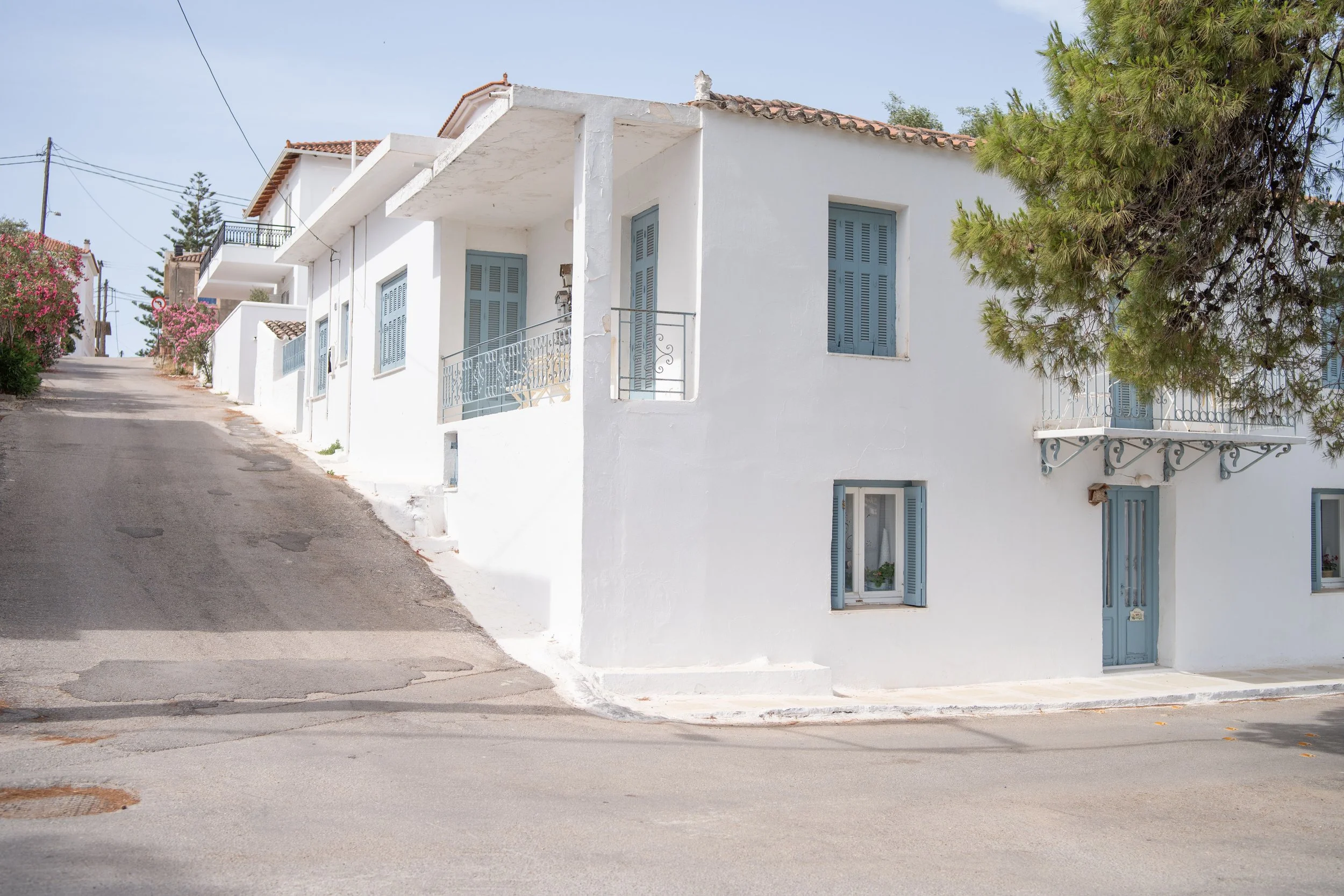
Where do you find a rental in Greece?
The Greek rental market runs on a mix of property portals, local agents and personal networks, and the best flats often never reach a website.
Spitogatos and XE.gr. The two big Greek property portals. Search in Greek as well as English (enoikíasi means rental, diamérisma means apartment), because plenty of listings never get an English version.
Local agents. Many landlords hand their flat to a neighbourhood agent and never advertise it. Walk the streets you like and look for agency windows and enoikiázetai (for rent) signs on balconies, which are still a real way flats get let.
Facebook groups. Expat groups for Athens, Thessaloniki and the bigger islands, plus neighbourhood groups in Greek, where tenants pass flats on to friends and landlords post directly.
Word of mouth. For Greek-Australians, the family network is the single best rental search engine in the country. Tell every cousin, koumbára (godmother) and café owner what you want.
Renting in Athens and Thessaloniki
Competition is fiercest in central Athens, where rents have climbed fastest and short-term letting has taken flats out of the long-term market. The government has suspended new short-term rental registrations in Athens's first, second and third districts (including Plaka, Kolonaki, Koukaki, Exarcheia, Petralona and Gazi) and in Thessaloniki's first district, and in September 2026 extended the freeze through to 31 December 2027, according to To Vima, with the aim of returning homes to long-term tenants. Expect flats in popular areas to go within days, and be ready to decide at the viewing.
Our piece on Athens gentrification and the cost of cool is worth reading before you fall for a neighbourhood that locals are being priced out of.
Renting on a Greek island
Island rentals follow the tourist calendar. Many owners rent from October to May (a winter let) and switch to holiday guests for summer, so a year-round lease on an island can be harder to find than a flat in Athens, particularly in the Cyclades. Start looking in early autumn, ask for a full three-year lease in writing, and be wary of any offer that only runs to June.
Buying is a different path altogether, and Buying Property in Greece From Australia covers it.
How much does it cost to rent in Greece?
Greek rents have risen year after year, and the old idea of Greece as an easy place to live on Australian dollars has not survived the housing crunch. Greek asking rents are usually quoted per square metre, and the Spitogatos index for the third quarter of 2026, reported by To Vima, gives a good picture of where they sit.
What a month's rent costs, third quarter 2026 (one-bedroom of 55 m² / two-bedroom of 80 m²)
Vouliagmeni (Athens Riviera). Around €1,230 / €1,790 a month
Kolonaki–Lycabettus and Palaio Psychiko. Around €990 / €1,440 a month
Southern Athens suburbs (Glyfada, Voula and around). Around €740 / €1,080 a month
Municipality of Athens. Around €670 / €980 a month
Cyclades. Around €670 / €980 a month for a year-round lease
Agios Stefanos (northern Attica). Around €370 / €540 a month, the cheapest area in Attica
Kilkis (northern Greece). Around €260 / €380 a month, the cheapest in the country
These are median asking rents worked out from the Spitogatos figures, so plenty of flats will sit above or below them, and newly renovated places in central Athens often ask more. Attica rents rose 5% over the year, and some neighbourhoods moved much faster, with Kaisariani up 25.7% and central Athens up 19.1%. None of these figures include the building fees, heating oil and utilities below, which can add a few hundred euros a month in winter.
The costs on top of rent
Deposit. Usually one to two months' rent, returned at the end of the lease if there is no damage or unpaid rent. Get a signed condition report with photos on move-in day.
First month in advance. Paid with the deposit when you sign.
Agent's fee. Greek agents' fees have no legal minimum and are negotiable, according to Spitogatos, and agents often ask tenants for around a month's rent. Agree the fee in writing before the first viewing.
Koinóchrista (building fees). They work a lot like strata fees in Australia. Every flat in an apartment block pays a monthly share of the building's running costs, including cleaning of the common areas, the lift, stairwell lighting and repairs, billed by the building manager (diacheiristís) and usually paid by the tenant on top of rent. Ask the landlord or building manager for the last few months' figures and build them into your budget from day one.
Heating oil. Many older apartment blocks run central heating on oil (petrélaio thérmansis), and every flat chips in to fill the building's tank before winter, with the cost split through the koinóchrista. Oil-fired central heating is expensive to run, and a cold Athens winter can push the monthly building bill up sharply, so ask what last winter cost before you sign.
Appliances. Some Greek rentals come without an oven, air conditioners or a washing machine, and the tenant brings their own. Check exactly what stays in the flat at the viewing, get it listed in the lease, and budget for anything missing.
Utilities. Electricity, water, internet and sometimes gas, covered in their own section below.
The rent rebate
Greece pays tenants back one month's rent every November, capped at €800 plus €50 per dependent child, to households under set income and property limits. The scheme's 2026 changes proposed raising the income ceilings to €25,000 for a single person and €35,000 for a couple. To qualify, the lease has to be registered and the rent paid by bank transfer, which is one more reason to rent properly, and you will need to be in the Greek tax system to claim it.
How do Greek leases work?
A Greek residential lease (misthotírio) gives tenants more security than most Australians are used to, and it comes with paperwork that runs through the tax office rather than a bond authority.
Three years minimum, by law
Under Laws 1703/1987 and 2235/1994, a residential lease in Greece lasts at least three years, even when the contract says one year, as Protothema explains. The landlord cannot end the lease early to move in themselves during that term, which is a protection Australian renters will appreciate.
The flip side is that leaving early is not automatic for tenants either. The lease can be shortened by a new agreement between both sides, and a tenant who walks out before three years without a serious reason may owe the landlord compensation, either under a penalty clause in the contract or for the landlord's proven loss, according to a Hellenic Consumers' Association summary in Naftemporiki. The landlord cannot keep your deposit as a penalty for leaving, only for unpaid rent or damage. Read the early-exit clause closely before you sign, and negotiate one in if your plans might change.
Rent increases
During the first three years, the rent can only rise if the lease includes an adjustment clause, usually a fixed 2% or 3% a year or a link to the Greek consumer price index, or if you agree to a new rent. After three years the new rent is set by agreement, with no legal cap. Check the indexation clause carefully, because it sets your rent for the whole term.
Registering the lease with the tax office
Every Greek lease is registered with AADE. The landlord files a lease information declaration (Dílosi Pliroforiakón Stoicheíon Místhosis) online, entering both parties' AFMs, and you receive a message in myAADE and by email asking you to accept or reject it. From June 2025, tenants have 30 days to respond, and if they do nothing the declaration counts as accepted, as SKAI reported. Check the rent, dates and address match what you signed before accepting, because the registered lease is what the tax office, the rent rebate and your utility companies all rely on.
A registered lease is also strong evidence of your new home for both tax offices, which matters for the residency questions in the first guide in this series.
Paying the rent
From 1 April 2026, rent has to be paid by bank transfer into an account in the owner's name that the owner has registered with AADE, under Law 5264/2024, according to To Vima. Payments to a relative, lawyer or property manager do not count. A landlord who still asks for cash or a transfer to someone else's account is asking you to give up your rent rebate, so ask for the owner's IBAN in writing and pay only into that.
How do you avoid rental scams in Greece?
A tight market brings out the scammers, and newcomers searching from Australia are the easiest targets. The fake listings follow a familiar script: a flat priced well under the area average, an owner who is conveniently overseas, and a request for a deposit to "hold" the keys before anyone has seen the place.
Never pay before a viewing. You or someone you trust should stand inside the flat before any money moves. A video call with the agent walking through the rooms is the minimum if you are still in Australia.
Check who owns it. Ask for the owner's name and AFM, and make sure the lease, the AADE registration and the bank account for the rent all name the same person.
Pay deposits by bank transfer to the owner's account, with a written receipt, and never in cash or through a money transfer app to a stranger.
Read the lease in Greek and English. Get a translation of anything you sign, or have your Greek accountant or a lawyer read it. Watch for clauses on early exit, rent indexation, who pays koinóchrista and which repairs fall on the tenant.
Check what comes with the flat. Open the kitchen and look for an oven, count the air conditioners and ask about the water heater, because some Greek rentals come with none of them. List every appliance in the lease.
Photograph everything on move-in day. Walls, floors, appliances and meter readings, sent to the landlord by email the same day, so the deposit conversation at the end is short.
Cycladic Spaces tip. Ask the landlord for a copy of last year's electricity bill and the koinóchrista for last winter. Those two figures show the true monthly cost of the flat, so if the landlord won't share them, ask why before you sign.
How do you set up utilities in a Greek rental?
In most long-term rentals the tenant moves the electricity, water and internet accounts into their own name, using the registered lease as proof. Some landlords keep the accounts in their name and pass on the bills, which is simpler at the start, but putting them in your name builds your paper trail in Greece and gives you control of your supplier.
Electricity. Greece has an open market, with the former state company DEI (also written DEH) alongside independent suppliers including Protergia, Elpedison, Heron and others. To open or transfer an account you generally need your AFM, ID and the lease, and some suppliers still ask you to visit an office in person, according to Lisbob's guide to electricity in Greece. Bills usually arrive every two months, starting with an estimate and later corrected against a meter reading, and the TV levy is included unless you ask your supplier to remove it.
Water. Run by EYDAP in Athens, EYATH in Thessaloniki and the local municipal water company almost everywhere else. Bills are often split through the building, so check with the building manager how yours is charged.
Internet and mobile. Cosmote, Vodafone and Nova are the main providers, with fibre spreading through Athens and Thessaloniki. Ask the landlord or neighbours which provider works best in the building, especially on the islands, where coverage varies street by street.
Heating. In older blocks with oil-fired central heating, you pay your share to fill the building's tank with heating oil before winter, through the koinóchrista, and it is expensive to run. Newer buildings may have natural gas, and plenty of flats rely on air conditioners for heating and cooling, which lands on your electricity bill. If the flat has no air conditioners, you may need to buy and install your own, so check before you sign.
The next guide in this series covers turning a bare Greek flat into a home, from where to buy furniture and appliances to the ovens, air conditioners and white goods some rentals come without.
What if the landlord wants to keep it off the books?
Say no. Some landlords still offer a lower rent for cash and no registered lease, and it can look tempting when flats are scarce. Without a registered lease you have no proof of address for your residence permit, bank or tax residency, you cannot move utilities into your name, you lose the annual rent rebate, and you have almost no protection if the landlord decides to sell or raise the rent next month. Rent has also had to go through a bank since April 2026, so the tax office now treats an unregistered, cash-paid flat as a red flag for both of you. Walk away and keep looking.
Practical tools for renting in Greece
Spitogatos and XE.gr. The main Greek property portals, both with saved searches and alerts.
myAADE. Where your lease registration arrives for acceptance, and where you can check the lease the landlord filed.
Google Translate camera mode. For reading listings, the lease and building notices about koinóchrista.
Viber and WhatsApp. Most Greek agents and landlords prefer messaging to email, and Viber is still the default for many.
Google Maps Street View. For checking a street, the building and the walk to the metro before you travel across Athens for a viewing.
Frequently Asked Questions
Can Australians rent an apartment in Greece?
Yes. Australians can rent in Greece with a Greek tax number (AFM), proof of their right to stay such as a visa or residence permit, and usually a Greek bank account to pay rent. Landlords often ask foreign tenants for bank statements or proof of income, and some ask for a larger deposit or a Greek guarantor.
How long is a rental lease in Greece?
A residential lease in Greece lasts a minimum of three years by law, even if the contract states a shorter term. The landlord cannot end it early to move in themselves. A tenant who leaves early without a serious reason may owe compensation under the lease or for the landlord's proven loss.
How much is rent in Athens?
In the third quarter of 2026, a one-bedroom flat of around 55 m² in the Municipality of Athens rented for about €670 a month at the median, and a two-bedroom of around 80 m² for about €980, based on the Spitogatos index. The same flats cost around €990 and €1,440 in Kolonaki. Building fees, heating oil and utilities come on top.
How much is a rental deposit in Greece?
Most Greek landlords ask for a deposit of one to two months' rent, paid with the first month's rent when the lease is signed. The landlord can keep it only for unpaid rent or damage, not as a penalty for leaving early.
Do you need an AFM to rent in Greece?
Yes. The landlord has to register every lease with the Greek tax office using both the landlord's and the tenant's AFM, so a Greek tax number is the first thing to get before you start viewing flats.
Can you pay rent in cash in Greece?
No. Since 1 April 2026, rent must be paid by bank transfer into an account in the owner's name registered with AADE. Tenants who pay any other way lose access to housing support, including the annual rent rebate of up to €800.
What are koinochrista in Greece?
Koinóchrista are monthly building fees, similar to strata fees in Australia, that every flat in a Greek apartment block pays towards cleaning, the lift, common lighting and repairs. In buildings with oil-fired central heating they also cover each flat's share of the heating oil, which pushes them up in winter. Tenants usually pay them on top of rent.
Is it hard to rent long-term on a Greek island?
It can be. Many island owners rent only from October to May and switch to holiday guests in summer, so year-round leases are scarcer than in Athens or Thessaloniki. Start searching in early autumn and insist on a full three-year registered lease.
Related reading
So You Want to Live and Work in Greece?. The first guide in the series, on tax residency, freelancing and EFKA, which your new lease feeds straight into.
The Greek Admin Setup Guide for Australians. The AFM, AMKA and TaxisNet codes, all of which you need before a landlord can register your lease.
Where to Stay in Athens: Best Neighbourhoods. A neighbourhood-by-neighbourhood read before you start the flat hunt.
Next in the series, setting up a Greek home.
Sign up to Tiny Postcards from Greece for the next guide in the series.
