
The Man Who Painted Greece From Memory
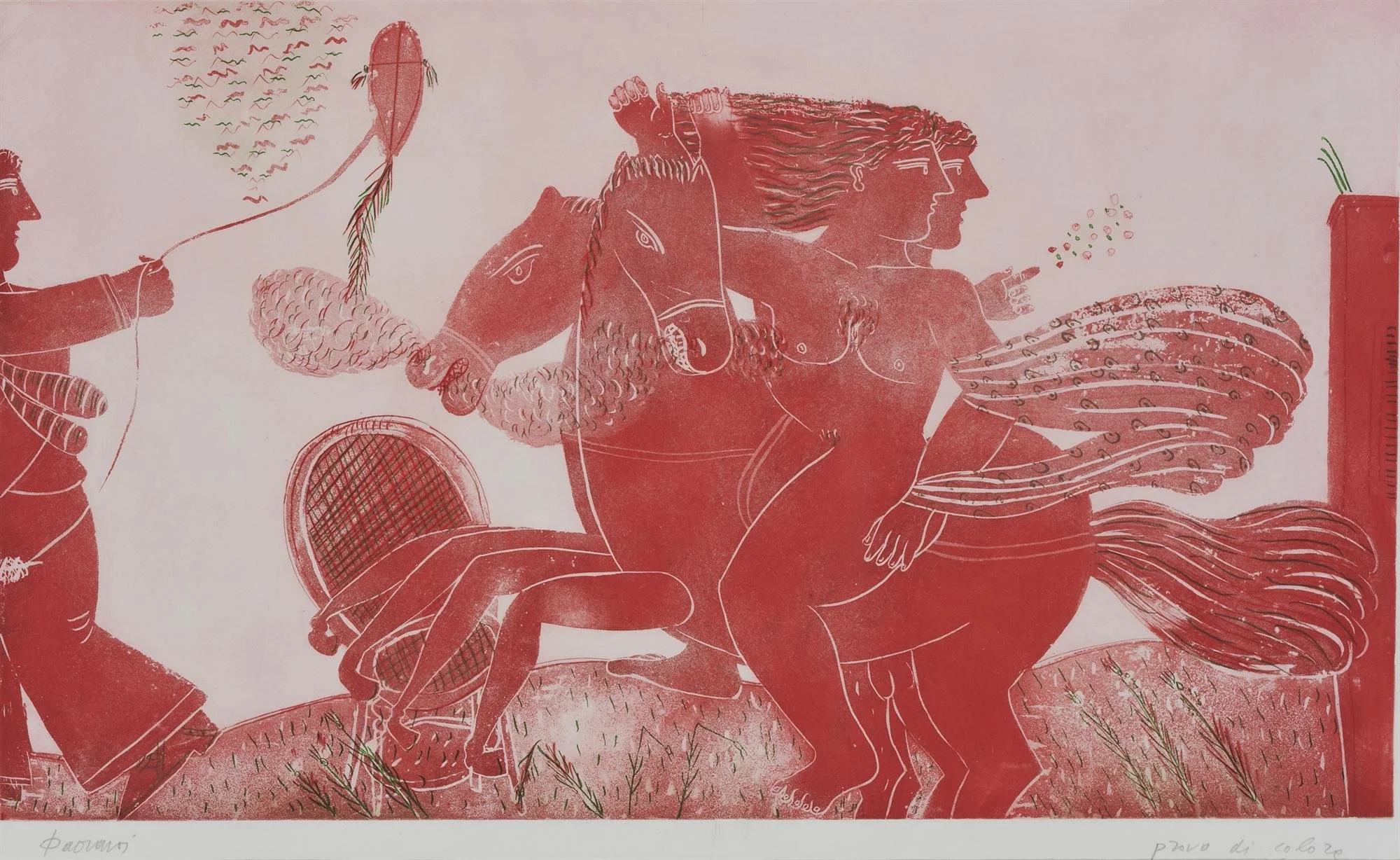
On Alekos Fassianos, the Greek painter who turned mythology into everyday life, and why his work deserves a wall in every home.
There is a painting called The Blue Cyclist, a lithograph by Alekos Fassianos. A figure in profile, flat as a silhouette on an ancient vase, riding through a sky the colour of the Aegean at four in the afternoon. The colours are ochre, deep red, and that very specific blue that has no real English name but every Greek person carries somewhere in the body. The figure is neither ancient nor modern. He is both. He is eternal, and he is absolutely, unmistakably Greek.
That is Alekos Fassianos. That has always been Alekos Fassianos.
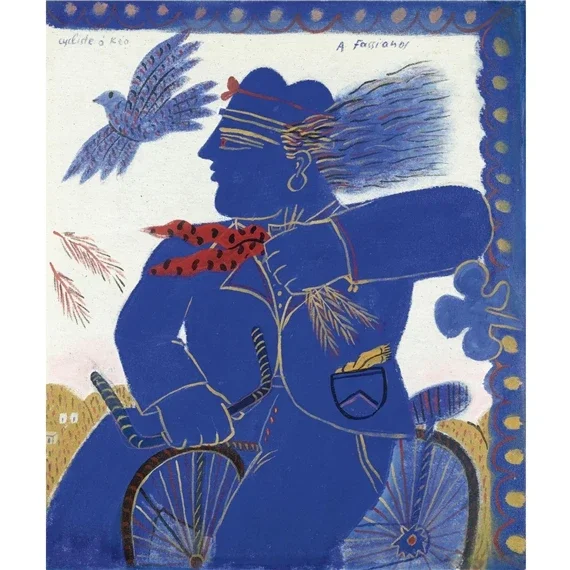
Blue Cyclist — Alekos Fassianos
Working across both Greece and abroad, Fassianos (1935 to 2022) created some of the most recognisable images of twentieth-century Greek art. Walk into a lobby, office space, or living room in Athens, and chances are there is a Fassianos poster on a wall somewhere. He achieved the rare and underrated thing: ubiquity without cheapening. Familiarity without contempt. If you are planning time in Athens, this is one artist whose work will follow you from the airport to the islands and back again.
I think about this a lot. The difference between art that becomes wallpaper and art that keeps demanding your attention even after years of proximity. Fassianos is the latter. Every time I look at his work I find something I missed. A bird I didn't notice. The quality of light on a bare shoulder. The way his figures lean into each other as though gravity itself is an expression of affection.
Who Was Alekos Fassianos?
He was born in Athens in 1935, but the Athens that formed him was another city entirely, one of low neoclassical townhouses and neighbourhoods animated by small shops and artisans. His father was a music teacher and composer. His mother, passionate about history, taught ancient Greek and took the children to archaeological sites. His grandfather encouraged him to paint. He spent twelve years studying violin at the National Conservatory, where he crossed paths with Mikis Theodorakis and Yannis Markopoulos, people who would remain important to him throughout his life.
This background matters because Fassianos is not a painter who stumbled onto Greekness as an aesthetic strategy. He was formed by it from the beginning. The ancient, the Byzantine, the folk, the musical: all of it went in early and came back out in paint. Rather than following the European avant-garde, he turned to his Greek heritage as the source of his artistic inspiration, drawing on ancient vase painting, Byzantine tradition, and Greek folk art.
In Paris in the 1960s, surrounded by every conceivable movement clamouring for his attention, he turned inward. Toward the thing he already knew. That is an act of considerable courage for a young artist. The avant-garde is seductive, especially in Paris, especially in the sixties. To refuse it, not out of ignorance but out of loyalty to something older, requires a secure sense of self that most twenty-five-year-olds simply do not possess. Fassianos possessed it.
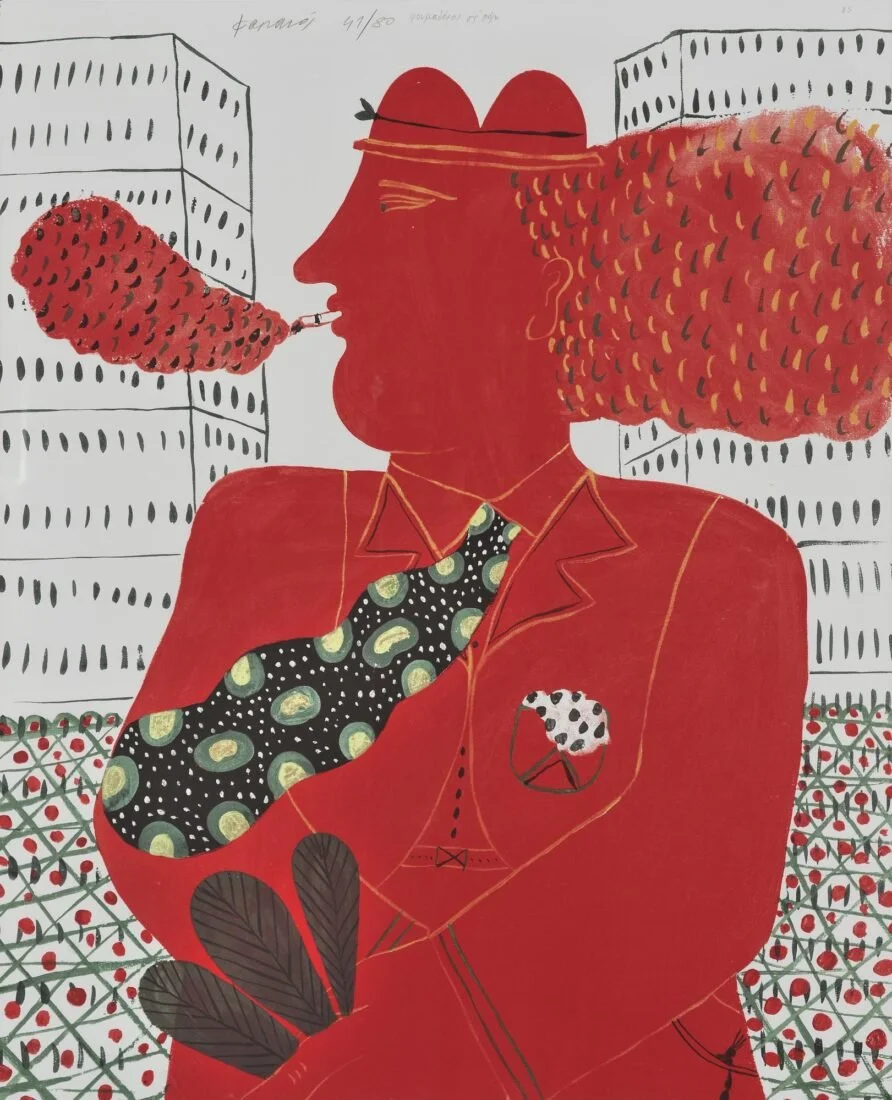
Alekos Fassianos, The Smoker (select edition). © Alekos Fassianos Estate.
What Makes Alekos Fassianos Paintings Unmistakable
His figures are flat and two-dimensional, mostly seen from the side, as if lifted off an ancient amphora and transferred into a new artistic setting. The archaic quality is deepened by his use of light-toned outlines in yellow, orange, and white, giving the impression of drawings etched into clay or terracotta.
And yet they move. This is the paradox at the centre of his work. These flat figures vibrate with kinetic energy. Hair and clothing blow as if caught in a breeze, and the figures all but jump from the walls. The bicycle riders lean into turns that don't technically exist on the canvas. The couples hold each other with a tenderness that has no business being this legible in a two-dimensional outline. The birds are always mid-flight.
His diverse visual vocabulary of people, mythical figures, animals, plants, and insects is often called the "Fassianos Universe." That phrase is accurate. It is a universe with its own physical laws, where the ancient and the quotidian exist simultaneously without irony or friction, as though it is simply obvious that a man in a suit might share a canvas with a figure from mythology. In Greece, it often feels that way. Fassianos just had the skill to render it.
The recurring figures in his Alekos Fassianos paintings, the bicyclist and the smoker appearing again and again, have always struck me as portraits of a kind of graceful, unhurried presence that feels increasingly rare. They are men at leisure in the deepest sense. Not bored. Not distracted. Present. Smoking with intention. Cycling with ceremony. Looking at them slows something down. That is not a small thing to ask of a painting, and most paintings, however beautiful, cannot do it. His do.
The Alekos Fassianos Museum Athens
The Alekos Fassianos Museum is housed in a building remodelled and designed by architect Kyriakos Krokos in close collaboration with Fassianos himself, completed in 1995 and opened to the public in April 2023. It sits in Agios Pavlos, the Athens neighbourhood where he grew up, which means the museum is also, in a way, a portrait of his childhood.
The exhibition covers his practice from 1956 to the end of his life, tracing his early years in Paris, a brief period of engagement with abstract art, his later turn toward Byzantine aesthetics and gold leaf, and the full range of his celebrated figurative work including collages and mixed media. There is also archival material: his writings, his set designs for productions by Ionesco and Sartre and Aristophanes, and the furniture he made for his own home, because Fassianos saw no meaningful distinction between fine art and functional art. He believed art should be everywhere, not confined to gallery walls or rare collections.
If you are planning time in Athens, the Fassianos Museum in Agios Pavlos belongs on the list. It is a short metro ride from the centre. Alight at Metaxourgeio, where you will also find two of his large public murals on the station walls. Pair it with a morning at the Acropolis or an afternoon in one of Athens' neighbourhood restaurants, and you have a full day that covers five thousand years of Greek visual culture in one loop. If you are still planning the wider trip, our Greece travel guides are a good place to start.
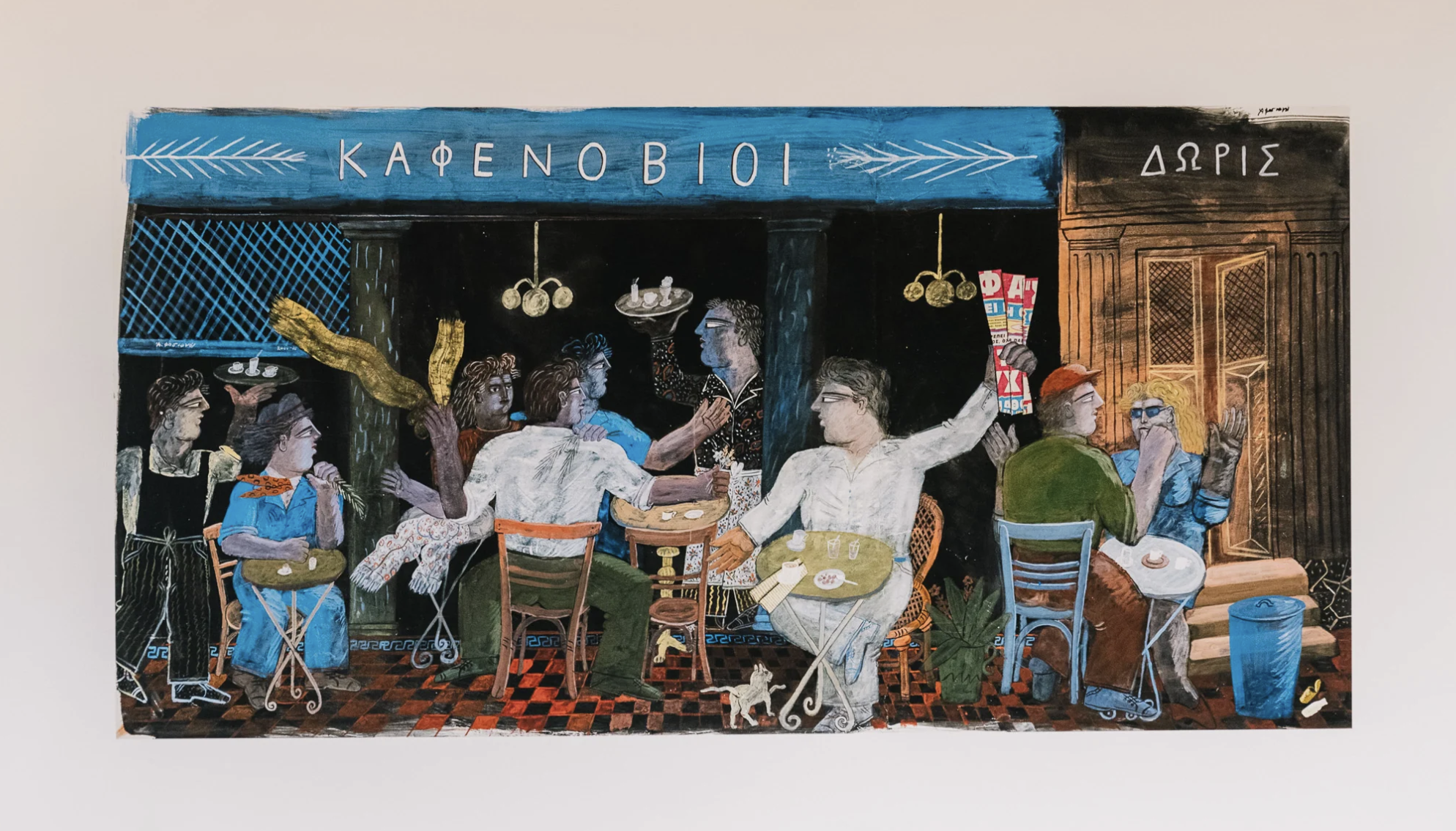
Visit the Alekos Fassianos Museum in Athens and pick up a print recreated in his style.
Why I Want It All Over My Walls
There is a specific and only slightly embarrassing fantasy I have been nursing for some time now. It involves a large Fassianos original on a white wall with natural light hitting it at the right angle. A cyclist. Or the smoker. Definitely the smoker.
For those who cannot stretch to an original (like me), the prints and Fassianos lithographs are the entry point. He worked across a remarkable range of media, producing countless lithographs, drawings, and posters alongside his canvas paintings, bronze sculptures, and large public murals. His lithographs in particular carry the full force of his visual language at a scale and price that makes them genuinely liveable with. Works are available through the official Fassianos estate and at international auction platforms via Artsy.
What Fassianos understood, better than almost any other Greek painter of his generation, is that beauty is not a luxury. It is a necessity. He said it himself: beauty lies behind what you feel, not behind what you see. His work operates on that principle in every painting, every lithograph, every figure leaning into the breeze on a canvas that somehow makes your own room feel quieter and more considered just by being in it.
That is what great art does. It changes the quality of the air around it. And the work of Alekos Fassianos has been doing that in Greek homes, in Parisian galleries, and on the walls of people who didn't even know his name, for the better part of seventy years.
Find space for it. You will not regret it.
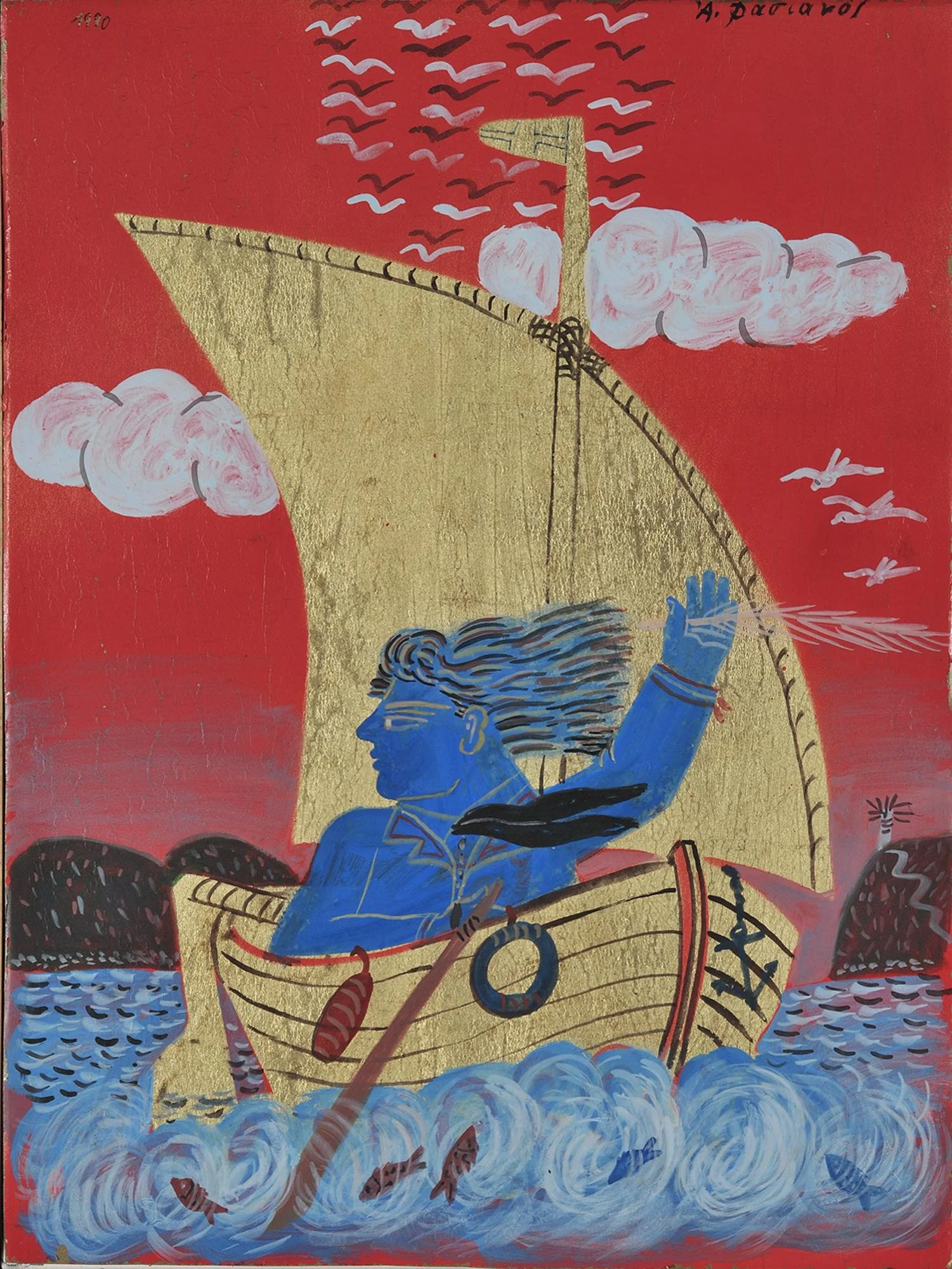
BOATMAN, 1990
Frequently Asked Questions
Who was Alekos Fassianos?
Alekos Fassianos (1935 to 2022) was one of Greece's most celebrated painters, known for his distinctive figurative style drawing on ancient Greek vase painting, Byzantine art, and Greek folk traditions. He spent much of his career between Athens and Paris and exhibited internationally across seven decades, representing Greece at the 1972 Venice Biennale and showing work in New York, Tokyo, Melbourne, and São Paulo.
What is the Alekos Fassianos Museum in Athens?
The Alekos Fassianos Museum is located in the artist's family home in the Agios Pavlos neighbourhood of Athens. It opened to the public in April 2023 and presents his work from 1956 to the end of his life, alongside archival material including his writings, set designs, and personal objects. Entry is free.
What are the most recognisable motifs in Fassianos paintings?
The bicycle rider, the smoker, couples in profile, birds in flight, and mythological figures are the recurring symbols in Alekos Fassianos paintings. His figures are typically flat, outlined in warm tones, and set against rich Mediterranean palettes of blue, ochre, terracotta, and gold.
Where can you buy Alekos Fassianos prints and lithographs?
Fassianos lithographs and prints are available through the official Fassianos estate and via major art platforms such as Artsy. Auction house platforms also carry his work regularly. Lithographs are the most accessible entry point for new collectors.
Is the Fassianos Museum worth visiting if you're not an art expert?
Absolutely. The museum is free to enter and the neighbourhood of Agios Pavlos is worth exploring in its own right. Fassianos himself believed art should be accessible to everyone, not just collectors or critics. Pair the visit with the Acropolis or a wander through Athens' neighbourhoods for a full day of Greek culture. If you are still building your itinerary, our Greece travel guides cover everything from Athens to the islands.
