
Greek Easter Holy Week. A Day-by-Day Schedule for 2026
Holy Week is not one long blur. It is ten days of very specific things, happening at very specific times, with very specific food on the table at each stage. If you have never navigated it before, or if you grew up with it but always just followed someone else, this is the guide that maps it out.
This is not a guide to the meaning behind each day. That is covered in our Greek Easter 2026 traditions guide and our Lazarus Saturday and Palm Sunday deep-dive. This is the practical one. The schedule. What is happening and when, what to cook, which services are worth attending, and how the whole week actually moves.
Holy Week 2026 at a glance
Lazarus Saturday, Saturday 4 April 2026
Palm Sunday, Sunday 5 April 2026
Holy Monday to Wednesday, 6–8 April (quiet build, evening services)
Holy Thursday, Thursday 9 April (red eggs, tsoureki, kitchen day)
Good Friday, Friday 10 April (Epitaphios procession, emotional peak)
Holy Saturday, Saturday 11 April (midnight Resurrection service)
Easter Sunday, Sunday 12 April (the feast)
Easter Monday, Monday 13 April (the slow exhale)
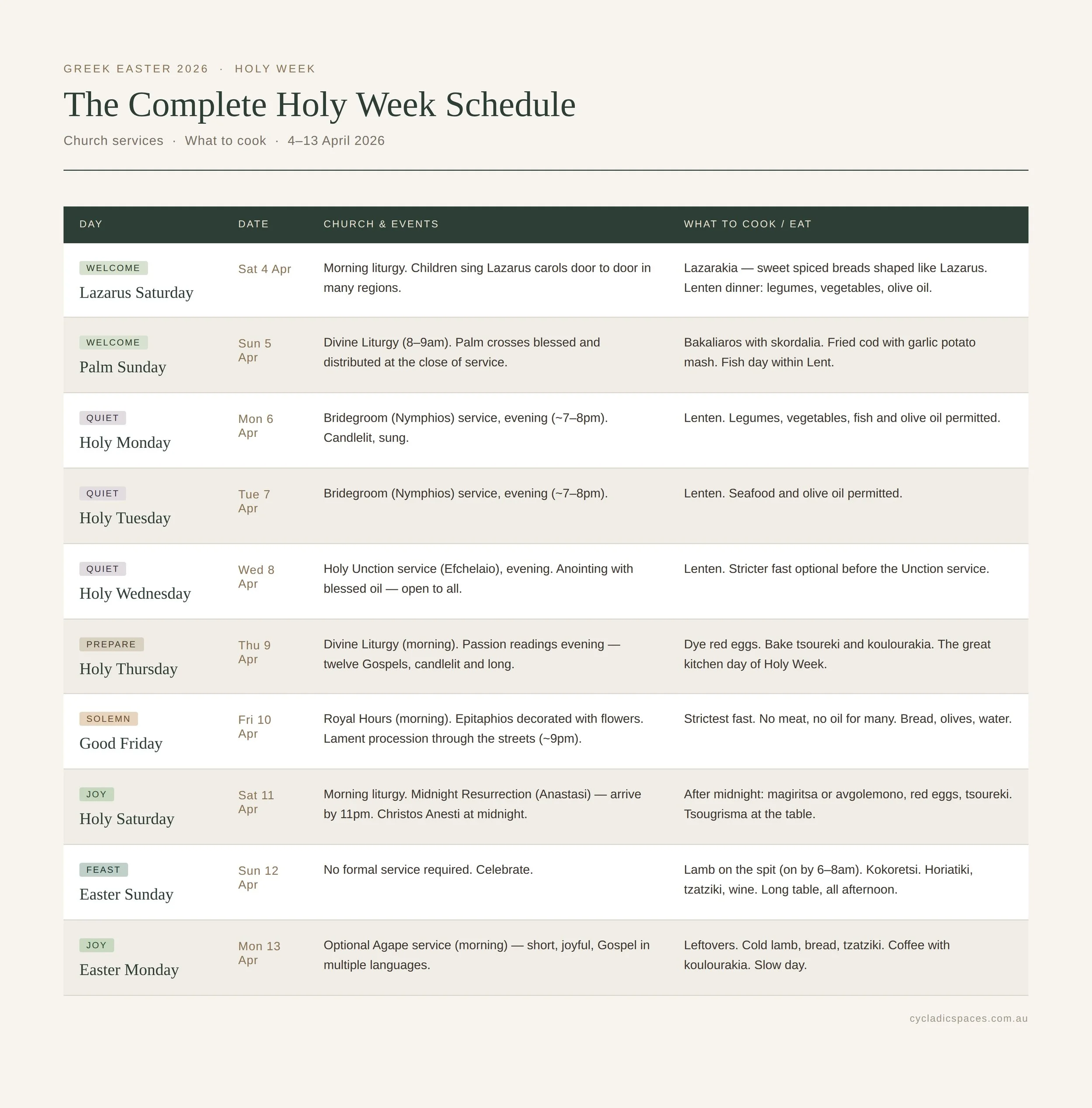
The full Holy Week schedule (services, food, and timing)
Use this as your master reference. Times are approximate. Services vary by church and region.
Day-by-day. What to do, what to cook
Lazarus Saturday. Saturday 4 April 2026
The week starts here, not on Monday. Lazarus Saturday sits just outside Holy Week proper, but it sets the tone. Joy, deliberately placed, before the grief that follows. For a full guide to the day and its traditions, see our Lazarus Saturday and Palm Sunday article.
Church service Morning liturgy, usually around 8–9am. Some churches hold a special children's service in the late morning.
What to cook
Lazarakia. sweet spiced breads shaped like Lazarus in his shroud. Lenten (no eggs or dairy), flavoured with cinnamon and cloves, sometimes filled with walnuts or raisins.
If you are not baking, buy them. Every bakery in Greece will have them on 4 April.
Dinner is still Lenten. legumes, roasted vegetables, olive oil dishes are all fair game.
Worth knowing If you are visiting regional Greece, check whether a local Lazaritses tradition is running. Girls and children carrying baskets of lazarakia and singing door to door is one of the most alive folk customs still practised.
Palm Sunday. Sunday 5 April 2026
Palm Sunday is one of the twelve Great Feasts of the Orthodox Church. It is joyful, attended broadly, and ends with a meal that is one of the better ones of the whole week.
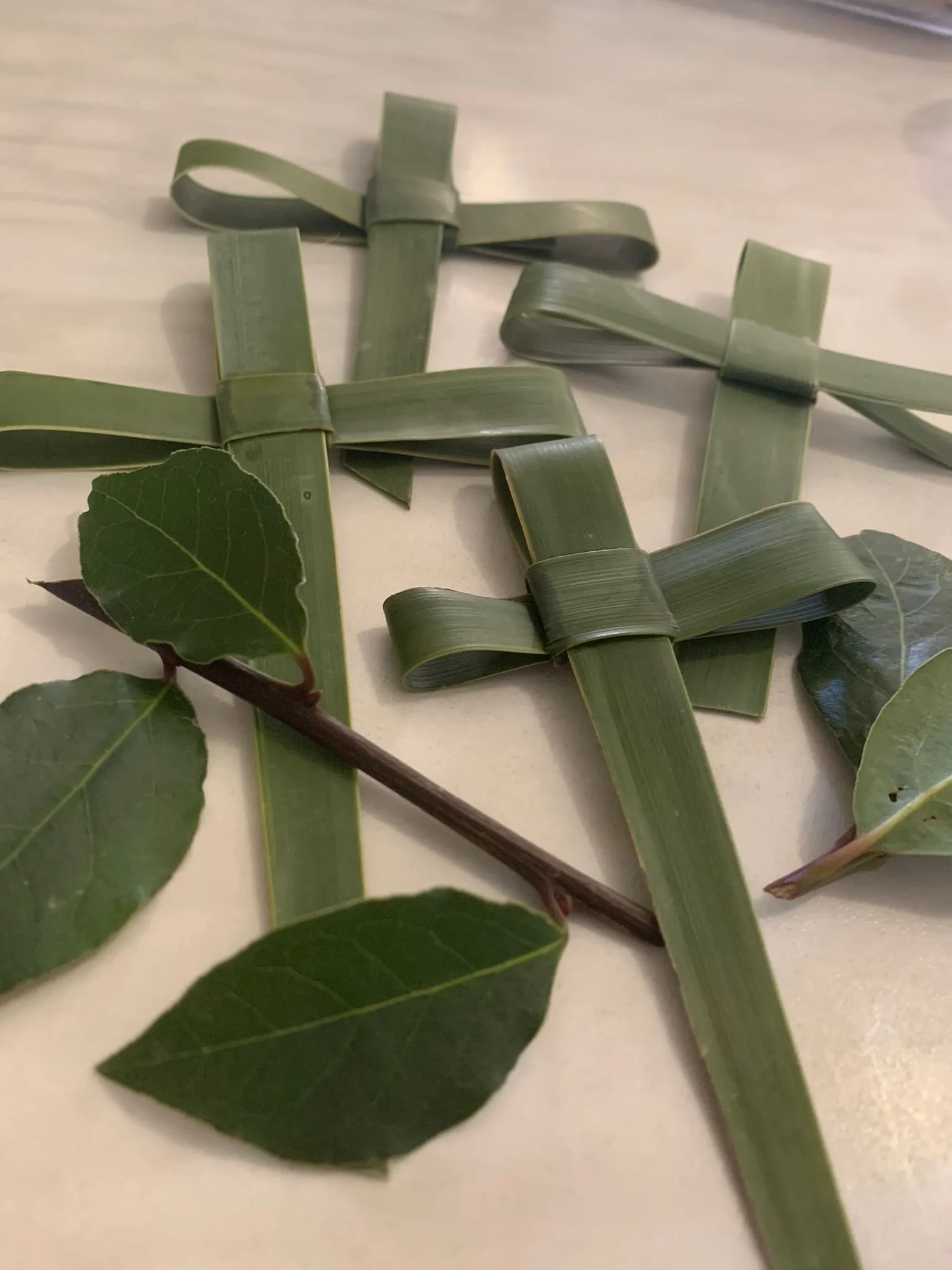
Church service Divine Liturgy, usually beginning around 8–9am. Attend the service and collect your palm cross. a small cross woven from palm leaves, blessed during the liturgy and distributed to the congregation. Take it home and put it near an icon or above the front door.
What to cook
Bakaliaros with skordalia. Fried cod. traditionally salt cod soaked for 24 hours to draw out the brine, then dipped in light beer batter and fried until golden. served with skordalia, a thick garlic and potato mash.
Palm Sunday is a feast day within Lent, which means fish, olive oil, and wine are all permitted. This is the one substantial Lenten lunch of Holy Week.
Many families also make horta (boiled wild greens with lemon) and a simple salad alongside.
If you are cooking bakaliaros from scratch buy salt cod no later than Friday 3 April, cut it into serving pieces, and soak in cold water in the fridge for 24 to 48 hours, changing the water two or three times. It will not taste right if you rush the soaking.
Holy Monday, Tuesday, Wednesday. 6 to 8 April 2026
These are the quieter days of Holy Week. Quieter does not mean empty. For many Greek families, the weekday services are the ones they remember most, because the churches are smaller and less crowded.
Church services
Holy Monday and Tuesday. The Bridegroom (Nymphios) service, held each evening around 7–8pm. This is one of the most beautiful services of the Orthodox year. long, candlelit, sung rather than spoken in many churches, and completely unlike a regular weekday service.
Holy Wednesday. The Holy Unction service (Efchelaio), usually in the evening. This is the service of anointing with blessed oil. for healing, for protection, for forgiveness. It is open to everyone and widely attended.
What to eat (Lenten rules apply all three days)
Holy Monday and Tuesday. Olive oil and fish are generally permitted. Legumes, vegetables, pulses, pasta with tomato or oil. all the Lenten staples. Revithia (chickpea soup), fasolada (bean soup), and briami (roasted vegetables) work well.
Holy Wednesday. Some people observe a stricter fast, especially before attending the Unction service. Others eat a simple Lenten dinner as normal.
What to prepare this week
Source your lamb if you are cooking for Sunday. Ask your butcher now. whole lambs are in high demand and many families pre-order.
Pick up red egg dye, beeswax candles for Saturday night, and tsoureki ingredients if you are baking on Thursday.
Holy Thursday. Thursday 9 April 2026
Holy Thursday is the kitchen day. Across Greece, the smell of vanilla, orange zest, and warm bread escapes every window. This is the day the house prepares itself.
Church service Divine Liturgy in the morning (around 8–9am), commemorating the Last Supper. In the evening, many churches hold a service with readings of the Passion. twelve Gospel readings, candlelit and long. If you attend one service this week beyond Good Friday and Saturday, make it this one.
What to cook
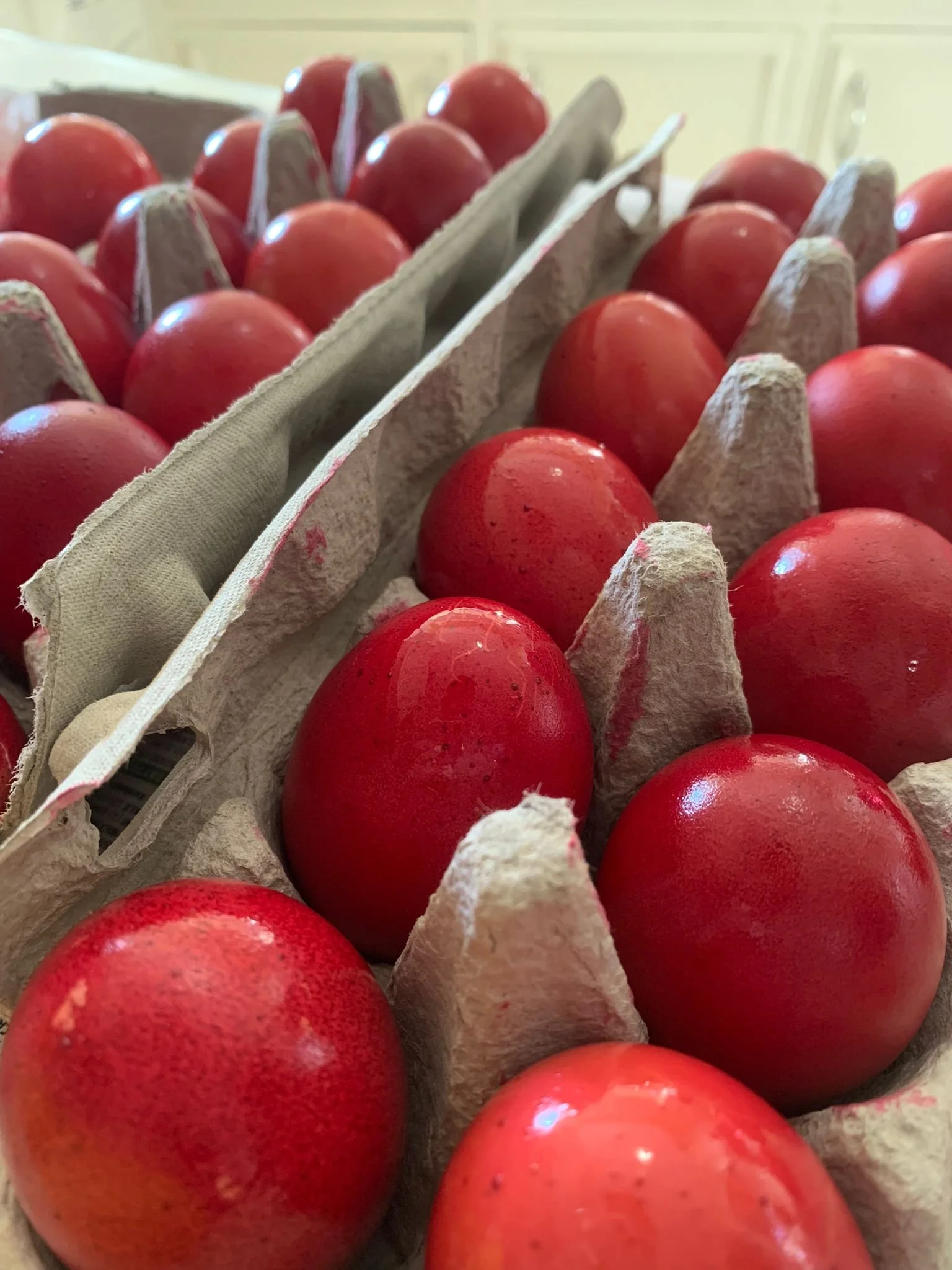
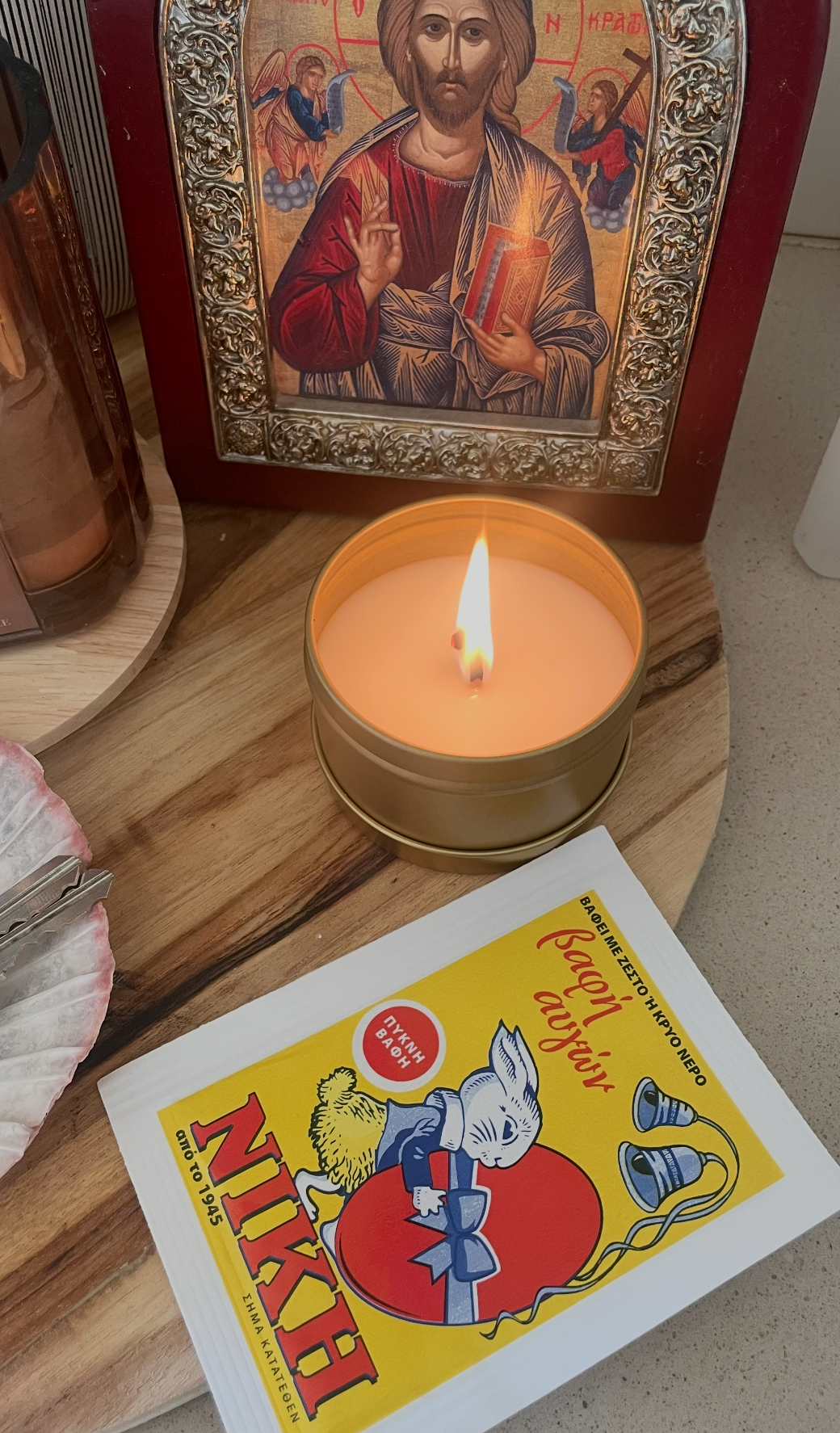
Red eggs (kokkina avga). Boil eggs to hard, dry them, then dye them red using either traditional red onion skins (simmer eggs in the skins for 30 minutes) or commercial Greek Easter dye packets (widely available in Greek grocery stores from late March). Handle the dyed eggs gently while warm. They need to dry completely before you stack them.
Tsoureki. The braided sweet bread of Easter, enriched with mahlab (the stone of sour cherry), mastic resin (optional), orange zest, and vanilla. It is not a quick recipe. Budget four to five hours including rises. Many families make multiple loaves: one to eat at midnight on Saturday, one for the Easter Sunday table, and one or two to give away.
Koulourakia. The Easter butter biscuits. shaped by hand into twists, braids, or spirals, egg-washed for a deep brown glaze. They keep for two weeks and go with everything. Bake a big batch.
Dinner on Holy Thursday is still technically Lenten for many households, though rules around oil and seafood vary by family and region.
Timing tip Start the tsoureki dough in the morning. Dye the eggs in the afternoon while the dough is rising. Bake the tsoureki and koulourakia in the evening. The house will smell extraordinary.
Good Friday. Friday 10 April 2026
Good Friday is the most solemn day of the year in Greece. Businesses close. Flags fly at half-mast. Church bells toll in a slow minor rhythm that sounds like the country itself is mourning.
Church services
Royal Hours. Friday morning, around 9–10am. Long readings, no music, quietly attended.
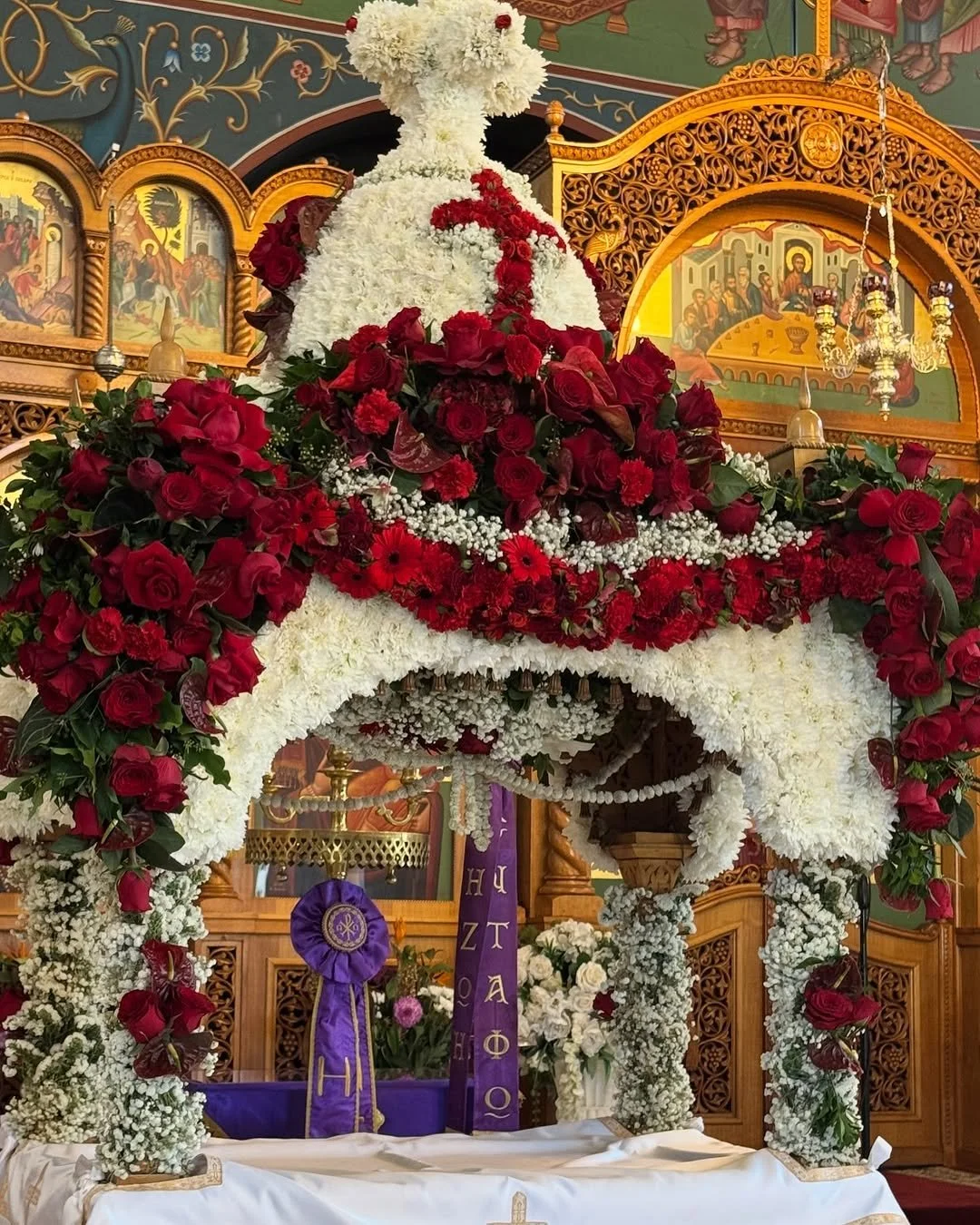
Epitaphios decoration. In the late morning or early afternoon, locals help decorate the Epitaphios (the symbolic tomb of Christ) inside the church with fresh flowers. jasmine, roses, carnations. If you are visiting Greece and want to participate, simply ask at the church. Most welcome extra hands.
The Lament (Epitaphios procession). Friday evening, usually starting around 9pm, sometimes later in larger cities. This is the procession where the decorated Epitaphios is carried through the streets on the shoulders of the faithful, followed by the entire congregation holding candles. It is one of the most moving experiences in the Greek calendar. Even if you are not religious, standing quietly at the roadside as the procession passes is entirely appropriate.
What to eat
Good Friday calls for the strictest fast of Holy Week. No meat, no dairy, no olive oil, no wine. Many people eat only bread, olives, and water, or skip lunch entirely.
In practice, many families observe a simple Lenten meal. vegetable soup, bread, olives. without the stricter abstentions.
The evening procession comes before midnight. Most people eat something light before they go.
What to prepare tonight
Set out your candles for Saturday night. Most families use the tall white tapered candles (lambades) sold outside churches in the lead-up to Easter.
If you are making magiritsa for after the midnight service, gather your ingredients. Lamb offal (liver, lungs, heart), spring onions, dill, rice, and eggs and lemon for the avgolemono. Prep can be done on Friday evening, but the soup is cooked fresh after you get home from church on Saturday.
Holy Saturday. Saturday 11 April 2026
Holy Saturday is the day that belongs to two feelings at once. The quiet that comes after Good Friday, and the anticipation that builds toward midnight. By afternoon the tension is almost physical.
Morning service The Saturday morning liturgy is one of the most beautiful and least attended services of Holy Week. which means you can usually find a seat. It includes the reading of twelve Old Testament prophecies and the first proclamation of the Resurrection, sung rather than announced, before the service concludes.
The midnight Resurrection service (Anastasi)
Arrive at the church by 11pm. Athens churches fill extremely early. Village churches are more forgiving.
Collect a candle at the entrance. The church will be lit only dimly. The priest will emerge from behind the altar with a single flame.
At midnight. The flame spreads through the crowd, person to person, as the priest calls out Christos Anesti (Christ is risen) and the congregation responds Alithos Anesti (Truly, He is risen). The hymn of the Resurrection is sung. Fireworks go off, usually simultaneously, across the country.
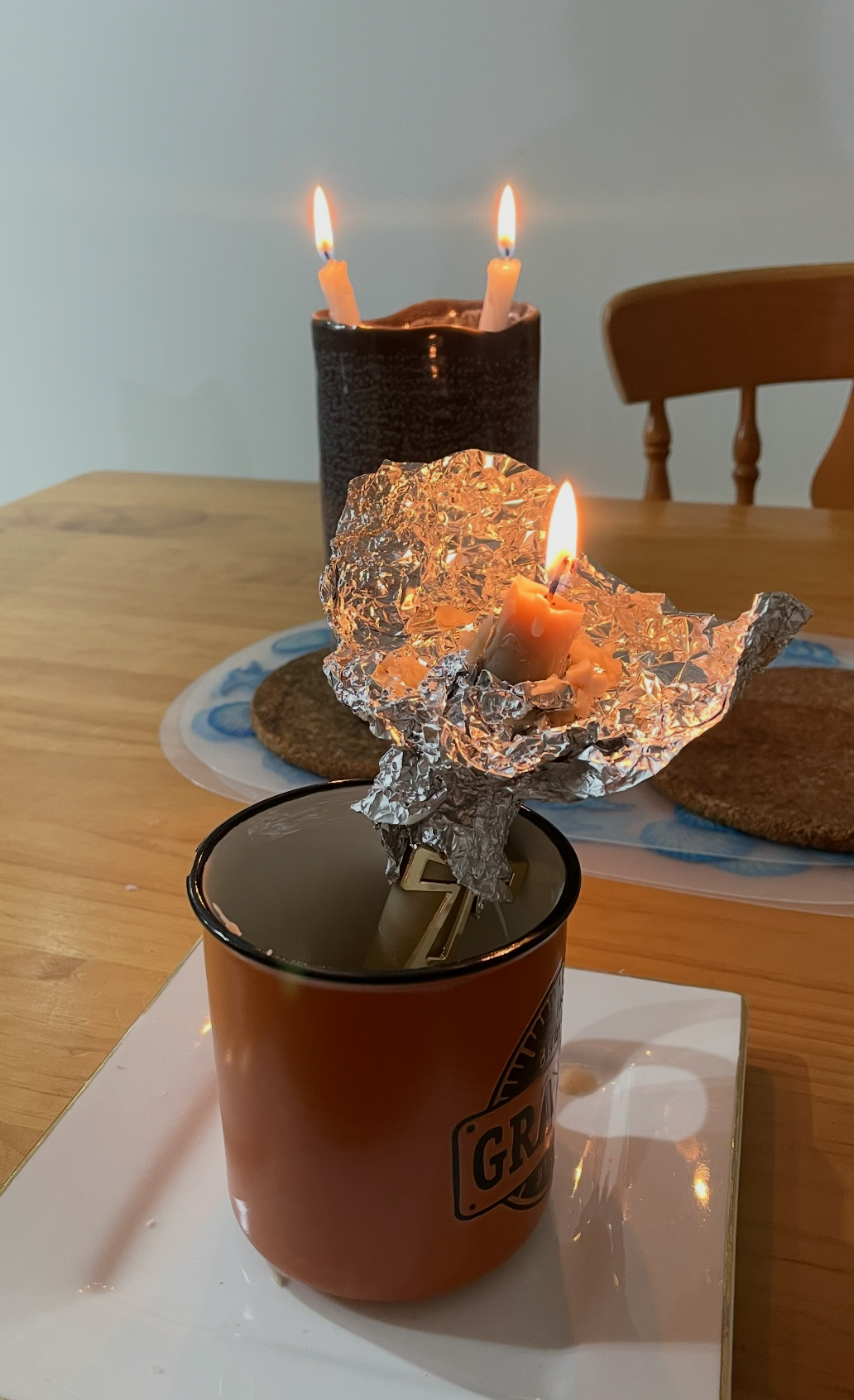
Protect your flame on the way home. The tradition is to keep the candle lit from the church all the way to your front door, then smoke a small cross on the door frame with the flame before you blow it out. Wax is part of the process.
What to cook after midnight
Magiritsa. The Easter lamb soup made from offal (liver, intestines, lungs), spring onions, fresh dill, rice, and finished with avgolemono (egg and lemon sauce). It is the dish that breaks the fast of Holy Week. It is earthy, warming, and tastes like nothing else in the Greek kitchen. Serve with red eggs and tsoureki. The red egg cracking (tsougrisma) happens here, at the table, after midnight.
If offal is not part of your Easter tradition, avgolemono soup made with lamb stock and rice is the gentler alternative. still the right dish, still the right moment.
Easter Sunday. Sunday 12 April 2026
Sunday is the feast. Everything Holy Week has been building toward. the grief, the anticipation, the midnight explosion. lands here on a long table in someone's backyard.
The main event
Lamb on the spit (souvla). The lamb is usually put on the spit early. between 6 and 8am. and slow-cooked for four to five hours over charcoal. Someone has to wake up for this. Usually the same person every year.
Kokoretsi (offal wrapped in intestines and roasted on a separate spit) is the traditional companion to the lamb, cooked at the same time. It is an acquired taste that Greeks take entirely seriously.
The rest of the table. Horiatiki (Greek salad), roasted potatoes, tzatziki, bread, wine. More red eggs. More tsoureki. Koulourakia passed around with coffee.
Tsougrisma, the red egg competition
Two people tap red eggs, pointed end to pointed end. One egg cracks. The survivor keeps going. The person with the last uncracked egg wins. What they win is largely bragging rights, though in some families the stakes are more elaborate.
Children will attempt to cheat. Refrigerator-hardened eggs, wax-coated shells, egg-swapping mid-game. This is tradition.
What time to eat The feast usually begins around noon, after the lamb comes off the spit, and continues for most of the afternoon. If you are a guest rather than a host, bring wine, bring sweets, and expect to stay for hours.
Easter Monday. Monday 13 April 2026
Monday is the exhale. Greece is still on holiday, but the noise has dropped.
Optional service The Agape (Love) service is held on Easter Monday morning in many churches. short, joyful, with the Gospel read in multiple languages simultaneously. If you missed the midnight service or want one more moment of the Easter feeling, this is a gentle way to close the week.
What to eat
Leftovers, done properly. Cold lamb from the bone, bread, tzatziki, a tomato. This is not a consolation meal. It is one of the better eating experiences of the week.
Coffee with koulourakia. Long lunches. No one is in a hurry.
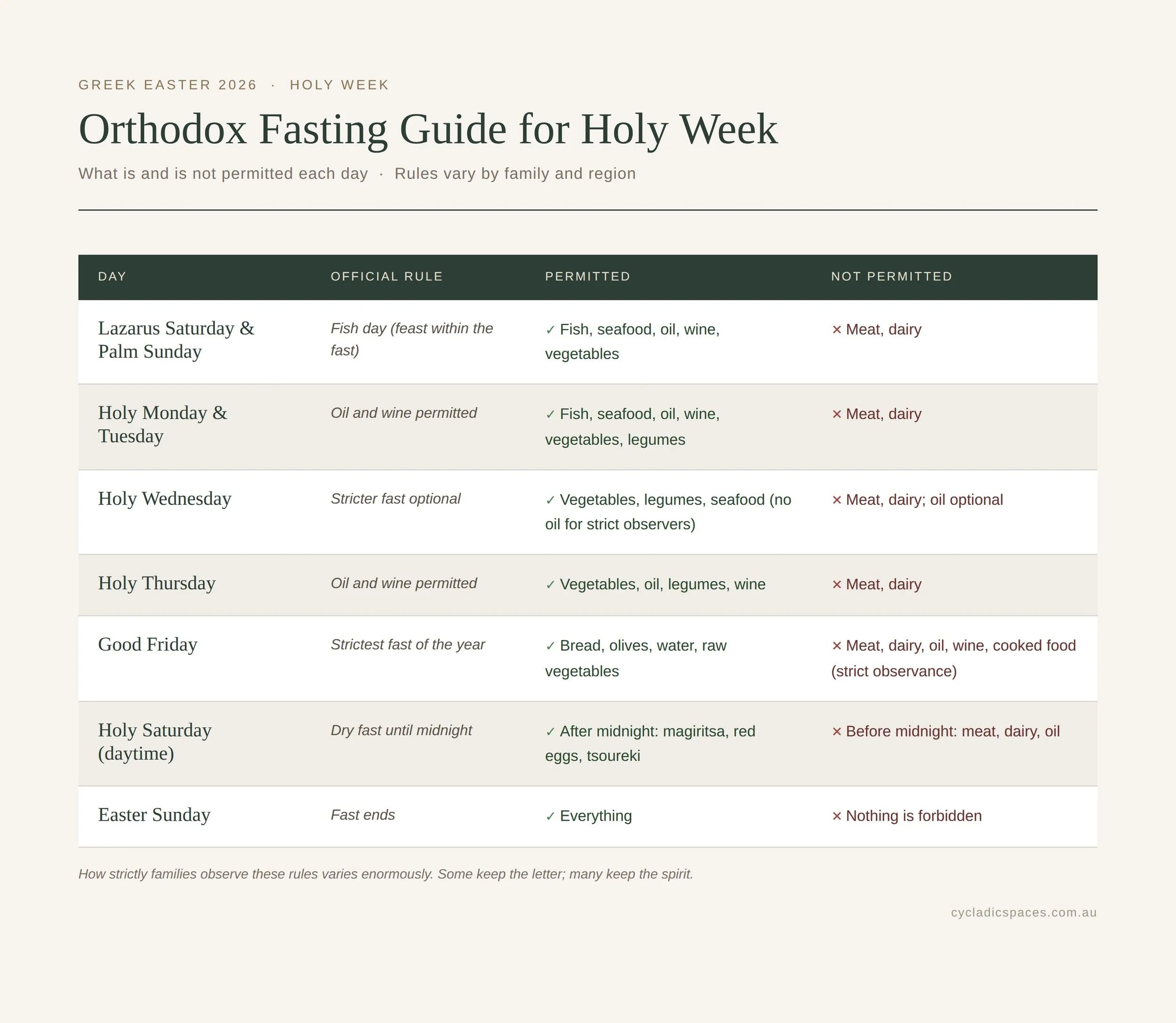
Greek Orthodox fasting guide for Holy Week
The Orthodox fasting rules during Holy Week are strict by design. each day calibrated to match the intensity of what is being commemorated. In practice, how strictly families observe these rules varies enormously. Some keep the letter; many keep the spirit.
Holy Week shopping and prep timeline
If you are cooking through the full week, here is when to buy and prepare what.
Two weeks before (by 27 March)
Order your whole lamb from the butcher if cooking for a large Easter Sunday group.
Source mahlab seeds and mastic resin for tsoureki if making from scratch (available at Greek specialty grocers and Middle Eastern food stores).
One week before (by 4 April)
Buy red egg dye packets (readily available at Greek grocery stores, or use red onion skins for a natural version).
Stock up on Easter candles for the midnight service.
Buy beeswax or tall white tapered lambades for Saturday night.
Holy Thursday (9 April). your kitchen day
Buy salt cod no later than 4 April if making bakaliaros for Palm Sunday (requires 24–48 hours soaking).
Gather tsoureki ingredients. Strong bread flour, mahlab, mastic (optional), orange zest, vanilla, eggs, butter, milk, yeast.
Gather koulourakia ingredients. Butter, sugar, eggs, vanilla, flour, sesame seeds for topping.
Have red eggs ready to display and crack.
Holy Saturday morning (11 April)
Gather magiritsa ingredients. Lamb offal (or substitute lamb stock), spring onions, dill, rice, eggs, lemons.
Prepare tsoureki for the midnight table. ideally baked Thursday, rested and ready.
Confirm your lamb is collected and marinated if applicable.
Which church services to attend (if you are choosing)
If you are new to Greek Orthodox Easter and want a sense of the week without attending every service, here is a practical guide to which services carry the most weight and atmosphere.
If you attend one service. The midnight Resurrection on Holy Saturday. Non-negotiable. This is the moment the whole week builds toward.
If you attend two. Add the Epitaphios procession on Good Friday evening. Deeply moving, experienced outdoors, accessible to everyone.
If you attend three. Add the Holy Thursday evening service with the Passion readings. Candlelit, long, sung. One of the most beautiful liturgical experiences of the Orthodox year.
If you attend four or more. The Bridegroom (Nymphios) services on Holy Monday and Tuesday evenings are extraordinary and less crowded than the big events. The morning liturgy on Holy Saturday is rarely attended and deeply rewarding.
If you are in Athens. Monastiraki Square, Mitropolis (Athens Cathedral), and the Church of Kapnikarea are all good options. For the midnight Resurrection, arrive very early. central Athens churches fill by 10pm.
If you are on an island. Hydra (no cars, candle-lit cobblestones) and Patmos (where the Book of Revelation was written) are particularly atmospheric. Smaller island churches will be more intimate and often more moving.
What to wear to Greek Orthodox Easter services
Good Friday and Holy Saturday midnight. Dark or muted colours are traditional. You do not need to dress in black, but something understated is appropriate for Good Friday. Saturday midnight. slightly dressier than weekday church is the norm, though standards have relaxed.
Palm Sunday and Easter Sunday. Lighter colours are fine. Smart-casual is the standard at most churches.
Women covering their heads is not required in Orthodox churches, though many older women do so as a sign of respect.
Shoulders and knees covered for entry to church is the general expectation, especially in smaller or more conservative communities.
Frequently Asked Questions
What is the most important day of Greek Orthodox Holy Week?
Holy Saturday midnight. the Anastasi (Resurrection service). is considered the peak of the Orthodox Church year. The midnight moment when Christos Anesti is announced carries the greatest weight emotionally and liturgically. Good Friday is the most solemn. Easter Sunday is the most festive.
What do you eat at midnight after the Anastasi?
Magiritsa. An Easter soup made from lamb offal, spring onions, dill, and rice, finished with avgolemono (egg and lemon sauce). It is the traditional dish that breaks the Lenten fast. Some families substitute a plain avgolemono with lamb stock if they prefer not to use offal. Red eggs and tsoureki are served at the same table.
Do you have to go to church for Greek Easter?
No, though many non-religious Greeks still attend the midnight Resurrection service because it is cultural as much as religious. The candlelight, the fireworks, the chorus of Christos Anesti, and the act of carrying the flame home are experiences that transcend regular church attendance.
What is tsoureki and when is it made?
Tsoureki is the braided sweet bread of Greek Easter, enriched with mahlab, mastic, orange zest, and vanilla. It is baked on Holy Thursday, displayed at the midnight table, and eaten through Easter Sunday and Monday. Bakeries sell it from the week before Easter.
What is the red egg tradition in Greek Easter?
Eggs are dyed red on Holy Thursday. the colour symbolises the blood of Christ and the red eggs represent new life. They are cracked against each other in a game called tsougrisma. Two people tap eggs pointed end to pointed end, the cracked egg loses, the survivor plays on. It is competitive and taken seriously by children across the country.
Can tourists attend the midnight Resurrection service?
Yes. Greek Orthodox churches are open to everyone for the Anastasi. No prior permission or formal dress code is required beyond the general expectation of modest, respectful clothing. Arrive by 11pm in popular locations, earlier in central Athens churches. Candles are available to purchase outside the church or just inside the entrance.
What is the Epitaphios procession on Good Friday?
The Epitaphios is a decorated bier representing the tomb of Christ, covered in flowers and carried through the streets of every town and village in Greece on Good Friday evening. The entire congregation follows on foot, holding candles. It is the most public and visible ritual of Holy Week. solemn, slow, and deeply atmospheric. Visitors are welcome to watch or walk along.
Is there a specific time for Easter lamb to be cooked?
Easter Sunday lamb is traditionally put on the spit early in the morning. between 6 and 8am. and slow-roasted over charcoal for four to five hours. The meal typically begins around midday when the lamb comes off the spit. In apartments or households without a spit, lamb is roasted in the oven with lemon, olive oil, garlic, and oregano instead.
The week as a whole
Holy Week in Greece is not something you watch from the outside. It is something the country does collectively, at the same time, with the same food on the table and the same candle in the hand. Even if you are only there for part of it, the cumulative effect lands.
The full guide to Greek Easter 2026 dates, meaning, and what to expect is in our Greek Easter 2026 traditions guide. The deep-dive into Lazarus Saturday and Palm Sunday is in its own piece. This is the practical one. The schedule that helps you know what is coming and how to cook for it.
