
Your Yiayia's Passport

How Greek and Cypriot citizenship by descent works, and how to start
Guest post by Nikolas Kraljevic, founder of CitizenGR and CitizenCY
Most people across the Greek diaspora fall into one of two camps. There are the ones who know, beyond any doubt, that they could probably get a Greek passport if they really wanted to, except the paperwork sits in a drawer with the good tablecloths and never quite makes it out. And there are the ones who have no idea they might already be Greek citizens by law. Both groups are usually right about more than they think.
I wanted to set down what is genuinely possible, because the bureaucracy around all of this can feel as though it was designed to make you give up at every step. None of what follows is legal advice. It is the plain English version of something that should have been plain English from the start.
Greek and Cypriot citizenship by descent both work on the same underlying principle: if you can document an unbroken line back to a Greek or Cypriot ancestor, you are not asking to become a citizen. You are asking the state to recognise something that was already true. The rest of this piece is about how that recognition works, where it tends to stall, and what to do first.
A bit of background, so this doesn't read like an advert
My name is Nikolas Kraljevic. I am based in Sydney with Croatian heritage on my dad's side, and a few years ago I started trying to claim Croatian citizenship for myself and my family. I had spent about a decade in cyber and tech before that, so I assumed the documents would be the easy part and the language would be the hard bit. It was the other way around.
The Croatian process took longer than I expected and ate more weekends than I would like to admit. Once I came out the other side with a passport in hand, friends started asking me to help them. Most of them were not Croatian. Greek, Cypriot, Italian, Polish, Irish, the whole spread. And the stories I kept hearing all rhymed.
A grandmother whose name was spelled three different ways across three different documents, which meant a stack of affidavits to prove she was the same person. An applicant who waited 18 months for a consulate response and was then told the wrong version of a form had been used. A village priest pulling a handwritten baptism record out of a leather-bound book and rescuing a case that had stalled for years. A chain of names that broke at the great-grandfather, because he had quietly renounced citizenship somewhere along the way and nobody had thought to check. The patterns were almost identical from country to country.
So I started building software to fix the parts I had found most painful: working out whether you were eligible at all, knowing which documents to chase, and keeping track of them once you had them. Croatia was the first version. Greek and Cypriot equivalents, CitizenGR and CitizenCY, came next, because the diaspora is large and the questions kept coming. More on that further down. Here is what you need to know.
Greek citizenship by descent
Greece grants citizenship through jus sanguinis, the legal term for "by blood." If a parent, grandparent, or further-back ancestor was a Greek citizen at the time you were born, there is a very real chance you are already Greek and simply have not claimed it yet.
That last part matters. You do not apply to become Greek the way you would naturalise in another country. You apply to be recognised as Greek, which is a different thing legally and, for many people, emotionally. The state is not granting you a favour. It is acknowledging something that was true the day you were born.
The descent paths usually look like this.
Through a Greek parent. If one of your parents was born in Greece or was a Greek citizen when you were born, you are almost certainly Greek already. The application is mostly about producing the documents that prove the chain. This is the fastest path when it applies.
Through a Greek grandparent. This is the most common path I see for second and third generation diaspora. Your grandparent needs to have been a Greek citizen, and you need to evidence the lineage with birth, marriage, and death certificates that connect each generation. The catch is that most of those records sit in Greek municipal registries, often in the village your family came from. The older ones can be patchy, water damaged, or missing a page.
Further back than grandparents. It is possible, but it gets harder. You need an unbroken chain of Greek citizens between you and the ancestor, and gaps in the documentation can stop an application cold. Not impossible. Just slower and more expensive.
There are quieter paths too. If you are an ethnic Greek living abroad, a homogenis, special provisions sometimes apply. There is citizenship by marriage if you are married to a Greek citizen and have lived in Greece for the qualifying period. And there is standard naturalisation if you settle there long term, though that is a seven-year road for most people and is not really what we are talking about here.
If your situation is mainly a Greek one, read how to get Greek citizenship by descent from Australia. It goes deeper on the law, the costs, and the conscription question than I can here.
Cypriot citizenship, similar shape, different rules
Cyprus also operates under jus sanguinis, but independence from Britain in 1960 creates a wrinkle that catches many applicants off guard.
If your Cypriot ancestor was born after 1960, the path is fairly straightforward provided you have the documents. If they were born before 1960, things get more complex, particularly around who automatically became a Cypriot citizen at independence and who needed to register. This is where a lot of applications stall, because people assume their grandparent's birth certificate from Limassol or Famagusta is enough on its own, and it usually is not.
The Cypriot Civil Registry process is its own beast. Records can come not only from municipal registries but in some cases from the Church of Cyprus, which keeps baptismal records that fill gaps the civil records do not. The Cypriot High Commissions and consulates across the diaspora, in London, New York, Toronto, Sydney, Melbourne and elsewhere, see these applications every day, but you still want to walk in already knowing roughly which path applies to you.
Worth flagging: a Cypriot passport is a full EU passport, with the right to live, work and study anywhere in the European Union. Cyprus also remains a competitive business jurisdiction, with a corporate tax rate of 15 per cent for companies that are tax-resident there, raised from 12.5 per cent in January 2026 to meet the OECD global minimum. That figure attaches to where a company is tax-resident, not to your passport, so take proper advice before building plans around it. But for a freelancer or remote worker weighing where a second citizenship could lead, the EU access alone matters more than it first sounds.
What to expect from the consulate
Greek consulates around the world, in Sydney, Melbourne, New York, Chicago, San Francisco, Boston, Toronto, Montreal, London and beyond, handle most diaspora applications, and they are, to put it kindly, under-resourced. Wait times for appointments can stretch further than people expect. I have heard of delays of 12 to 24 months from initial enquiry to certificate of registration, especially for anything routed through the Special Registry Office in Athens. Cyprus tends to move a little faster, but only a little.
The single biggest mistake I see is people booking an appointment before they have their documents in order. You walk in, get told one record is missing or one apostille has the wrong stamp, and you go to the back of a very long queue. Get your paperwork properly sorted first. Then book.
Where to start
If you take nothing else from this piece, take these three things.
First, talk to your oldest relatives now. Write down names, villages, approximate dates, and any documents they might still have tucked in a drawer or a shoebox. This costs nothing and it gets harder every year. The records in the villages are not getting younger, and neither are the people who remember which village.
Second, find out which municipality your ancestor was registered in. Greek and Cypriot records are local. A consulate cannot help you if you do not know whether your papou was registered in Kalavryta or Kalymnos. This is also the question that, once answered, unlocks almost everything else.
Third, do not pay a lawyer to tell you whether you are eligible. That part you can usually work out yourself, or with a free tool. Pay a lawyer for the parts that genuinely need legal expertise, which is mostly the lodgement and any complications around gaps in the chain. A good lawyer will thank you for arriving prepared.
One more thing worth knowing before you start: citizenship is rarely the end of the story. Many families who reclaim a passport then find themselves thinking about property, and the rules there have their own traps. If that is on your horizon, Cycladic Spaces has a separate guide to inheriting property in Greece from Australia that is worth reading before any money or paperwork changes hands.
A small note on what we built
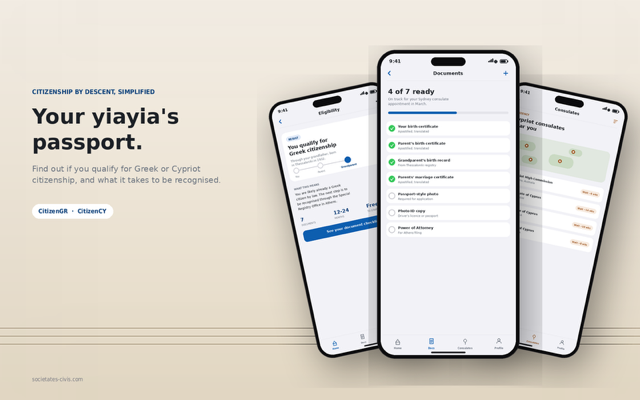
That third point is part of why CitizenGR and CitizenCY exist. They walk you through eligibility for free, give you a document checklist tailored to your situation, point you at the right consulate or registry, and let you keep track of where each piece sits. They do not replace a lawyer for the lodgement and are not trying to. They simply stop you paying $300 an hour for something a flowchart could have told you.
If you have been thinking about any of this for a while, the honest advice is to start. Even if all you do this month is write down what your grandparents told you about the village, you are further along than 90 per cent of the people in your position. Whatever you decide to do with the citizenship once you have it, and plenty of people sit on it for years before they use it, the option is worth having. It outlives you, and it passes to your children.
Καλή τύχη.
Frequently Asked Questions
Can I be a Greek citizen without knowing it?
Yes. Greece recognises citizenship by descent, so if a parent or grandparent was a Greek citizen when you were born, you may already be Greek under the law and simply need to be registered. You are not applying to become a citizen, you are asking the state to recognise an existing status.
How far back can Greek citizenship by descent go?
There is no fixed generational limit, as long as you can document an unbroken chain of Greek citizens between you and the ancestor. In practice, claims through a parent or grandparent are the most straightforward. Anything further back is possible but slower, because the documentation gets harder to find.
What is the difference between Greek and Cypriot citizenship by descent?
Both work on jus sanguinis, citizenship by blood. The main difference is Cyprus's 1960 independence from Britain, which changes the rules depending on whether your ancestor was born before or after that year. Cypriot records may also come from the Church of Cyprus, not only civil registries.
How long does a citizenship by descent application take?
Timelines vary widely. Greek applications routed through consulates and the Special Registry Office in Athens can take 12 to 24 months from enquiry to certificate of registration. Cypriot applications tend to move slightly faster. Having every document correct before you book an appointment is the single biggest thing within your control.
Do I need a lawyer to claim citizenship by descent?
Not to check eligibility, which you can usually work out yourself or with a free tool. A lawyer is most useful for the lodgement itself and for resolving gaps or inconsistencies in the documentation chain. Arriving prepared keeps legal costs down.
Nikolas Kraljevic is the founder of CitizenGR and CitizenCY, eligibility and document-tracking tools for Greek and Cypriot citizenship by descent. This is a guest post. Cycladic Spaces publishes diaspora voices we think our readers will find useful, and does not receive payment for editorial coverage. Always confirm your situation with the relevant consulate or a qualified lawyer. For more on citizenship, property and tax for Greeks abroad, see our Greeks Abroad guides.
