
How to Get Greek Citizenship by Descent from Australia

Getting Greek citizenship by descent from Australia took me 18 years. Not because the law is complicated. On paper, it’s one of the most generous descent-based citizenship pathways in Europe. It took ten years because nobody tells you what the process actually looks like. Not the consulate. Not the municipality. Not the well-meaning relative who assures you it’ll be fine, ela, just send the papers.
My father is from Meganisi, a small island in the Ionians with fewer than a thousand permanent residents. His citizenship was never in question. Mine, technically, wasn’t either. I was born to a Greek father, which under Greek law means I’ve been a citizen since birth. The problem is that being a citizen and proving you’re a citizen are two entirely different things in Greece. And the gap between those two realities is where most Greek-Australians get stuck.
This guide is the one I wish I’d had. It covers the legal framework, the documents, the dates that matter, the traps nobody warns you about, and a few honest notes on what it’s like to navigate Greek bureaucracy from 15,000 kilometres away.
Who Qualifies for Greek Citizenship by Descent
Greek citizenship operates on the principle of jus sanguinis, or right of blood. It doesn’t matter where you were born. It doesn’t matter whether you speak Greek. What matters is whether your parent (or grandparent, or in some cases great-grandparent) was a Greek citizen at the time of your birth, and whether you can prove the chain of connection through official records.
The governing legislation is Law 3284/2004, the Greek Citizenship Code, which consolidated decades of piecemeal nationality law into a single framework. Under this code, a child born to a Greek citizen acquires Greek citizenship automatically at birth. That right transmits indefinitely from generation to generation. There is no generational cutoff, which makes Greece unusually generous compared to countries like Italy or Ireland that impose limits.
The Greek Ministry of Foreign Affairs puts it plainly: Greek consular authorities do not “grant” citizenship. They assist you to exercise a right that already exists. Your registration in a Greek municipality is the legal proof of that right.
But there are complications. The biggest one has a specific date attached to it.
The 1984 Maternal Line Rule
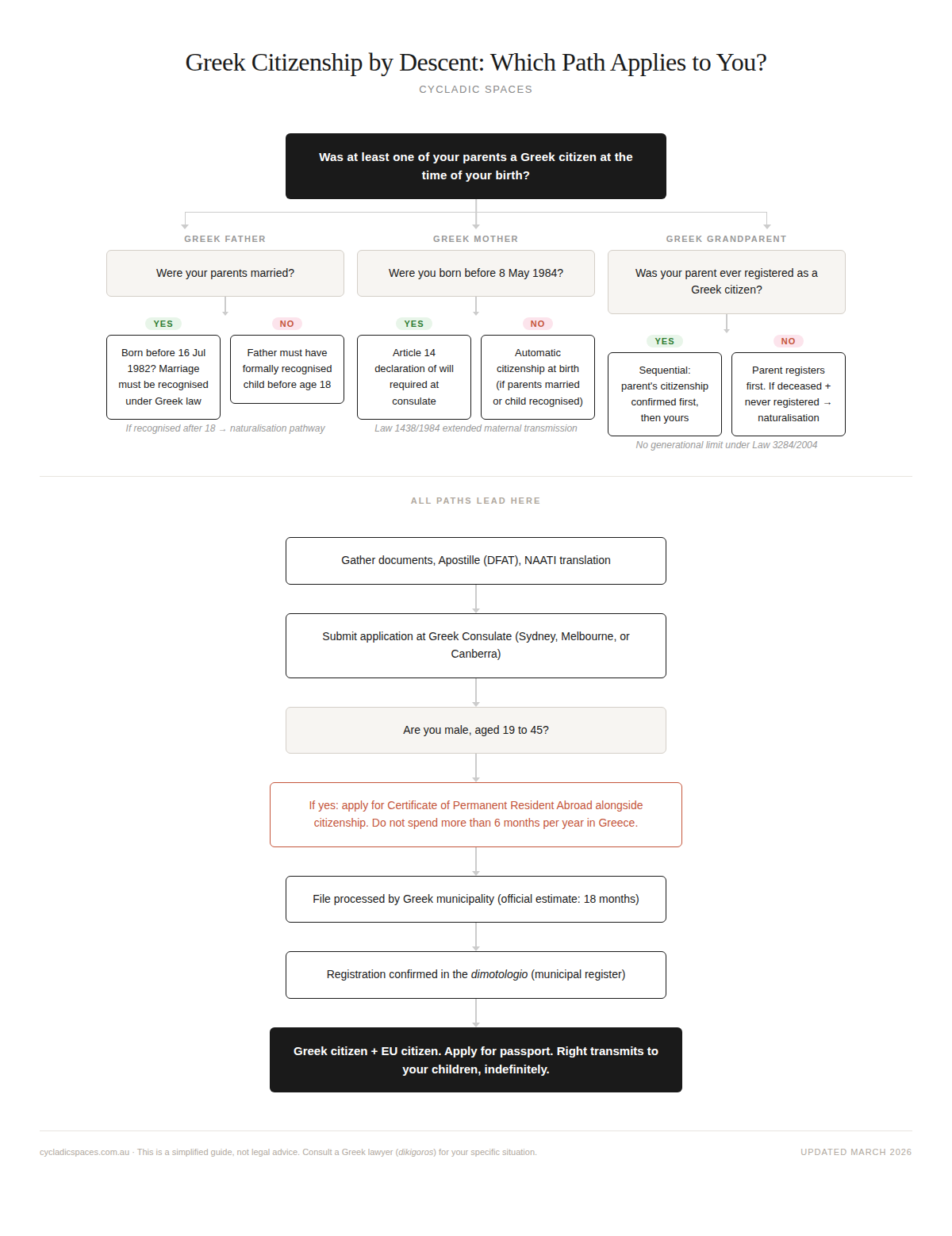
Before 8 May 1984, Greek citizenship could only pass through the father. If your mother was Greek and your father was not, and you were born before that date, you did not automatically acquire citizenship. Law 1438/1984 changed this going forward, and a separate provision (Article 14 of the current Citizenship Code) allows those born before 1984 to a Greek mother to acquire citizenship by making a formal declaration of will at the consulate or a Greek regional authority.
This is one of the most common complications for Greek-Australians. Thousands of families in Melbourne and Sydney have a Greek mother and a non-Greek father, and the children born before 1984 were never registered. If this is your situation, your mother (or you, if she has passed) may need to initiate a separate registration process before your own application can proceed.
There’s a second date to know: 16 July 1982. Before that date, children born to a Greek father and a non-Greek mother needed to be born in wedlock, and the marriage needed to be recognised under Greek law at the time. Civil marriages and non-Orthodox church marriages before 1982 can create additional documentation hurdles. The Greek Embassy in London’s citizenship categories provide the clearest publicly available breakdown of these date-specific rules.
Children Born Out of Wedlock
This comes up a lot. Unlike the 1984 maternal line rule or the 1982 paternal marriage requirement (both of which only affect people born before those dates), the out-of-wedlock distinction is still active Greek law today. The rules are different depending on which parent is Greek.
If your mother is Greek and you were born out of wedlock, you are automatically a Greek citizen at birth. Full stop. This has always been the case under Greek law, regardless of when you were born. No declaration of will is needed, no additional steps beyond the standard registration process. The maternal line rule described above (the pre-1984 restriction) only applied to children born in wedlock to a Greek mother and a foreign father.
If your father is Greek and you were born out of wedlock, it depends on whether he formally recognised you as his child and when that recognition happened. Under the current Greek National Registry rules on recognition, if he recognised you (via a notarial act or court order) while you were still under 18, you acquired Greek citizenship automatically from the date of that recognition. If recognition happened after you turned 18, automatic citizenship does not apply. You would instead need to go through the naturalisation process for ethnic Greeks, which is a different and longer path.
In practical terms, your father’s name needs to appear on your birth certificate. Some consular offices (the UK Embassy’s guidelines are the most explicit on this) require that both parents co-signed the birth certificate. If your father’s name is not on your birth certificate and no formal recognition took place in Greece, establishing the paternal link may require a DNA test or a court declaration, which adds time and complexity. Your lawyer in Greece can advise on the specific steps for your situation.
This is not a historical quirk. It applies to children born today. The 2015 civil partnership law (Law 4356/2015) expanded things slightly: children born to parents in a registered civil partnership are now treated the same as children born in wedlock, so if the Greek father enters a civil partnership with the mother, citizenship is automatic. But outside of marriage or civil partnership, formal recognition is still required. The short version: Greek mother, out of wedlock = automatic citizen at birth, always has been, still is. Greek father, out of wedlock = depends on formal recognition, and that recognition must happen before the child turns 18.
Citizenship Through Grandparents
If your grandparent was Greek but your parent never registered as a citizen, the process becomes sequential. Your parent must first establish their own citizenship before yours can be confirmed. If your parent is deceased and was never registered, the process may require naturalisation rather than simple registration, which is a longer and less certain path.
If only your great-grandparent was Greek, every intermediate generation must be properly documented and registered. This is where applications can stretch from months into years, particularly when dealing with ancestors who emigrated before modern civil registration existed in rural Greece.
Dual Citizenship: Australia and Greece
Australia allows dual citizenship, and Greece does too. You will not need to renounce your Australian passport to become a Greek citizen. The two exist in parallel. As a Greek citizen, you’re also an EU citizen, which means the right to live, work, and study across all 27 member states without a visa.
The Documents You’ll Need
The exact requirements depend on your category. The Sydney Consulate’s citizenship categories PDF lists twelve distinct categories based on your parents’ citizenship status, marital status, whether their marriage is registered in Greece, and your date of birth. But the core documents are consistent.
For Yourself
Your Australian birth certificate (the full certificate from Births, Deaths and Marriages, not a commemorative one). Your current Australian passport. Your own marriage certificate, if applicable.
For Your Parents
Your parents’ birth certificates. Their marriage certificate, both civil and church if a church ceremony took place. Their Greek passport or Greek ID card, or alternatively their Australian passport if they were naturalised. A certificate of registration from their Greek municipality, confirming their entry in the dimotologio (municipal register).

The Apostille
Every official Australian document must carry an Apostille stamp before it’s submitted. The Apostille authenticates the document for international use under the Hague Convention. You get it through DFAT’s Authentication and Apostille services. Critical detail: get the Apostille before you have the document translated, because the Apostille stamp itself needs to be translated into Greek.
The Translation
All documents not in Greek must be translated by a NAATI-certified Greek translator. The Greek authorities do not accept uncertified translations, online translations, or translations done by family members. No matter how fluent your yiayia is.
The Document Traps
This is where it gets real. Names are the single biggest source of delays. Your grandfather’s surname might be spelled one way on his Greek birth certificate, another on his Australian naturalisation papers, and a third way on your parent’s birth certificate. Greek names were often transliterated inconsistently by immigration officials. Παπαδόπουλος might appear as Papadopoulos, Papadopulos, or Papadopoullos depending on who was holding the pen. Each discrepancy can require a statutory declaration, an affidavit, or additional archival research to resolve.
Missing documents are equally common. If your parents’ marriage was never registered in Greece (which is the case for many Greek-Australians who married in Australia), that registration must happen before your citizenship application can proceed. If your Greek parent passed away before registering the marriage, the process becomes significantly more complex.
The Process from Australia, Step by Step
There are Greek consular offices in Sydney, Melbourne, and Canberra, with honorary consulates in Adelaide, Brisbane, Darwin, Newcastle, and Perth. Which one you deal with depends on where your Australian birth events took place. The Sydney Consulate, for example, can only process applications for events that occurred in NSW.
Step 1: Determine Your Category
Contact your relevant consulate and ask which category you fall into. The Sydney Consulate’s citizenship PDF lists twelve categories with different document requirements for each. This step alone can take weeks if you’re going back and forth by email. For Sydney: grgencon.sid@mfa.gr. For passport appointments (registered citizens only): appointment.mfa.gr.
Step 2: Gather and Prepare Documents
Order birth and marriage certificates from Births, Deaths and Marriages in your state. Get Apostille stamps from DFAT. Have everything translated by a NAATI-certified translator. If your parents’ marriage isn’t registered in Greece, one of them needs to register it at the consulate first, which requires its own set of documents and its own appointment.
Step 3: Book a Consulate Appointment
Appointments are by request. You email the consulate with a completed application form and wait. Some consular services are now available through MyConsulLive, the Greek government’s online portal (you’ll need myTAXISnet credentials). Processing times vary wildly. The official estimate from Greek authorities is around 18 months from submission to confirmation, but straightforward cases can resolve faster and complex ones can take considerably longer.
Step 4: Registration with a Greek Municipality
Once your citizenship is confirmed, your details are entered into the dimotologio of a Greek municipality, typically the municipality where your ancestor was registered. This is the step that makes it real. You’re now in the system.
Step 5: Greek Passport
After registration, you can apply for a Greek passport through the consulate. The Hellenic Passport Centre oversees issuance. Processing takes approximately four to eight weeks. You’ll need three specific-format photos (4cm x 6cm with particular technical specs, not standard Australian passport photos). Passport fees are €84.40 for adults, paid in AUD at the current exchange rate. The consulates accept cash; Sydney also accepts card.
Get a Lawyer in Greece. Then Get an Accountant.
This is the single most important piece of advice I can give, and it has nothing to do with the citizenship application itself.
Find a Greek lawyer, a dikigoros, based in Greece. A good one. A reliable, honest one that speaks English. And hold onto that lawyer for dear life.
You will need them for citizenship, yes. A lawyer can act under a notarised Power of Attorney (plirexousio), which means they are physically present in Greece to chase municipalities, retrieve archival documents from dusty offices, deal with the KEP (Citizen Service Centres), and handle the kind of in-person follow-up that you simply cannot do from Adelaide or Sydney. In a system where progress often depends on someone showing up and asking the right question in person, a lawyer on the ground is the difference between a two-year process and a five-year one.
But here’s the thing: citizenship is rarely where it ends. Once you’re a registered Greek citizen, the Greek state starts to care about you in ways you weren’t expecting. If you inherit property (and many Greek-Australians will, because yiayia’s house on the island is still sitting there), you need a lawyer. If you buy property in Greece, you need a lawyer. If you need to deal with AADE (the Independent Authority for Public Revenue) for tax matters, you need a lawyer. If you need to navigate the inheritance acceptance process at a Greek court, you need a lawyer. The bureaucracy is interconnected, and the person who helped you get registered in the dimotologio is the same person who can help you with everything that comes after.
And get that lawyer to set you up with an accountant, a logistis. You will need a Greek tax number (AFM) the moment you do anything in Greece beyond existing. Property, bank accounts, inheritance, even receiving a rental payment. All of it flows through the AFM. Your accountant handles your annual tax obligations through myAADE (the online tax portal), files returns where required, and keeps you compliant. Greece and Australia do have a Double Taxation Agreement which prevents you being taxed twice on the same income, but navigating what’s owed where is not something you want to DIY.
Expect to pay between €500 and €2,000 for professional legal assistance with citizenship, depending on complexity. Translation and Apostille costs add a few hundred dollars on top. But the real value of a good dikigoros is that they become your permanent point of contact with the Greek state, for citizenship, for property, for tax, for all the things that come after you open this door.
The Traps Nobody Warns You About
Military Service for Men
This is the big one, and it catches people. Greece has compulsory military service for all male citizens aged 19 to 45, currently 12 months in the army. That includes you, the moment your citizenship is confirmed. It does not matter that you’ve never lived in Greece. It does not matter that you were born in Footscray.
The good news: there is a clear exemption pathway for Greeks living abroad. Under Law 3421/2005, you can obtain a Certificate of Permanent Resident Abroad if you’ve lived outside Greece for at least 11 consecutive years, or worked abroad full-time for at least 7 consecutive years. This certificate defers your obligation until age 45, at which point it expires permanently.
The critical detail: your total time in Greece must not exceed six months in any calendar year. If you overstay, your exempt status can be cancelled and you may not be permitted to leave Greece until you fulfil the service requirement. Apply for the certificate as part of your citizenship process. Your consulate handles it alongside the main application. The Queensland Honorary Consulate’s military service page has the clearest publicly available list of required supporting documents.
There’s currently a proposal from the Deon Policy Institute for a Diaspora Civilian Service alternative, which would allow eligible men to fulfil obligations through approved social or technical service from their country of residence. As of early 2026, this remains a proposal, not law.
The Registration Gap
Many Greek-Australians assume they’re registered in Greece because their parent is Greek. They’re often not. Greek citizenship exists in law from the moment of your birth to a Greek parent, but it only exists in practice once you’re registered in the dimotologio. Until then, you can’t get a Greek passport, you can’t vote, and for all practical purposes the Greek state doesn’t know you exist.
Documents Expire (or Might as Well)
Greek authorities often require certificates to be recently issued, sometimes within the last six months. If your application stalls and you’ve already obtained Apostilled, translated documents, you may need to re-order and re-translate them. I learned this the expensive way.
The Municipality Doesn’t Always Respond
Part of the process involves your file being sent to the municipality where your ancestor was registered. Small municipalities (and there are hundreds of them) don’t always have the staff or systems to process things quickly. Follow-up is your responsibility, and it often requires someone in Greece making phone calls on your behalf. This is where your dikigoros earns their fee.
How Long It Actually Takes
The honest answer: it depends entirely on your circumstances. If both your parents are Greek citizens, their marriage is registered, and your documents are in order, the process can be resolved in well under a year. If your parents’ marriage was never registered, or you’re applying through the maternal line pre-1984, or there are name discrepancies across documents, or your ancestor’s municipality is slow to respond, it can take years.
Mine took ten. That’s an outlier. Most of the delay was caused by a combination of missing paperwork, a municipality that moved at its own speed, and the reality that life got in the way. But I know Greek-Australians who’ve waited three, four, five years. The official processing estimate of 18 months is optimistic for anything beyond the simplest cases.
The single best thing you can do to speed up the process is get your documents right the first time. Every rejection, every request for additional paperwork, every re-translation adds months.
Digital Tools That Now Exist
Gov.gr is the central portal for Greek government services and is now available in English. Through it (or through MyConsulLive at the consulate), you can access some consular services remotely, including certificates of permanent residence abroad, copies of municipal registration certificates, and vital record requests. You’ll need myTAXISnet credentials to log in.
myAADE is the tax portal where your accountant will file returns and manage your AFM. These platforms are functional but often default to Greek once you get past the landing page, which is another reason to have a lawyer and accountant who can navigate them natively.
What It Means Once You Have It
A Greek passport is an EU passport. That means freedom of movement across all 27 member states: the right to live and work in Paris, Berlin, Amsterdam, Lisbon, or anywhere else in the EU without a visa or work permit. For Australians, who face increasingly restrictive work-visa pathways in Europe (including the digital nomad visa route), this is transformative.
It also means you can pass citizenship to your own children. Under Greek law, a child born to a Greek citizen acquires citizenship automatically at birth, regardless of where the child is born and regardless of whether the parent acquired their own citizenship by descent. Greeks born abroad may transmit citizenship to their children from generation to generation, indefinitely. There is no limit. The only requirement is registration in a Greek municipality.
That’s worth sitting with for a moment. For many Greek-Australian families, the connection to Greece was interrupted not by law but by paperwork. Grandparents who emigrated and never registered their children. Parents who meant to get around to it but didn’t. Decades of bureaucratic distance. Getting your citizenship sorted now means your children, and their children, won’t have to navigate the same process you did. You’re closing the gap for every generation that follows.
And there’s something else, something harder to quantify. When I finally held my Greek passport, I felt the weight of a connection that had always existed but had never been made official. My father left Meganisi as a young man. His citizenship was never in question, but mine had been in limbo for a decade. Getting it resolved didn’t change who I am. But it confirmed something that mattered.
Greek Citizenship by Descent from Australia: Complete Checklist
This checklist covers the core steps and documents for claiming Greek citizenship by descent as an Australian resident. Use it to track your progress. Requirements vary by category. Confirm your specific category with your consulate before beginning.
Eligibility Confirmation
Confirm at least one parent or grandparent held Greek citizenship at the time of your birth. Check whether your Greek ancestor is registered in a Greek municipality (dimotologio). If claiming through your mother and born before 8 May 1984, confirm a declaration of will is required under Article 14 of Law 3284/2004. If claiming through your father and born before 16 July 1982, confirm the marriage was recognised under Greek law at the time. If claiming through a grandparent, confirm your parent’s citizenship must be established first. Contact your relevant Greek consulate to confirm which of the twelve categories applies to you.
Core Documents to Gather
Your full Australian birth certificate from Births, Deaths and Marriages (not a commemorative certificate). Your current Australian passport. Your marriage certificate, if applicable. Your parents’ birth certificates. Your parents’ marriage certificate (both civil and church, if applicable). Your Greek parent’s Greek passport, Greek ID card, or Australian passport. A certificate of registration (pistopoiitiko) from the Greek municipality where your ancestor is enrolled.
Document Authentication
Obtain an Apostille stamp for each Australian document through DFAT’s Authentication and Apostille services. Get Apostilles before translation (the stamp itself must be translated). Have all documents translated into Greek by a NAATI-certified Greek translator. If your parents’ marriage is not registered in Greece, register it at the consulate before submitting your citizenship application.
Application Submission
Complete the application form (available from your consulate). Book an appointment with the relevant Greek Consulate General or Embassy. Submit all documents at your appointment. Receive confirmation that your file has been transmitted to the Greek municipality for processing.
If You Are Male (Ages 19 to 45)
Apply for a Certificate of Permanent Resident Abroad alongside your citizenship application. Provide proof of continuous residence abroad for 11+ years or full-time employment abroad for 7+ years. Provide a Statement of International Movement Records from the Department of Home Affairs. Provide all current and expired passports. Note: your time in Greece must not exceed 6 months per calendar year to maintain exempt status.
After Citizenship Is Confirmed
Confirm your registration in the Greek municipal register (dimotologio). Obtain your Greek birth certificate from the municipality. Apply for a Greek passport through the consulate (processing: 4 to 8 weeks, fee: €84.40 for adults). Obtain a Greek tax number (AFM) through your accountant if you intend to hold property, inherit, or conduct any financial activity in Greece. Register your children’s citizenship if applicable (minor children of a newly registered Greek citizen acquire citizenship automatically).
Professional Support
Engage a Greek lawyer (dikigoros) based in Greece, preferably English-speaking, who can act under a Power of Attorney. Ask your lawyer to connect you with a Greek accountant (logistis) for tax number registration and ongoing compliance. Budget €500 to €2,000 for legal assistance (depending on complexity), plus $300 to $800 for Apostille stamps and NAATI translations.
Frequently Asked Questions
Can I get Greek citizenship through my grandparents?
Yes, but your parent must establish their own citizenship first. If your grandparent was Greek and your parent was never registered, the process is sequential. Your parent’s citizenship must be confirmed before yours can proceed. If your parent is deceased and was never registered, the path becomes more complex and may require naturalisation.
What if my parents weren’t married? Can I still get Greek citizenship?
Yes, but it depends on which parent is Greek, and these rules still apply today. If your mother is Greek, you are automatically a citizen at birth regardless of marital status. This has always been the case and remains current law. If your father is Greek, he must have formally recognised you as his child (via notarial act, court order, or having his name on your birth certificate) while you were still under 18. A registered civil partnership (under Law 4356/2015) counts the same as marriage. If recognition happened after you turned 18, the automatic pathway does not apply and you would need to pursue naturalisation as an ethnic Greek instead. If your father’s name is not on your birth certificate and no formal recognition took place, establishing the paternal link may require a DNA test or court declaration.
Do I need to speak Greek to get citizenship?
No. Citizenship by descent has no language requirement. You’re claiming an existing legal right, not applying through naturalisation (which does require a Greek language exam for non-ethnic Greeks).
How much does Greek citizenship by descent cost?
Government fees are modest. Stamp duty at the consulate is under €100. The real costs are Apostille stamps (around $80 per document through DFAT), NAATI-certified translations ($50 to $150 per document), and professional assistance if needed (€500 to €2,000). Budget $500 to $2,500 all up, depending on complexity and whether you use a lawyer.
Will I have to do Greek military service?
If you’re male and aged 19 to 45, you’re technically subject to conscription under Law 3421/2005. However, Greek citizens who have lived abroad for 11+ consecutive years (or worked abroad full-time for 7+ years) can obtain a Certificate of Permanent Resident Abroad, which defers the obligation until age 45, after which you are permanently exempt. Apply for this alongside your citizenship application.
Can I pass Greek citizenship to my children?
Yes. Under Law 3284/2004, a child born to a Greek citizen acquires citizenship automatically at birth, regardless of where the child is born. This applies whether you acquired your own citizenship by birth, descent, or naturalisation. Greeks born abroad can transmit citizenship to their children from generation to generation, indefinitely. Your children will need to be registered in a Greek municipality to exercise their citizenship rights (passport, voting, etc.), but the right itself exists from birth.
How long does the process take from Australia?
The official estimate is 18 months. Straightforward cases (both parents Greek, marriage registered, documents clean) can be faster. Complex cases involving unregistered marriages, pre-1984 maternal line claims, or name discrepancies can take two to five years or more.
Which Greek consulate do I contact?
It depends on where your Australian birth events occurred. The Sydney Consulate covers NSW (grgencon.sid@mfa.gr). The Melbourne Consulate covers Victoria, South Australia, Western Australia, and the Northern Territory (37 to 39 Albert Road, South Melbourne). The Embassy in Canberra covers the ACT. Honorary consulates in Adelaide, Brisbane, Darwin, Newcastle, and Perth can assist with some services but cannot issue passports.
Can I get Greek citizenship if my Greek parent is deceased?
Yes. Your parent’s death does not extinguish your right to citizenship by descent. If your deceased parent was already registered as a Greek citizen in a municipal record, your path is straightforward: you provide their registration certificate along with your own documentation. If your parent was never registered, the process becomes more complex. You may need to establish their citizenship posthumously through their own parent’s records, which can involve tracing documentation back through multiple generations. In some cases, if the chain of registration was never completed, the consulate may direct you toward the naturalisation pathway for ethnic Greeks rather than direct registration. This is one of the situations where having a lawyer in Greece handling the municipality side makes a real difference.
Do I need to visit Greece to get citizenship?
Technically, no. The entire process can be initiated and completed through the Greek consulate in Australia. You submit your documents, they forward everything to the relevant municipality in Greece, and you wait. In practice, having a lawyer in Greece (a dikigoros) who holds Power of Attorney on your behalf can speed things up significantly. They can follow up directly with the municipality, resolve document issues in person, and push things along when the process stalls. Many Greek-Australians find the process moves faster when someone is physically chasing it on the ground. You do not need to be in Greece for any part of the application, but you will need to visit a Greek consulate in Australia in person at certain stages, including to submit your declaration of will (if applicable) and to collect your passport once citizenship is confirmed.
Will I lose my Australian citizenship if I become Greek?
No. Both Australia and Greece fully recognise dual citizenship. Since 4 April 2002, Australian citizens who acquire a foreign citizenship do not lose their Australian citizenship. Before that date, under Section 17 of the Australian Citizenship Act 1948, Australians who voluntarily acquired another nationality could automatically lose their Australian citizenship. If you or a family member acquired Greek citizenship before April 2002 and were not aware of this rule, it is worth checking your Australian citizenship status with the Department of Home Affairs, as some people discovered years later that their Australian citizenship had lapsed. For anyone applying today, there is no risk. You will hold both passports, and neither country requires you to renounce the other.
Can I get Greek citizenship if my ancestor’s citizenship was revoked?
This is complicated. Article 19 of the Greek Citizenship Code (Law 3370/1955) allowed the Greek government to strip citizenship from people of “non-Greek ethnic origin” who left Greece without intending to return. An estimated 60,000 people lost their citizenship under this provision before it was abolished in 1998. The repeal did not automatically restore citizenship to those who had lost it, so if your ancestor was affected, their citizenship status may be unclear. Some descendants have successfully navigated this through the naturalisation pathway for ethnic Greeks, and legislative changes in 2011 and 2017 opened additional routes for affected individuals, including Greek Jews who lost citizenship. This is a case where you need a Greek lawyer who understands the specific history of citizenship revocation and can advise on whether direct registration or naturalisation is the right path.
18 Years and a Burgundy Passport
The Greek state doesn’t make this easy. It makes it possible, which is not the same thing. The paperwork is real, the timelines are unpredictable, and the bureaucratic culture is, let’s say, operating on its own frequency.
But the right is real too. If your parent or grandparent was Greek, that citizenship has been yours since the day you were born. All you’re doing is proving it. Get the documents right. Find your dikigoros. Be patient with the consulate and the municipality and make friends if you can. Build in more time than you think you’ll need. And know that the passport at the end of it, that burgundy EU passport, opens more than borders.
This article is based on personal experience and publicly available information from Greek government sources. It is not legal advice. Greek citizenship law is complex, and individual circumstances vary. Consult a qualified Greek lawyer (dikigoros) before making decisions about your citizenship application. Laws, fees, and processing times referenced in this article were accurate at the time of writing (March 2026) and may have changed.
OFFICIAL SOURCES REFERENCED
Greek Citizenship Code (Law 3284/2004): English translation
Law 1438/1984 (maternal citizenship): Legislationline.org
Article 14 declaration of will (Greek mother, pre-1984): Mitos.gov.gr (English)
Citizenship upon recognition (Greek father, born out of wedlock): Mitos.gov.gr (English)
Greek MFA Australia, Greek Citizenship page: mfa.gr
Sydney Consulate citizenship categories (PDF): mfa.gr
Sydney Consulate General: mfa.gr
Melbourne Consulate General: mfa.gr
Honorary Consulates in Australia: mfa.gr
MyConsulLive online services: mfa.gr
Passport appointment booking (Sydney): appointment.mfa.gr
Hellenic Passport Centre: passport.gov.gr
Passports info (MFA Australia): mfa.gr
Greek MFA UK, citizenship categories by date of birth: mfa.gr
Military service, Law 3421/2005 (QLD Consulate): greekconsulateqld.com.au
Gov.gr, Greek digital government portal (English): gov.gr
AADE, Independent Authority for Public Revenue: aade.gr
Australia/Greece Double Taxation Agreement (ATO): ato.gov.au
DFAT Apostille services: smartraveller.gov.au
