
Melbourne Chef Philip Vakos Returns to His Roots on MasterChef Greece
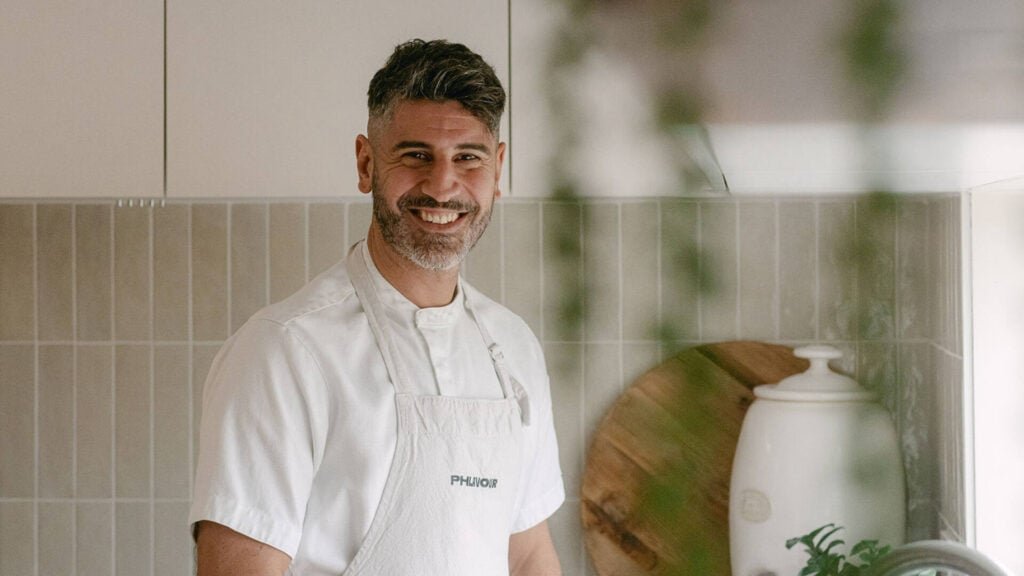
The third-generation Greek Australian is cooking his way back to the homeland, and honestly, it's making us want to book flights.
Philip Vakos grew up in Tasmania with two Cretan grandmothers. This is, I think, all you need to know about where his cooking comes from. The rest is just biography.
But here's the biography anyway. The Melbourne-based chef first appeared on MasterChef Australia back in 2010, during season two, when he was still working as an accountant and wondering if spreadsheets were really going to be his whole life. Fifteen years later, he's traded the Richmond kitchen of Bahari, his Greek restaurant, for a very different kind of competition. This January, Vakos appeared on MasterChef Greece, representing Australian Greeks in a season that's brought diaspora cooks from Dubai, Egypt, Germany and Switzerland back to compete in the country their families left behind.
He cooked lamb. Of course he cooked lamb. The dish drew on both Australian and Greek flavours, and it earned him his apron.
Why This Story Matters for Anyone Planning a Trip to Greece
There are around 420,000 people of Greek ancestry living in Australia. Melbourne alone has one of the largest Greek-speaking populations outside of Athens. We have our own dialect, our own food traditions, our own particular way of being Greek that's been shaped by distance and time and the fact that our yiayias had to make do with whatever they could find at the local shops in 1952.
Vakos's grandparents migrated from Greece to Australia in the 1940s. He spoke about this during his audition, the significance of returning to Greece to cook as a third-generation Greek. There's no word for it in English, this particular homecoming. You're not returning, exactly, because you've never lived there. But you're not arriving as a stranger either.
If you've ever visited Greece with Greek heritage, you know the feeling. The taverna owner asks where your family is from. You mention a village name and suddenly you're getting free ouzo and meeting someone's cousin who might be your cousin too. The connection is immediate, even when your Greek is terrible.
The 'Gringlish' Chef and What He's Built in Melbourne
Before we go any further with the Greece story, it's worth understanding what Vakos has spent the last decade doing in Australia.
Bahari, his restaurant in Richmond, serves what he calls 'Gringlish' food. It's Greek cooking filtered through an Australian sensibility, or maybe Australian cooking filtered through Greek memory. The name means 'spice' in Greek. His grandmothers' philosophy was simple: keep it simple, but keep them guessing. If you want to understand what to eat in Greece beyond souvlaki, Vakos's menu is a good primer.
"We always pay our respects to our Greek origins," Vakos has said. "But we are a little innovative and different."
This is essentially the diaspora experience turned into a menu. You honour where you came from while acknowledging that you're also, inevitably, from somewhere else. The moussaka tastes different when you've grown up eating meat pies too. That's not dilution. That's just what happens when cultures actually live together instead of existing in separate boxes.
Vakos runs Bahari with his wife and business partner Heleena. He hadn't planned to go back to television competition. Twelve years of running a restaurant will cure most people of any desire to cook under time pressure while cameras roll.
But Greece was different.
"Sometimes life throws you an opportunity, and you either say no, or grab it with both hands," he said. "I'm really grateful to have firstly, the love and support of my wife, and also family, to be able to partake in this season, and be able to represent Australian Greeks."
What MasterChef Greece 2026 Is Doing Differently
This season of MasterChef Greece (which premiered on Star Channel on 18 January 2026) has deliberately sought out competitors from the Greek diaspora. The show has brought in cooks of Greek heritage from around the world, all returning to their ancestral homeland to compete.
It's a recognition of something Greeks have always understood: the nation doesn't stop at its borders. There are Greeks everywhere. In Melbourne and Montreal and Munich and Alexandria. In small towns in Tasmania where two Cretan grandmothers taught their grandson to cook.
The judges were reportedly moved when Vakos spoke about his family history. His down-to-earth personality came through on screen, alongside the obvious fact that the man knows his way around a lamb dish.
For Australians Thinking About Their Own Greek Trip
Watching a Greek Australian cook his way through a Greek kitchen has a way of stirring something. Maybe it's time to finally book that trip.
If your family came from the islands, the Cyclades are calling. Santorini gets all the attention, but the smaller islands offer something closer to the Greece your grandparents might remember. Naxos has beaches that go on forever and a food scene that rivals anywhere in the country. Milos, Paros, Folegandros. Less polished, more real. Our 2026 guide to the Greek islands covers what's worth your time and what you can skip.
If your people were from Crete, like Vakos's grandmothers, the food alone is worth the flight. Cretan cuisine is considered some of the best in Greece, shaped by the same mountains and olive groves and sea that shaped everything else about the island.
And if you have no Greek heritage at all, none of this matters less. Greece doesn't ask for your credentials. It just asks you to sit down, eat something, and stay a while.
Not sure when to go? The best time to visit Greece depends on what you're after, but shoulder season (May, June, September) usually hits the sweet spot between good weather and manageable crowds.
Starting in Athens
Most Australians will land in Athens before heading anywhere else, so it's worth getting the city right. If you're planning to eat your way through the capital (and you should), we've put together a list of the best restaurants in Athens for 2026. Skip the tourist traps in Plaka and head to Psiri or Koukaki for something more interesting.
And if you're wondering where not to stay in Athens, we've got opinions on that too.
Once you've done the Acropolis and eaten too much, the ferries to the islands leave from Piraeus. Our ferries page has the basics on booking and what to expect.
The Restaurant to Visit Before You Go
If you're in Melbourne and want to understand what Vakos means by Gringlish cooking, Bahari in Richmond is the obvious starting point. The restaurant has been running for over twelve years, which in hospitality terms is roughly equivalent to a hundred. The menu changes, but the philosophy doesn't: Greek flavours, Australian context, both things held together without pretending they're the same.
Vakos also runs cooking classes upstairs, if you want to learn some of what those Cretan grandmothers taught him.
MasterChef Greece airs on Star Channel. For Australians keen to follow Vakos's progress, episodes are available through Greek streaming platforms. Whether he wins or not, he's already done the thing that matters: taken flavours across an ocean and brought them home.
Related reading:
