
What to Eat in Greece Beyond Souvlaki - An Insider's Guide to Greek Food
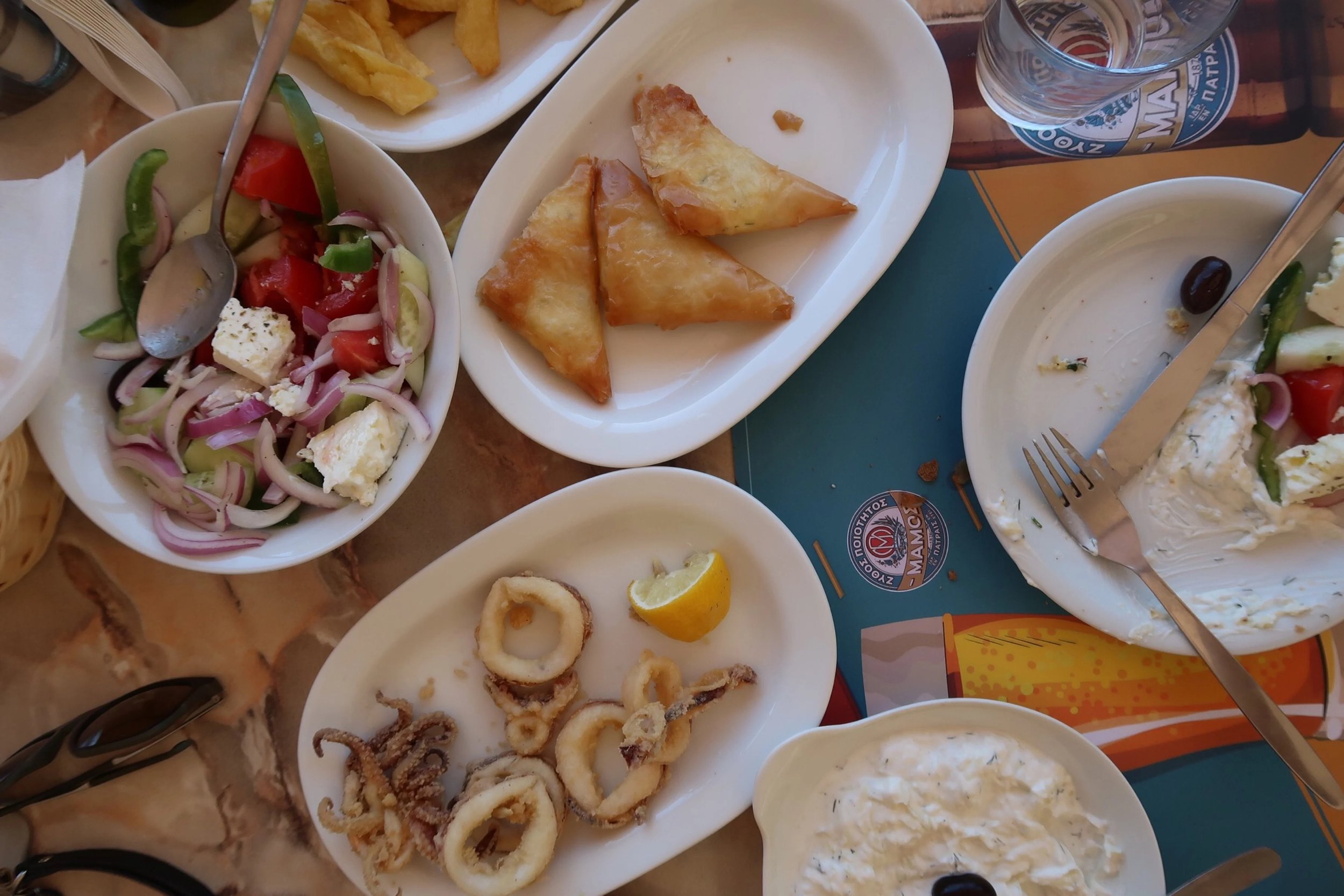
You've had the gyros. You've photographed the feta. Now it's time to eat like someone whose grandmother actually taught them something.
Every traveller to Greece orders souvlaki. This is not a criticism. It's delicious, it's everywhere, and there's a reason the entire country runs on grilled meat and pita. But if souvlaki is all you eat, you're experiencing roughly five percent of what authentic Greek food has to offer. You're standing at the threshold of one of the world's great food cultures and ordering the equivalent of a hamburger.
I say this as someone whose family is from a small island in the Ionian, where the rhythms of eating haven't changed much in generations. Where lunch still starts at two and dinner never before nine. Where the question isn't what's on the menu but what the fisherman brought in this morning and whether your aunt has finished rolling the dolmades.
Greek food is not about restaurants. It's about what your yiayia made on Tuesday because that's what you eat on Tuesdays. It's about the baker who knows your family and slips an extra tiropita in the bag. It's about dishes that don't photograph well for Instagram but taste like someone's entire childhood.
Here's what to order in Greece instead.
The Classics You're Probably Skipping
Moussaka
Yes, you've heard of it. No, you probably haven't ordered it. Moussaka sits on every taverna menu looking vaguely like lasagne's Mediterranean cousin, and tourists bypass it for the familiar comfort of grilled meat on a stick.
This is a mistake.
Proper moussaka, with its layers of silky eggplant, spiced mince, potatoes, and a thick béchamel top that should be golden and slightly caramelised, is one of the great comfort foods of the world. It's heavy, unapologetically rich, and best eaten in the middle of a long afternoon when you've got nowhere to be. The spicing is subtle but essential: cinnamon, nutmeg, a bay leaf that's been doing its work for hours.
Order it at a taverna where the moussaka is displayed in a bain-marie behind glass, not listed on a laminated menu with photos. That's how you know it was made that morning and has been slowly coming to room temperature, which is exactly how it should be served.
Pastitsio
Moussaka's often-overlooked sibling. If moussaka is the eggplant dish, pastitsio is the pasta one: long, fat tubes of pasta layered with the same spiced meat sauce and béchamel. It arrived via Italian influence centuries ago and became so thoroughly Greek that Italians wouldn't recognise it.
The best pastitsio has a crust on top that's almost bronzed, and the pasta should be just slightly overcooked by Italian standards: tender, yielding, having absorbed all that flavour from the meat and the béchamel seeping through the layers. Greeks don't do al dente. We do comfort.
What the Locals Actually Order
Gavros Marinatos
This is the dish that separates the tourists from the Greeks.
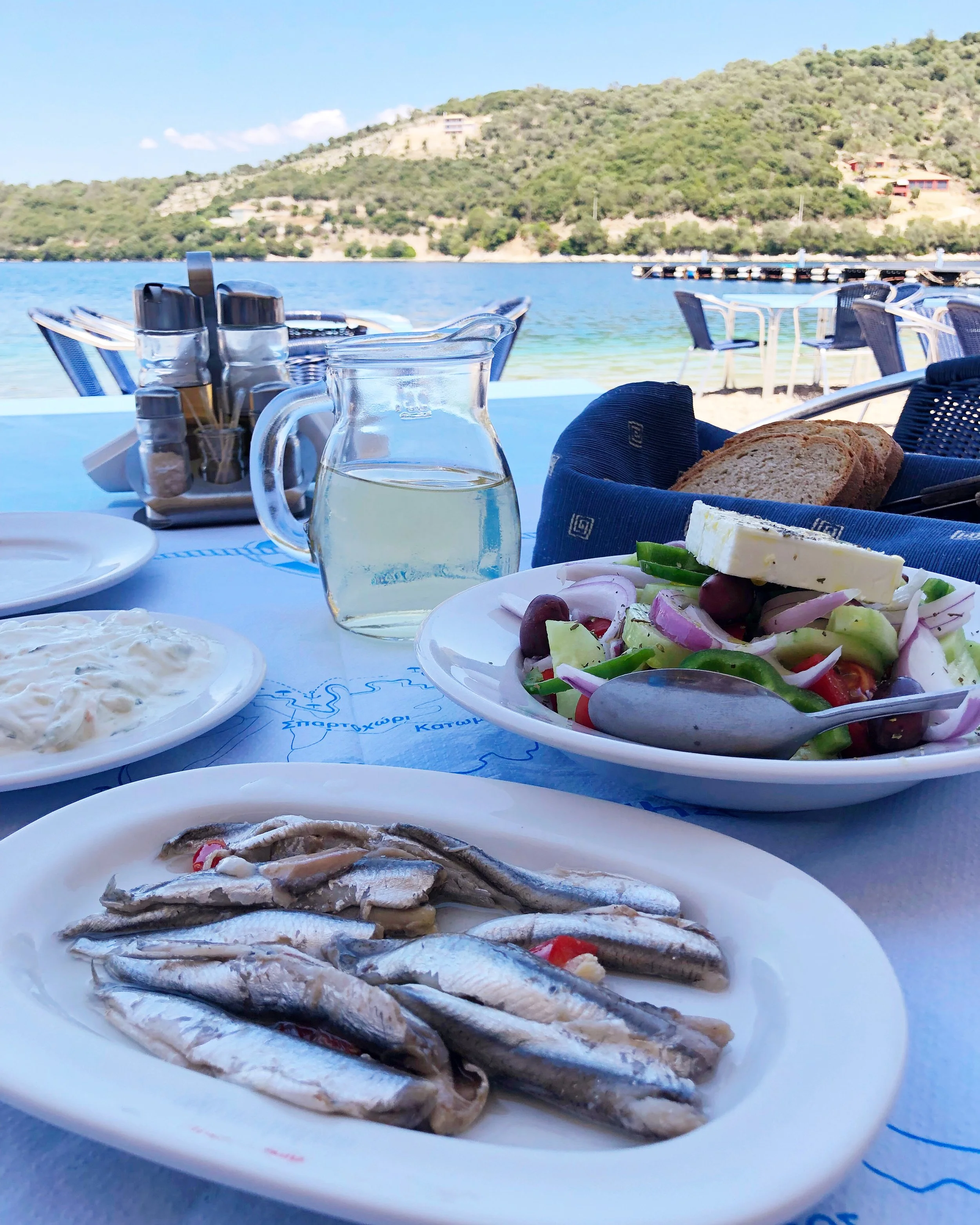
Gavros marinatos is fresh anchovies cured in salt and vinegar until they turn from translucent grey to opaque white. It's essentially the Greek equivalent of ceviche, except it's been made this way for centuries before ceviche became fashionable.
There is a beachside taverna on Meganisi, the island my family is from, that makes their own gavros marinatos fresh each day. The anchovies arrive still glistening from the morning catch, and by lunchtime they've been filleted, layered with coarse salt and garlic, and drowned in enough vinegar to "cook" the flesh. By dinner, they're perfect. Vinegary, bright, the flesh firm but yielding.
I eat them every single day when I'm there. Not because I'm being adventurous or trying to seem authentic, but because they're genuinely one of the best things I've ever tasted.
Order them as a meze with a cold glass of ouzo and some crusty bread. If you've only ever had anchovies from a tin, you'll understand why those are an insult to the species.
Fava
Here's my insider tip: skip the tzatziki. Everyone orders tzatziki. It comes automatically with everything. Instead, ask for fava.
Not fava beans. Despite the name, Greek fava is made from yellow split peas, cooked until they collapse into a silky, lemony purée that's been a staple in these islands since the Bronze Age. Santorini is famous for theirs, grown in volcanic soil that makes them sweeter and smoother than anywhere else, but you'll find excellent fava across Greece.
It arrives drizzled with olive oil, often scattered with capers and raw onion, and you eat it with bread, obviously. It's vegan, it's ancient, it's one of the best dips in the Mediterranean, and tourists almost never order it.
Dakos
The Cretan salad that makes a Greek salad look like an afterthought.
Dakos starts with a barley rusk, called paximadi, so hard you could build a house with it. You briefly dip it in water (briefly! not a soak, just a flash) so it softens just enough to eat without breaking a tooth. Then you pile it with grated ripe tomatoes, good olive oil, crumbled mizithra or feta, and dried oregano. That's it. That's the whole dish.
It sounds too simple to be transformative, but the combination of the chewy, grain-forward rusk absorbing all that tomato juice and olive oil, the salt of the cheese, the hit of oregano? It's perfect. It's what Cretan farmers have been eating for lunch for centuries, and it's proof that sometimes the best food is the food nobody's trying to improve.
Breakfast Like a Greek
Tiropita and Spanakopita from the Fourno
The first thing you need to understand about Greek breakfast is that Greeks don't really eat breakfast. Not in the eggs-and-bacon sense. What they do is stop by the fourno, the local bakery, on their way to work and pick up something wrapped in phyllo.
Tiropita (cheese pie) is the default: flaky, buttery phyllo wrapped around a filling of salty feta and egg. Spanakopita adds spinach to the equation. Both are eaten warm, standing at the counter or walking down the street, ideally with a Greek coffee strong enough to restart your heart.
The thing about fourno tiropita is that every neighbourhood has its own bakery, and every family has their bakery. The fournaris (baker) knows your family. Your grandmother probably bought bread from his grandmother. This is not a transaction; it's a relationship.
If you're in Greece and you're eating breakfast at your hotel buffet, you're doing it wrong.
Tsoureki Stuffed with Bueno
Now, tsoureki is traditionally an Easter bread. It's sweet, braided, flavoured with mahlepi (cherry seed spice) and mastic (resin from Chios), and studded with a red-dyed egg. But modern Greek bakeries have done what modern bakeries do: they've started stuffing it with chocolate.
My favourite is from Kallos Bakery in Lefkada. They take the traditional tsoureki dough, soft, aromatic, slightly sweet, and stuff it with Kinder Bueno. The result is obscene in the best possible way: that distinctive mahlepi flavour meeting hazelnut chocolate, the bread still warm enough that everything melts slightly at the centre.
Is it traditional? Absolutely not. Is it one of the best Greek pastries I've ever eaten? Without question.
Dishes That Deserve Your Attention
Giouvetsi
This is one of Greece's most popular Sunday roast dishes, and most tourists don't even know it exists.
Giouvetsi is lamb or beef slow-cooked with orzo pasta in a terracotta dish until everything becomes one glorious, tomatoey, cinnamon-scented mess. The pasta absorbs the meat juices and the sauce until it's thick and sticky, the meat falls apart at the suggestion of a fork, and the whole thing gets finished with grated kefalotyri or mizithra crumbled over the top.
It's the dish Greek grandmothers used to prepare on Sunday morning and take to the local baker's oven after he'd finished the bread, so it could slow-cook in the residual heat while the family was at church. It's the food that makes you understand why Greek meals last three hours.
Stifado
A stew that arrived via the Venetians and became so thoroughly Greek that we've claimed it. Stifado is meat, usually beef or rabbit, sometimes octopus, braised with pearl onions in a wine and tomato sauce thick with cinnamon and clove.
The pearl onions are essential. They go in whole and cook until they're sweet and melting but still hold their shape, little flavour bombs throughout the stew. The sauce should be dark and glossy, the meat falling-apart tender, the whole thing redolent of warm spice in a way that feels both familiar and exotic.
It's a winter dish, really, but tavernas serve it year-round because tourists expect consistency. Order it anyway.
Ladera
This is not a single dish but a whole category: ladera means "cooked in oil," and it refers to the vast family of Greek vegetable dishes braised slowly in olive oil until they're silky and tender.
Fasolakia (green beans with tomato), bamies (okra), briam (the Greek ratatouille of eggplant, zucchini, and potato), yemista (tomatoes and peppers stuffed with rice). All ladera. All frequently skipped by tourists looking for something more "substantial."
Here's the thing: Greeks eat these as main courses, not sides. A plate of fasolakia with good bread, some feta on the side, is lunch. It's filling, it's healthy, it's cheap, and it's what Greeks actually eat when they're not performing Greek food for tourists.
The Sweet Stuff
Loukoumades
Greek doughnuts, essentially. Small balls of fried dough soaked in honey syrup and scattered with cinnamon and walnuts. They're served hot, which is essential, because the contrast between the crisp exterior and the soft, almost custardy interior only works when they're fresh from the oil.
Modern versions come drizzled with chocolate or sprinkled with pistachios, but the classic honey-and-cinnamon version is still the best. Order them for dessert, or do what Greeks do and order them at 11pm after a meal that started at 9, because Greek dinner schedules make no sense and all the sense simultaneously.
Galaktoboureko
Custard wrapped in phyllo, soaked in syrup. It sounds simple because it is simple, and simplicity is the point. The phyllo should shatter, the custard should be thick and vanilla-scented, the syrup should soak into the bottom layers while the top stays crisp.
It's the dessert you order when you've already eaten too much and you're going to eat more anyway, because that's what you do in Greece.
How to Eat Like a Greek
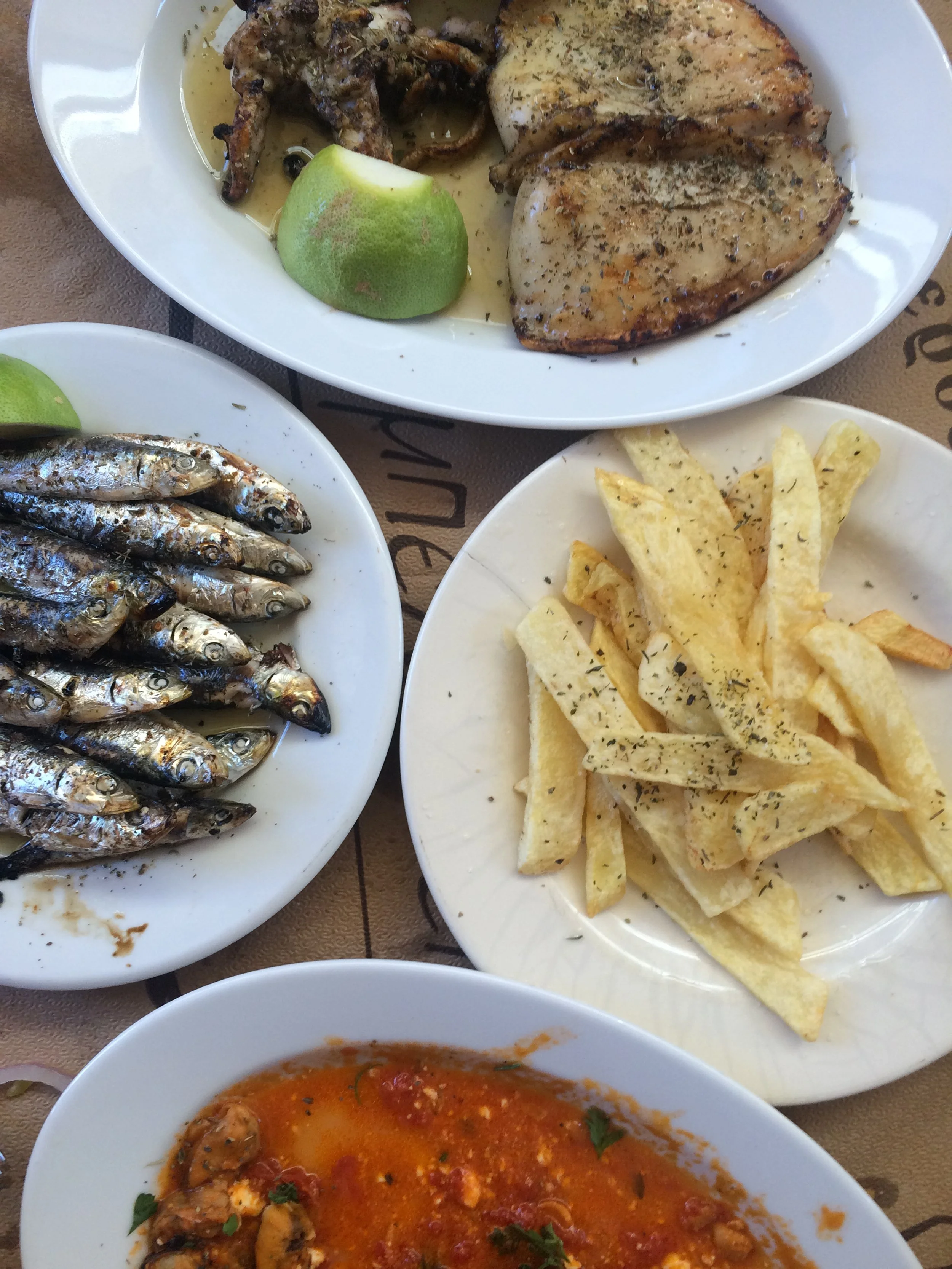
The best meals I've had in Greece weren't at restaurants with TripAdvisor ratings or Instagram-worthy plating. They were at family tables where someone's aunt had spent the morning rolling dolmades because that's what you do on a Wednesday. They were at tavernas where the menu was whatever the kitchen had made that day, and you pointed at the display case and said "that one" and "some of that" and "whatever you recommend."
The best Greek food is not about novelty or innovation. It's about doing the same things people have been doing for centuries, because those things work. It's about ingredients that taste like themselves: tomatoes that taste like tomatoes, olive oil that tastes like olives, cheese that tastes like the goats that made it.
So yes, have the souvlaki. But also have the gavros marinatos and the fava and the dakos and the giouvetsi. Order the tiropita from the fourno at 7am and the loukoumades at 11pm. Sit down for a three-hour lunch and let the waiter bring you things you didn't order.
That's how Greeks eat. And that's how you should eat in Greece.
Looking for more insider tips? Explore our Greek food guides and Greek island travel content, from Lefkada's best beaches to the hidden gems of the Cyclades.
